
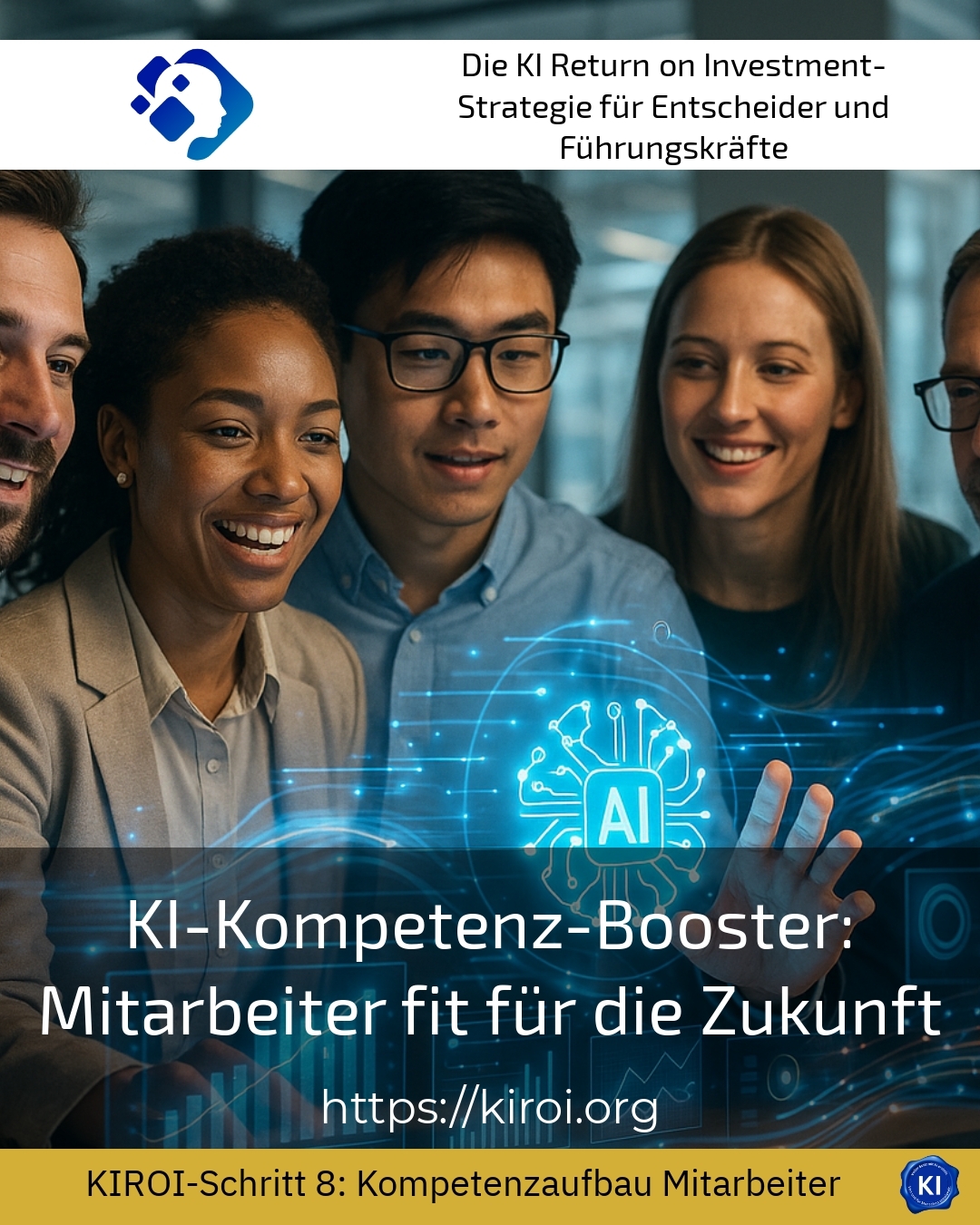
Imagine your entire workforce becoming true future shapers within a few months, actively using new technologies for better results rather than fearing them. AI Skills Booster This is the crucial lever that makes employees fit for the future and gives companies a sustainable competitive advantage. In a rapidly changing world, it is no longer enough to rely solely on technological innovation. Instead, what is needed are people who can understand, apply and creatively develop these tools. This is precisely where strategic competence development, which goes far beyond traditional training, comes in. This article shows you how to empower your teams in a sustainable way.
Why traditional further education is no longer sufficient
The world of work has fundamentally changed in recent years. Classic seminars and one-off workshops often don't achieve the desired effect. Employees forget a large part of what they have learned within just a few weeks. At the same time, digital technologies are developing at a pace that quickly makes static learning formats obsolete. Companies often report that their training measures are well-received but do not bring about any sustainable change in everyday work.
For example, a medium-sized trading company invested significant sums in external training for its purchasing department. The participants were enthusiastic about the new possibilities of automated data analysis. However, just two months later, most of them were back to their usual methods. The problem was not a lack of motivation. Rather, there was a lack of structured support in their daily work.
A logistics company had similar experiences when introducing new planning systems. Dispatchers received intensive training on the technical functions. However, they did not understand how these tools were supposed to facilitate their daily work. The situation only changed noticeably when the company switched to a continuous coaching format. The employees developed their own application ideas and gradually optimised their processes.
A financial services provider also reported initial difficulties in digitalising its customer advisory services. The advisors were meant to use intelligent analysis tools for portfolio recommendations. However, without accompanying skills development, these systems remained largely unused. The advisors preferred to rely on their own experience because they did not fully understand the new possibilities.
The AI Competency Booster as a Strategic Instrument
An effective AI Skills Booster goes far beyond mere knowledge transfer and focuses on sustainable behavioural change. Various factors play a crucial role in its success. Firstly, a realistic assessment of the current skills within the entire company is needed. Based on this, tailor-made development paths can be created for different employee groups. transruptions-Coaching supports companies precisely with such transformation projects and provides impulses for future-proof human resources development [1].
An insurance company used this approach for the further development of its claims processing. The case workers not only learned new systems but also developed a deep understanding of how they work. They recognised which tasks can be automated and where human expertise remains indispensable. This clarity significantly reduced apprehension and increased the acceptance of new ways of working.
A similar pattern was observed in the manufacturing industry with a car parts supplier. Production workers were initially given basic insights into how intelligent quality control systems work. Afterwards, they collaborated with experts on specific use cases from their own work area. This hands-on approach led to significantly higher engagement with the new technologies.
An energy provider implemented cross-departmental learning groups for its network planning. Engineers, technicians, and administrative staff regularly exchanged experiences with new analysis tools. This collaborative approach not only fostered technical understanding but also significantly improved internal communication.
Practical learning formats for sustainable skills development
The design of learning formats is crucial for the success of any skills initiative within a company. Short, regular learning units often show better results than lengthy intensive seminars [2]. Employees can directly apply and reflect on what they have learned in their daily work. This leads to sustainable changes in daily workflows. At the same time, the reluctance to try new things and make mistakes is reduced.
A pharmaceutical company developed an innovative learning concept for its research department. Scientists received short, weekly prompts on new analytical methods. These were tested directly on current research projects and evaluated together. The combination of theoretical input and practical application proved particularly effective.
In the retail sector, a large department store chain implemented a mentoring system for the introduction of new inventory management systems. Experienced employees supported their colleagues in learning the new tools. This peer-to-peer support fostered trust and enabled individual learning paces. Furthermore, valuable feedback loops emerged for the further optimisation of the systems.
A hotel chain implemented gamified learning elements for its reservation management. Staff were able to test various optimisation strategies in simulated scenarios. This approach fostered a willingness to experiment and reduced the fear of making mistakes in live operations. The insights gained were directly incorporated into improved booking processes.
Best practice with a AIROI customer
A medium-sized mechanical engineering company with around four hundred employees faced the challenge of qualifying its service technicians for predictive maintenance scenarios. Existing competencies were insufficient to fully exploit the new possibilities of proactive maintenance. Working together with transruptions-coaching, the company developed a comprehensive six-month qualification programme. Initially, we analysed existing skills and identified specific development needs for each employee group. Based on this, individual learning paths were created, encompassing both fundamental technical knowledge and practical application scenarios. The technicians learned to correctly interpret sensor data and derive action recommendations from it. Crucially, a basic understanding of how the algorithms used worked was imparted. This transparency built trust in the new tools and encouraged their consistent use in daily work. Upon completion of the programme, participants reported significantly higher confidence in using the new systems. The error rate in maintenance operations decreased noticeably, and customer satisfaction improved tangibly. The company now plans to extend this approach to other areas.
Making employees fit for the future: Cultural aspects
Technical competence alone is not enough to make organisations future-proof. A corporate culture that promotes and values continuous learning is at least as important [3]. Leaders play a central role in this as role models and enablers. If they actively try out new tools themselves, it also encourages their teams to be more willing to experiment.
A management consultancy established a weekly exchange of experiences for all consultants. In these sessions, the consultants shared their experiences with new analytical methods and presentation tools. This open dialogue created an atmosphere of shared learning and reduced competitive thinking between teams. At the same time, valuable synergies arose from the exchange of best practices.
One media company went a step further and introduced regular innovation days. On these days, employees could try out new technologies without pressure to succeed. For example, journalists tested various research tools and automated text analyses. These protected experimental spaces fostered creativity and lowered the barrier to technological innovation.
A buddy system for digital transformation was established in an auditing firm. Younger employees with a high affinity for technology supported experienced partners in learning new tools. This intergenerational approach made optimal use of the different strengths of both groups. The older employees contributed their extensive specialist knowledge, while the younger ones provided technical impetus.
AI Competence Booster in Daily Management Practice
Führungskräfte können den Erfolg von Kompetenzentwicklungsprogrammen maßgeblich beeinflussen durch ihr eigenes Verhalten. Ein AI Skills Booster unfolds its full effect only when management actively supports the transformation. Regular discussions about learning progress and challenges show employees that their development is taken seriously. Recognition for brave experiments, even if they are not always successful, promotes a positive learning culture.
A telecommunications company consistently integrated skills development into its leadership discussions. Team leaders regularly discussed each employee's progress in learning new skills. This structured support signaled the importance of the topic and created binding development goals. At the same time, managers gained valuable insights into their teams' potential support needs.
An airline used its existing crew briefings for short learning impulses on new systems. The brief units fitted well into the information exchange that was already taking place before flights. This made learning a natural part of the daily work routine and not an additional burden. The pilots and cabin crew greatly appreciated this pragmatic approach.
In the healthcare sector, a hospital network established regular case conferences with a focus on new diagnostic possibilities. Doctors and nurses jointly discussed how modern analysis tools can support their work. This interdisciplinary exchange promoted mutual understanding and significantly improved collaboration between the professional groups.
Measurable successes and continuous improvement
Every investment in skills development should be verifiable for its effectiveness. This is not just about quantitative metrics like training hours or participant numbers. Rather, it is about actual behavioural changes in daily work and their impact on results [4]. Regular reflection loops help to continuously optimise programmes and adapt them to changing requirements.
A construction company developed a simple feedback system for its project management training courses. After each learning unit, employees rated its practical relevance to their daily work. This direct feedback allowed for quick adjustments and significantly improved learning satisfaction. Furthermore, the participants felt taken seriously and involved.
An advertising agency used regular retrospectives to evaluate the usefulness of new creative tools. The teams openly discussed which tools actually improved their work and which did not. This honest reflection prevented ineffective systems from being used out of misplaced loyalty. Instead, employees focused on innovations that were genuinely helpful.
A transport company systematically compared the performance indicators of its drivers before and after qualification measures. The analysis showed significant improvements in fuel consumption and route optimisation after appropriate training. These objective data also convinced sceptical employees of the benefits of continuous professional development. At the same time, they provided valuable arguments for further investment in this area.
My AIROI Analysis
The transformation of companies through new technologies is only sustainable if people can embrace and actively shape this change. A strategically aligned AI Skills Booster This forms the foundation for a future-proof organisation that views change not as a threat, but as an opportunity. The numerous examples from various industries clearly show that there is no universal path to success, and that individual solutions are always required. The crucial factor is the consistent alignment of all measures with the actual needs of the employees and the strategic goals of the company.
From my many years of experience supporting transformation projects, I can confirm that cultural factors are often more important than technical details. Companies that establish a genuine learning culture benefit in the long term from greater innovation capacity and employee satisfaction. It is therefore essential to actively involve leaders from the outset and position them as role models. Transruption coaching can provide valuable momentum here and support companies in developing tailor-made concepts.
Investing in employee skills pays off multiple times over, as it doesn't just boost immediate performance. It also increases attractiveness as an employer and retains talented professionals within the company long-term. In times of increasing skilled labour shortages, this aspect should not be underestimated. Those who systematically develop their workforce are simultaneously investing in the future viability of their entire organisation.
Further links from the text above:
[1] McKinsey – The State of AI
[2] Harvard Business Review – Learning
[3] World Economic Forum – Future of Jobs Report
[4] Gartner – Future of Work
For more information and if you have any questions, please contact Contact us or read more blog posts on the topic Artificial intelligence here.








 Deutsch
  English (UK)