
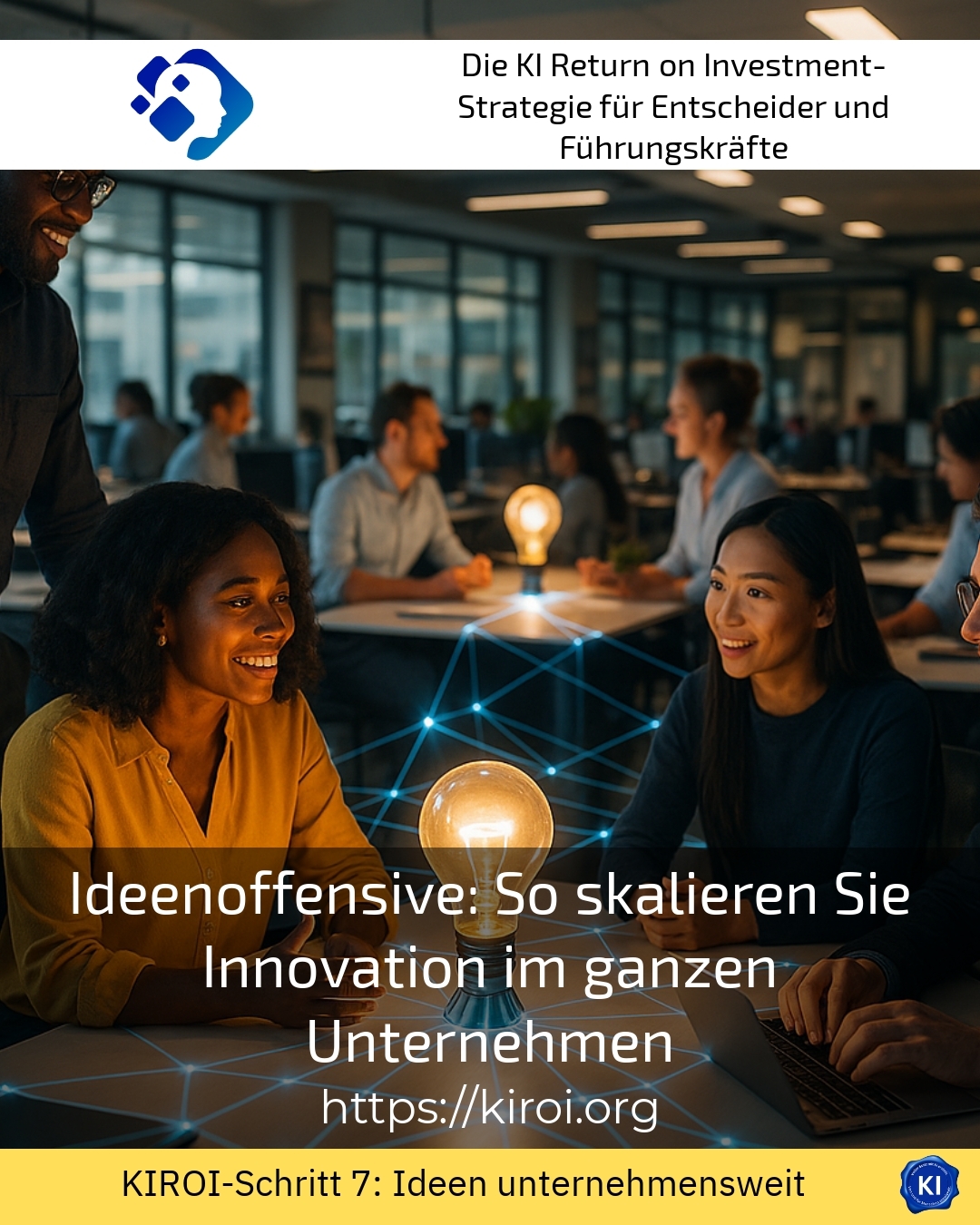
Imagine your entire workforce transforming into an inexhaustible source of creative breakthroughs that can sustainably transform your business. Innovation Offensive: How to Scale Innovation Throughout the Company begins exactly where traditional hierarchies end and collective intelligence takes its first steps. Many organisations struggle with the challenge of brilliant ideas getting lost within individual departments before they can reach their full potential. This article will show you concrete ways to systematically unleash and sustainably harness creative energy.
Understanding the fundamentals of a successful idea offensive
Before organisations can scale their creative capacities, they must first understand the fundamental mechanisms that generate and foster innovative thought. It is not enough to simply establish a suggestion platform; rather, a well-thought-out ecosystem is required that provides psychological safety while simultaneously offering clear structures for the further development of concepts. Leaders often report that their employees do possess valuable insights, but these are rarely systematically captured or followed up on.
The creation of such a culture initially requires an honest assessment of existing obstacles. In many cases, invisible barriers block the free flow of creative impulses. These include, for example, the fear of negative evaluation by superiors. A lack of time for creative thinking is equally problematic. Furthermore, a lack of transparency regarding what happens to submitted suggestions significantly hinders participation. Transruption coaching can help to identify and gradually dissolve these hidden blockages.
Furthermore, technological infrastructure plays a crucial role in democratising creative processes. Modern digital tools make it possible to gather and visualise contributions from all levels of the organisation. They promote cross-departmental exchange and create connections between related concepts. At the same time, they support the transparent tracking of the progress of individual initiatives. The selection and implementation of suitable systems should always be guided by a clear strategic vision [1].
Best practice with a AIROI customer
A medium-sized company in the manufacturing sector faced the challenge that valuable suggestions for improvement regularly fell by the wayside. Management had already made several attempts to establish a functioning system, but none of these efforts had a lasting impact. As part of a structured support process with transruptions-coaching, a comprehensive analysis of existing communication channels was initially carried out. This revealed that the employees were generally highly motivated to contribute their experiences. However, they lacked the confidence that their contributions would actually be heard. Together, we developed a multi-stage concept that defined clear responsibilities and established binding response times. Within six months, participation increased fourfold. Several of the concepts submitted led to measurable improvements in production efficiency. Managers also reported a noticeably improved atmosphere in their teams.
Structures for the Ideas Offensive: How to Systematically Scale Innovation
Successfully scaling creative processes requires robust organisational structures that ensure both flexibility and commitment. Without clear frameworks, even the most enthusiastic initiative risks sinking into chaos. Therefore, it is advisable to establish defined processes from the outset. These should transparently map out the journey of an idea from its initial formulation to its potential implementation.
A proven model envisages various development stages that each proposal goes through. In the first phase, all inputs are collected and coarsely categorised. This is followed by an initial assessment by an interdisciplinary committee. Promising concepts are then allocated resources for in-depth development. In mechanical engineering organisations, for example, this can mean that designers and manufacturing experts jointly examine technical feasibility. In healthcare, on the other hand, medical staff and administrative personnel might collaborate [2].
The integration of artificial intelligence can significantly speed up and improve these processes. Modern systems are capable of automatically categorising incoming suggestions and matching them with existing initiatives. They can identify similarities and highlight potential synergies. Furthermore, they assist in identifying experts who could be relevant for further development. This technological support relieves the pressure on the people involved. It allows them to concentrate on the value-adding aspects of evaluation and further development.
Another key success factor lies in the consistent communication of results. Employees must regularly find out which suggestions have been implemented and what impact they have had. This transparency builds trust and motivates further participation. In the automotive industry, several suppliers have had very positive experiences with monthly innovation reports. These are made accessible to all employees and celebrate both major breakthroughs and minor improvements equally.
Cultural prerequisites for sustainable creative development
Beyond all structures and technologies, corporate culture remains the decisive factor for the success of any innovation offensive. An atmosphere of trust and mutual appreciation forms the foundation on which creative processes can flourish. Managers bear a special responsibility in this. They must demonstrate through their own behaviour that unconventional ideas are welcome and taken seriously.
This means, specifically, that even unfinished or initially impractical-seeming suggestions must be treated with respect. In the pharmaceutical industry, it has been shown that seemingly outlandish ideas can sometimes lead to groundbreaking developments. A company from this sector reports that one of its most successful product innovations originated from a suggestion that was initially met with amusement. The combination of technical expertise and a culture of openness made it possible to recognise the hidden potential [3].
At the same time, the emphasis on creativity must not lead to the neglect of analytical rigour. Successful organisations strike a balance between free thinking and critical examination. They establish mechanisms that allow concepts to be tested quickly and affordably. In retail, for example, several companies are relying on limited pilot projects in selected stores. These allow new approaches to be trialled under real-world conditions before larger investments are made.
Best practice with a AIROI customer
A financial services provider with several thousand employees was looking for ways to better leverage the creative potential of its workforce. The initial situation was characterised by a traditionally rather conservative corporate culture, in which hierarchies played a strong role. As part of a long-term collaboration, we jointly developed a programme for cultural transformation. This programme included training for managers as well as the introduction of new formats for cross-departmental exchange. The establishment of so-called innovation cafés, where employees from different departments came together in a relaxed atmosphere, proved to be particularly effective. Transruption coaching supported the managers in developing a new attitude towards unconventional suggestions. After about a year, a significant change was evident in employees' perceptions. Satisfaction levels regarding the opportunity to contribute their own ideas rose significantly. Several of the newly developed service concepts are now being successfully implemented.
The role of leadership in the company-wide idea offensive
Managers at all levels play a central role in successfully scaling creative processes. Their job isn't to have the best ideas themselves. Rather, it's about creating spaces where others can unleash their full potential. This requires a fundamental rethink in many organisations. Traditional ideas of leadership often emphasise the leader's role as decision-maker and problem-solver.
In the context of a Innovation Offensive: How to Scale Innovation Throughout the Company this role is fundamentally changing. Leaders are becoming enablers and catalysts. They ask the right questions rather than providing ready-made answers. They connect people with complementary skills and create opportunities for serendipitous encounters. In the logistics industry, a major provider has had very positive experiences using leaders specifically as bridge-builders between different locations [4].
The development of these new leadership skills requires time and targeted support. Many managers have built their careers in an environment that rewarded different behaviours. The transition to an enabling leadership style can therefore be associated with uncertainty and resistance. This is where professional coaching can provide valuable impulses. It supports leaders in reflecting on their own patterns and developing new behaviours.
Of particular importance here is the ability to deal with ambiguity and uncertainty. Creative processes are inherently open-ended and cannot be fully planned. This can initially be challenging for leaders accustomed to clear objectives and measurable results. In software development, agile methods have already demonstrated how productive such an attitude of openness can be. These experiences can be transferred and adapted to other areas.
Measurement and continuous improvement of creative processes
Even though creative processes cannot be fully quantified, systematic measurement of success remains indispensable. It allows progress to be made visible and continuous improvements to be initiated. However, not only output metrics, such as the number of implemented suggestions, should be considered. Indicators that reflect the quality of the processes and employee participation are at least as important.
A balanced KPI system could, for example, include the following dimensions: Firstly, the quantity of incoming suggestions and their distribution across departments and hierarchy levels. Secondly, the lead times from submission to the decision on further processing. Thirdly, the satisfaction of the submitters with the process and the feedback received. In the energy sector, several companies also use qualitative interviews with particularly active employees to gain deeper insights into the success factors [5].
The insights gained should be regularly translated into improvement measures. A proven approach is to conduct periodic retrospectives, where all participants jointly reflect on what has worked well and where there is still potential. This practice, originating from agile software development, can be excellently applied to the management of creative processes. It fosters a culture of continuous learning and shared responsibility.
My AIROI Analysis
Following intensive engagement with numerous organisations across various sectors and sizes, some key insights are emerging. Successfully scaling creative processes is not a one-off project, but a continuous journey. It requires an interplay of cultural, structural, and technological factors. None of these aspects can be viewed or optimised in isolation.
Particularly noteworthy is the transformative effect that a consistently lived culture of openness can have on the entire company. The positive effects are not limited to generating new product ideas or process improvements. Rather, organisations report increased employee satisfaction and a stronger sense of belonging. People who feel heard and taken seriously also engage more strongly with their employer in other areas.
At the same time, experience shows that hasty or half-hearted initiatives can do more harm than good. If employees repeatedly experience their contributions coming to nothing, this leads to frustration and cynicism. It is therefore advisable to start with manageable pilot projects and to evaluate them carefully before rolling them out company-wide. Accompanying coaching can help to avoid typical pitfalls and to learn from the experiences of other organisations.
The integration of Artificial Intelligence offers enormous opportunities to increase the efficiency and effectiveness of creative processes. However, technology must never become an end in itself. It should always serve people and support them in their creative work. Organisations that manage to find this balance will be able to realise significant competitive advantages in the coming years.
Further links from the text above:
[1] Harvard Business Review – Innovation Management
[2] McKinsey – The Eight Essentials of Innovation
[3] Forbes Innovation Hub
[4] MIT Sloan Management Review – Leadership
[5] Gartner – Innovation Insights
For more information and if you have any questions, please contact Contact us or read more blog posts on the topic Artificial intelligence here.









 Deutsch
  English (UK)