
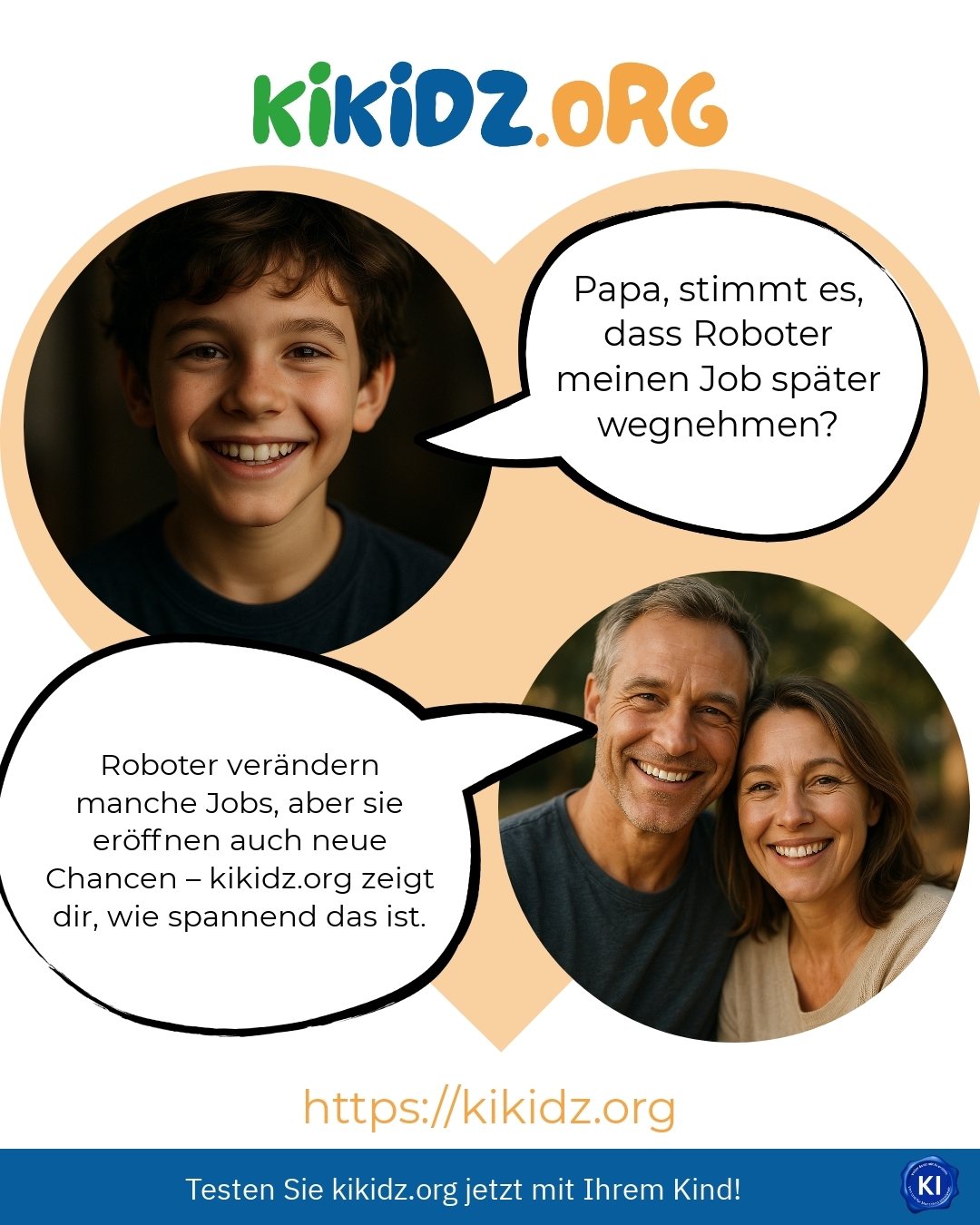
Children sometimes ask questions that make parents think: „Dad, is it true that robots will take my job later?“ This question affects many families, as technological advancement and automation are significantly changing our working world. In this post, we'll explain how robots are influencing jobs, what opportunities are arising from this, and how you, as parents, can support your children.
Dad, is it true that robots will take my job later? – A realistic view
Diese Sorge begegnet Eltern häufig. Roboter und künstliche Intelligenz verändern die Berufswelt, aber eine pauschale Antwort gibt es nicht. Fakt ist: 77 % der Beschäftigten in Deutschland begrüßen Roboter am Arbeitsplatz, weil sie monotone, gefährliche oder belastende Tätigkeiten übernehmen sollen und die Wettbewerbsfähigkeit der Wirtschaft stärken[1][2]. Beispielweise kann ein Anlagenbediener entlastet werden, während technologische Fachkräfte profitieren.
Parents often report that children share their anxieties about the future. One mother recounted: „My son asks me if robots will replace his future profession as a craftsman. I explain to him that it will primarily be about collaboration between humans and machines.“ Another family observes their child learning about robots with curiosity, while simultaneously seeking creative solutions.
How robots are shaping the changing world of work and what that means for jobs
The use of robots frequently leads to a redistribution of activities. Routine tasks disappear, while new professions and competencies emerge[3]. Although the number of simple, repetitive jobs is declining, demand for technical and creative workers is growing. Young workers have better chances of adapting to these changes.
Three everyday examples from parents:
- A father reports that his daughter is interested in programming because she understands how robots are controlled.
- A mother tells how her son was motivated by a school course on AI to pursue careers involving human contact.
- A family gains information together at a technology exhibition, aiming to alleviate their children's anxieties.
Dad, is it true that robots will take my job later? – How parents can support their children
It is important to make the opportunities and challenges of digitalisation understandable to children. Parents can provide impetus on how career paths are changing and what skills will be in demand in the future. Creativity, social commitment and lifelong learning remain indispensable.
Practical tips for parents:
- Answer questions openly and honestly to allay fears.
- Using age-appropriate media and workshops on robotics and AI together.
- attending further education courses, such as kikidz.org offering, as here children can playfully learn how technology and robots can shape their future.
An example of how parents can empower their children: „I explained to my son that robots help with dangerous tasks, but humans always remain important. In his project, he learned that creativity and teamwork cannot be replaced by machines.“
My analysis
The question „Dad, is it true that robots will take my job later on?“ is valid and should be openly discussed. Robots are taking over many tasks that are strenuous or dangerous, and they help to compensate for skills shortages[1][2]. Nevertheless, new career opportunities are opening up, especially for younger people, with a stronger focus on technology, creativity, and social skills[3]. Parents are important companions in preparing children for these changes. Training in kikidz.org is an excellent way to give children skills in this area and to reduce anxieties.
Further links from the text above:
Robots Save the Location – Market and SMEs 2025
Robots against the skills shortage – Robotics Association 2025
Scientific study on the change in employment structure due to robots 2025
For more information and if you have any questions, please contact Contact us or read more blog posts on the topic Children and Artificial Intelligence here. You can find the courses here: Children and Artificial Intelligence Courses











 Deutsch
  English (UK)