
Why do some retailers disappear from the market while others double their sales – even though they operate in the same environment?
This question is of greater concern to decision-makers in the consumer goods industry than ever before. The answer lies in consistently adapting to changing customer expectations. The current Retail trends 2025: Strategies for retail and consumer goods This provides a clear roadmap. Those who take the right steps today secure crucial competitive advantages. At the same time, new business models are emerging that fundamentally change traditional structures. In this article, you will learn about the developments that are shaping the market. You will also learn about concrete approaches that are already working. The AIROI model serves as a guiding framework for practical implementation.
The transformation of traditional retail through digital technologies
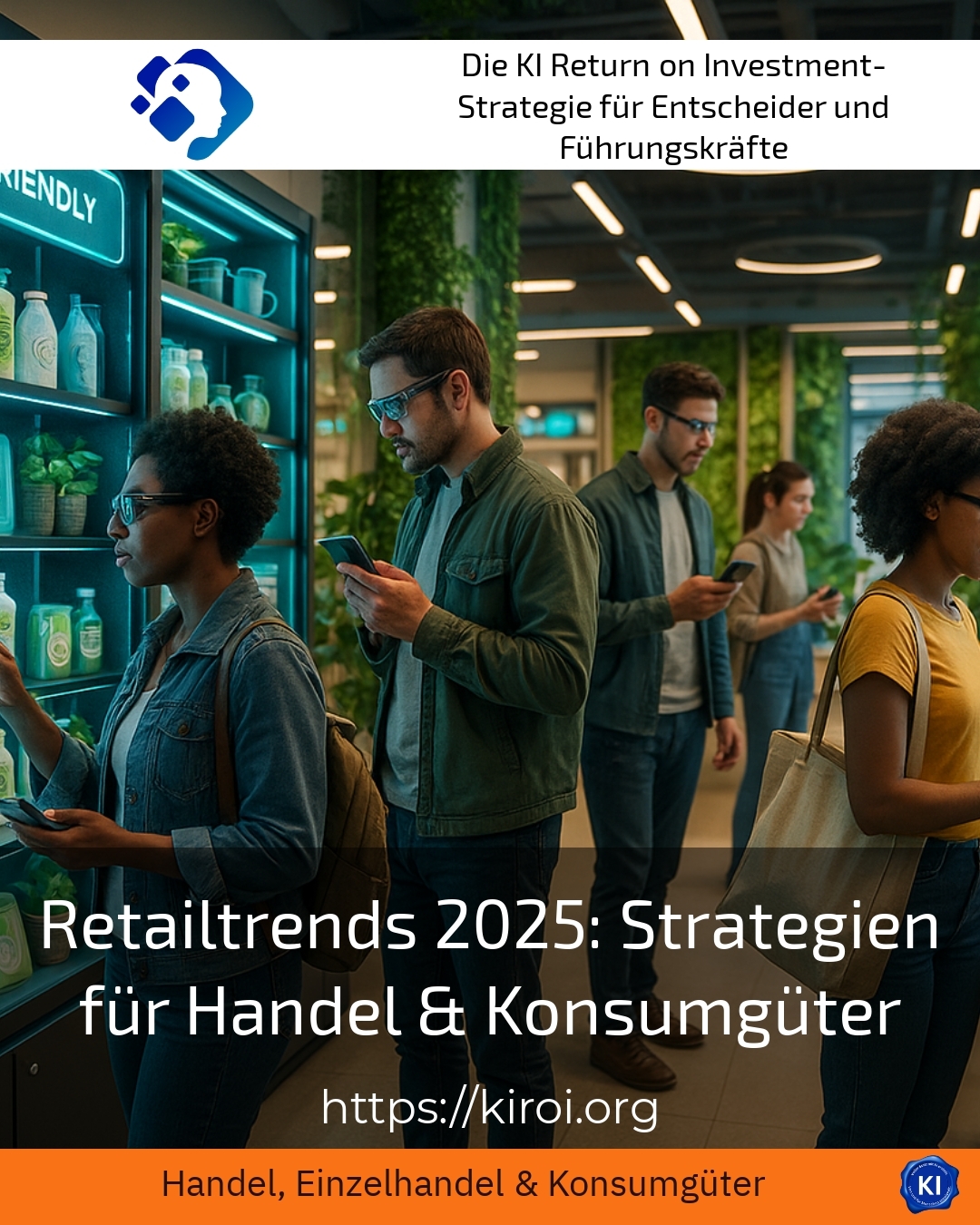
Physical retail is reinventing itself. Innovative technologies are merging with proven sales concepts. One example is the drugstore chain dm with its intelligent shelf systems. These automatically recognize when products are running out. Employees receive immediate notifications on mobile devices.
The grocery trade is also taking new approaches. REWE is testing cashierless shopping concepts at selected locations. Customers scan items when placing them in the shopping cart. Payment is automatically processed when leaving the store. Such solutions significantly reduce waiting times and increase customer satisfaction.
The fashion retailer Zara relies on interactive mirrors in changing rooms. These suggest matching accessories and enable the ordering of additional sizes. The staff is informed and brings the desired items directly to the changing room. The Retail trends 2025: Strategies for retail and consumer goods It clarifies that technology does not replace people. Instead, it creates spaces for better advice and individual customer service. [1]
Best practice with a AIROI customer
A medium-sized furniture store from southern Germany approached our transruptive coaching team. The company struggled with declining visitor numbers despite its good products. Together, we analyzed the customer journey and identified gaps. Customers researched online but did not find a seamless connection to the store visit. Within six months, the team implemented an omnichannel strategy following the AIROI-model. Online-researched articles can now be booked directly in the store. A digital room planner enables the visualization of furniture in the customer’s own home. Employees received tablets with access to advanced product information and availability. The conversion rate in the store increased by 34 percent. Often, employees report better sales conversations thanks to the technical support. The example impressively demonstrates how transruptive coaching can serve as a support for projects related to digital transformation.
Personalization as the key to customer retention
Individual offers become the decisive differentiating feature. The sports goods retailer Decathlon uses movement data from fitness apps. With the consent of the users, customized product recommendations are generated. A runner receives different suggestions than a swimmer or cyclist.
Douglas has completely revamped its loyalty program. Members receive personalized skincare recommendations based on previous purchases. The app reminds them of suitable follow-up purchases before products run out. Such proactive services create real added value for customers.
In the food sector, Edeka is experimenting with individualized weekly plans. The function takes into account nutritional preferences, allergies, and previous purchases. Appropriate recipes are suggested and the ingredients are added directly to the shopping list. This form of support in everyday life significantly strengthens the emotional bond with the brand. [2]
Data-driven decisions in the consumer goods sector
Artificial intelligence is fundamentally changing product assortment planning. Lidl and Kaufland analyze weather data for their ordering plans. When a heat wave is announced, the systems automatically increase the order quantities for beverages and grilling products. This predictive planning minimizes both shortages and overstocking.
The textile retailer H&M relies on AI-based trend analyses. Social media data is integrated into collection planning. Emerging patterns and colors are detected earlier than through traditional market research. The time-to-market is thereby noticeably shortened.
Smaller retailers also benefit from intelligent tools. Cloud-based solutions make advanced analytics affordable. A privately owned bookstore can today use similar forecasting methods as large chains. The democratization of technology creates new opportunities for the small and medium-sized business sector.
Sustainability as a competitive factor in modern trade
Environmental awareness increasingly influences purchasing decisions. The outdoor equipment manufacturer Vaude has made its entire supply chain transparent. Customers can track the CO2 footprint of each product online. This openness creates trust and justifies higher price points.
Ikea is testing furniture subscription models in different markets. Customers rent furniture instead of buying it. After the usage phase, the furniture is refurbished and rented again. This circular model appeals especially to younger target groups. [3]
In the grocery trade, the concept of packaging-free supermarkets is expanding. The chain Original Unverpackt has found imitators. Conventional retailers are also setting up corresponding departments. REWE and Alnatura offer filling stations for muesli, pasta and cleaning products. Retail trends 2025: Strategies for retail and consumer goods They clearly show that sustainability is no longer just a niche topic.
Best practice with a AIROI customer
A regional supermarket chain from northern Germany sought guidance in its sustainability transformation. The management recognized the growing pressure from customers and employees. Our transruptive coaching accompanied the project over eight months. First, we identified the status quo using the AIROI-framework. The analysis revealed untapped potential in cold chain technology. Through intelligent temperature control, energy costs were reduced by 22 percent. In parallel, the company implemented a food rescue program. Shortly before the expiration date of the shelf life, significantly reduced quantities of items are offered. The remaining products are donated to the local charity. The measures were actively communicated and significantly strengthened the brand image. Frequent customers often report an increased sense of identification with the retailer. The project provides an example of how transruptive coaching can be used as a support for projects related to sustainability strategies.
Social Commerce and new sales channels
The boundaries between entertainment and shopping are increasingly blurring. TikTok Shop has entered the German market. Influencers present products in short videos. Purchases are made directly in the app without any interruption to the media experience. Significant sales are being generated, especially in the cosmetics and fashion sectors.
Established retailers are also intensively using live shopping formats. MediaMarkt regularly hosts product presentations in live streaming. Viewers can ask questions and receive exclusive offers. This interaction creates a sense of community and increases the likelihood of purchase.
The toy retailer Vedes is focusing on curated shopping for grandparents. A consultation service helps with choosing age-appropriate gifts. The order is placed by phone or via video chat. This also reaches customers who are less digitally inclined. [4]
Employees as a crucial success factor
Technology alone does not create transformation. People must embrace and shape the changes. The home improvement retailer Hornbach invests heavily in digital training. Employees learn to use new systems in their own academies. Trainings take place during working hours and are paid for.
Aldi has given its executives expanded decision-making authority. Branch managers can independently respond to local circumstances. This decentralization significantly increases agility in day-to-day operations. At the same time, increased responsibility increases motivation.
The electronics retailer Expert involves employees in innovation processes. Ideas from sales are systematically collected and evaluated. Successful proposals are rewarded and rolled out company-wide. This culture of participation creates identification with change projects.
Retail trends 2025: Strategies for retail and consumer goods in logistics
The final mile determines customer satisfaction. Gorillas and Flink have shown how fast deliveries can be. Now established retailers are responding with their own express services. Müller Drogerie delivers within two hours in major cities.
Package machines are becoming an important touchpoint. DHL, Amazon and Hermes are continuously expanding their networks. Retailers are also integrating pickup stations into their stores. Tchibo uses its own stores as decentralized logistics hubs. Online orders are collected there and delivered for pickup.
Drone deliveries remain limited to test areas for the time being. However, they could soon close supply gaps in rural regions. Deutsche Post is testing corresponding concepts in East Germany. Public acceptance is growing with each successful delivery.[5]
My AIROI Analysis
After careful consideration of current developments in the retail and consumer goods sector, clear patterns emerge. The most successful companies combine technological innovation with human expertise. They do not view digitalization as an end in itself, but as a tool to engage with customers. Data plays a central role in this, but is used responsibly.
The AIROI-model offers a structured framework for this transformation. It takes into account both technical and organizational aspects. I consider it particularly important to involve all stakeholders. Employees must understand and be able to contribute to changes. Only then can sustainable acceptance of new processes and tools be achieved.
The examples from the market vividly demonstrate that no company is too small for innovation. Cloud solutions and modular systems significantly reduce the barriers to entry. At the same time, the pressure to change is growing due to changing customer expectations. Those who do not act today risk losing their relevance tomorrow.
Transruptions coaching can provide valuable insights and accompany transformation processes. The combination of industry expertise and methodological know-how supports decision-makers in navigating complex changes. It is not about prefabricated solutions, but about individual strategies. Each company has its own strengths, challenges, and target groups. It is important to preserve and digitally strengthen this individuality.
Further links from the text above:
[1] German Trade Association – Digitization in Retail
[2] EHI Retail Institute – Omnichannel strategies
[3] Council for Sustainable Development – Sustainable Consumption
[4] Federal Association of E-Commerce and Mail Order – Social Commerce
[5] Federal Association of Logistics – Last Mile Innovations
For more information and if you have any questions, please contact Contact us or read more blog posts on the topic Artificial intelligence here.







 Deutsch
 English (UK)