
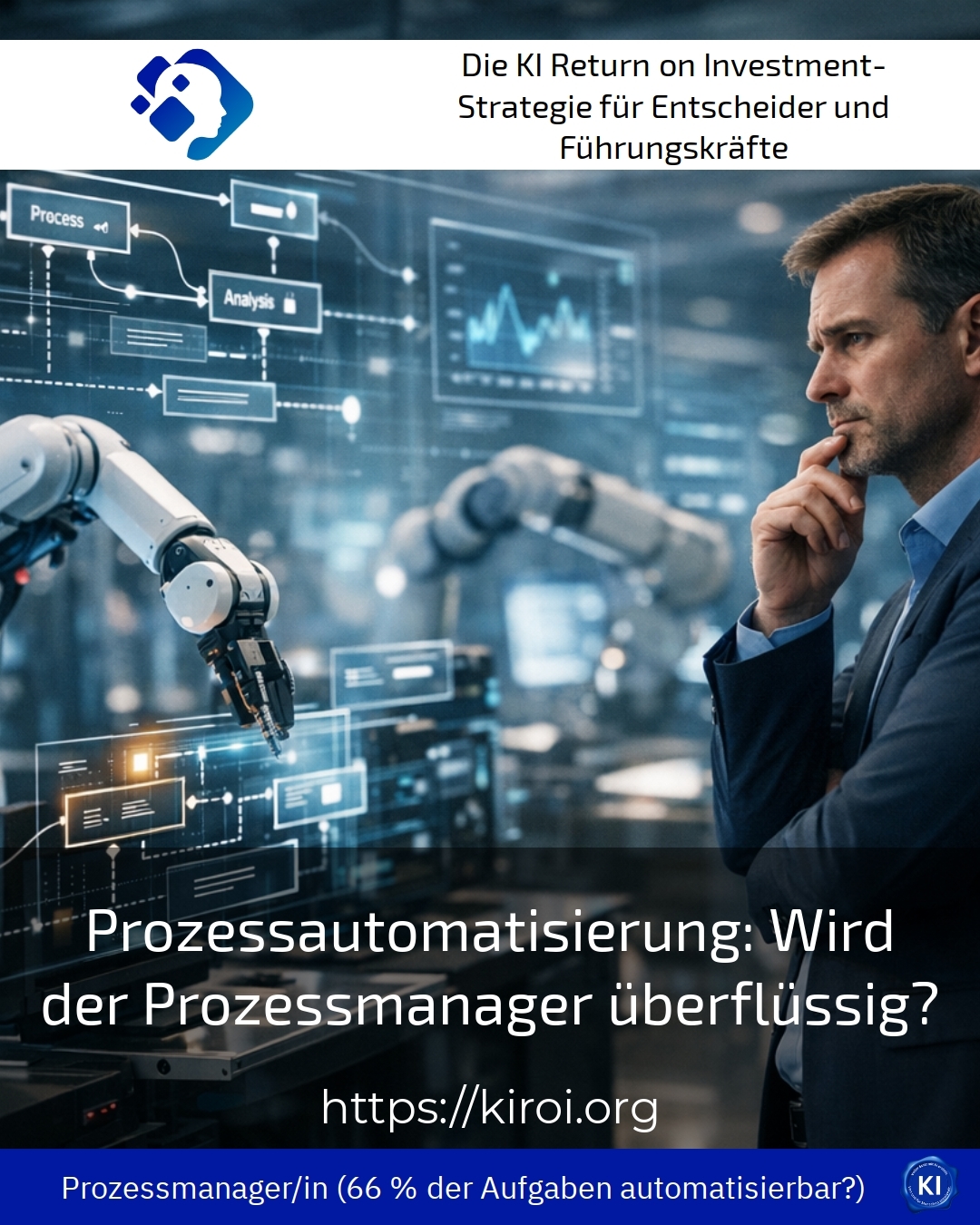
Will your expertise soon be replaced by algorithms, or are you facing the greatest opportunity of your career? This question currently concerns countless professionals who are engaged in optimizing work processes on a daily basis, and the answer is more nuanced than popular headlines would suggest. The Process automation It fundamentally changes entire industries, but at the same time creates entirely new fields of expertise and areas of responsibility. In this article, we will explore together how the role of professionals is changing, what skills will become indispensable in the future, and why human support in digital transformation seems more important than ever.
The transformation of traditional professional roles through process automation
Digitalization is now permeating all sectors of the economy at a speed that would have been unimaginable just a few years ago. According to data from the Job Future Observatory of the Institute for Employment Research [1], numerous administrative tasks present significant potential for automation. Especially repetitive tasks such as data entry, document processing, and standardized testing processes can now be largely automated. In the manufacturing industry, intelligent systems, for example, take on quality control, warehouse management, and production planning tasks. Logistics companies rely on automated route optimization, while financial service providers increasingly perform credit checks algorithmically. Retail uses automated ordering systems that monitor inventory in real time and independently trigger reorders.
However, these developments do not in any way mean the end of human expertise. Rather, the requirements are shifting towards strategic and creative competencies. In the insurance industry, professionals today coordinate complex claims processing that requires empathy and judgment. Hospitals require specialists who optimize medical workflows while considering ethical aspects. Municipal governments are desperately seeking experts who digitize citizen services while ensuring personal contact at the same time.
Best practice with a AIROI customer
A medium-sized company in the machinery sector faced the challenge of fundamentally modernizing its order processing, with long-standing employees initially expressing significant concerns about their future role. Through structured support within the transruptive coaching framework, it was possible to actively involve the professionals in the transformation process. Together with the management, the experts defined which activities should be automated and which would still require human expertise. Within six months, the team of skeptical observers had transformed into dedicated agents of change. The former clerks now took on advisory roles, where they personally assisted customers with complex special requests. The company reports today on significantly higher employee satisfaction, while at the same time the lead times for standard orders decreased by more than half.
New competencies in times of process automation
The ability to connect technological possibilities with business acumen is increasingly becoming a key skill in almost all industries. Professionals who previously performed solely operational tasks are now developing into strategic consultants. In auditing firms, specialists today analyze complex data streams and identify patterns that automated systems might miss. Advertising agencies require creative minds to curate AI-generated content and refine it to suit the brand. Human resources professionals rely on experts who critically question algorithmically generated pre-selection criteria and assess cultural fit.
The platform of the Institute for Labour Market and Occupational Research [1] impressively illustrates that activities with a high proportion of social interaction in particular exhibit a significantly lower risk of automation. Customer advisory services in the banking sector require trust and empathy that machines cannot authentically simulate. Nursing facilities require people who can individually care for residents and accompany family members sensitively. Educational institutions rely on teachers who can motivate students and address personal needs.
Clients often report in transruptive coaching that they initially experience fears that are transformed into confidence through structured reflection. They recognize that their years of experience have invaluable value that cannot be replicated by any software. The ability to create connections, develop creative solutions, and maintain interpersonal relationships remains exclusively human.
Process automation as a tool, not a threat
The perspective decisively determines whether digital transformation is perceived as an opportunity or a risk. Companies that involve their workforce early and create training opportunities benefit from higher motivation and lower turnover. In the pharmaceutical industry, automated systems support researchers in data analysis, while they can focus on interpreting complex relationships. Architecture firms use AI-supported design tools that perform routine calculations and free up time for creativity. Tax consulting firms automate tax collection, allowing advisors to spend more time on individual client support.
Accompanying experienced coaches can provide valuable insights during this change process. transruptions coaching positions itself as a reliable partner in projects related to the digital realignment of work processes. The methodological support helps teams identify and specifically develop their own strengths. This leads to new role models that combine technological expertise with human intuition.
Best practice with a AIROI customer
A facility management service company struggled with high employee turnover after the introduction of a digital deployment planning software was announced. The employees feared being replaced by algorithms, and some long-standing professionals had already preemptively tendered their resignations. The transruptions coaching accompanied the management level in developing a transparent communication strategy and actively involving the workforce in the implementation. In workshops, employees worked together with technical experts to determine which functions the software should take on and which decisions still required human judgment. The experienced facility managers now took on advisory roles in emergency situations and trained new colleagues on how to use the system. After the successful implementation, the turnover significantly decreased, while customer satisfaction increased noticeably due to faster response times. The executives reported on a positively changed corporate culture in which technology was perceived as support rather than competition.
Sector-specific developments and their impact
Various sectors of the economy are experiencing the effects of technological changes at varying intensity and speed. The banking sector is investing heavily in automated credit decision systems, while retaining personal advice for wealthy private clients. Telecommunications companies are using chatbots for standard inquiries, while complex troubleshooting still requires qualified technicians. The food industry is automating production lines, but requires skilled workers for quality assurance and product development.
In the energy industry, intelligent systems monitor power grids around the clock, but strategic planning for network expansion remains the domain of human experts. Media companies are experimenting with automated news production, but for investigative research they rely on experienced journalists. The tourism industry uses booking platforms with AI-based recommendation systems, while travel agencies offer personalized advice for individual travel needs.
The data from the Job Futureometer [1] show a differentiated picture that relativizes general predictions. While certain job profiles do indeed exhibit high automation probabilities, new professional profiles are also emerging that did not exist just a few years ago. Data Stewards, AI ethicists, and digital transformation managers are examples of roles that have emerged from technological change.
The human dimension of transformation
Beyond all technological considerations, it is ultimately the human being at the center of every successful change. The ability to withstand uncertainties, continuously develop, and respond flexibly to new requirements becomes the crucial resource. In craft businesses, masters combine traditional skills with digital tools, thus opening up new customer groups. Law firms use contract generators, while legal assessment of complex cases continues to require qualified lawyers. Real estate agents use virtual viewing tools, but convince prospective buyers through personal expertise and negotiating skills.
Transruptive coaching supports leaders and teams in finding this balance between technology and humanity. Together, strategies are developed that leverage both efficiency potential and strengthen employee competencies. This integrative approach prevents digitalization from being pursued as an end in itself and puts sustainable business success at the forefront.
My AIROI Analysis
The intense discussion about the impact of technological changes on occupational profiles leads to a clear conclusion: Human expertise is by no means unnecessary; it undergoes a fundamental enhancement when it is combined with digital tools. The AIROI methodology offers a structured framework for successfully navigating this transformation and at the same time taking into account both economic efficiency and human needs. Companies that understand and support their employees as active agents of change will operate more successfully in the long term than those that rely solely on technological solutions.
The analysis clearly shows that process automation does not have to be a threat but can serve as a catalyst for professional development. Professionals who continuously expand their skills and position themselves as a bridge between humans and machines will be in greater demand in the digital workplace than ever before. The combination of technical understanding, strategic thinking, and interpersonal skills creates a profile of requirements that hardly seems to be automatizable. The key remains the willingness to actively shape change rather than passively endure it, with professional guidance significantly facilitating this process. The future belongs to those who understand technology as a tool and specifically employ their unique human skills to create value that no machine can replicate.
Further links from the text above:
[1] Job-Futuromat of the Institute for Employment Research
For more information and if you have any questions, please contact Contact us or read more blog posts on the topic Artificial intelligence here.








 Deutsch
 English (UK)