
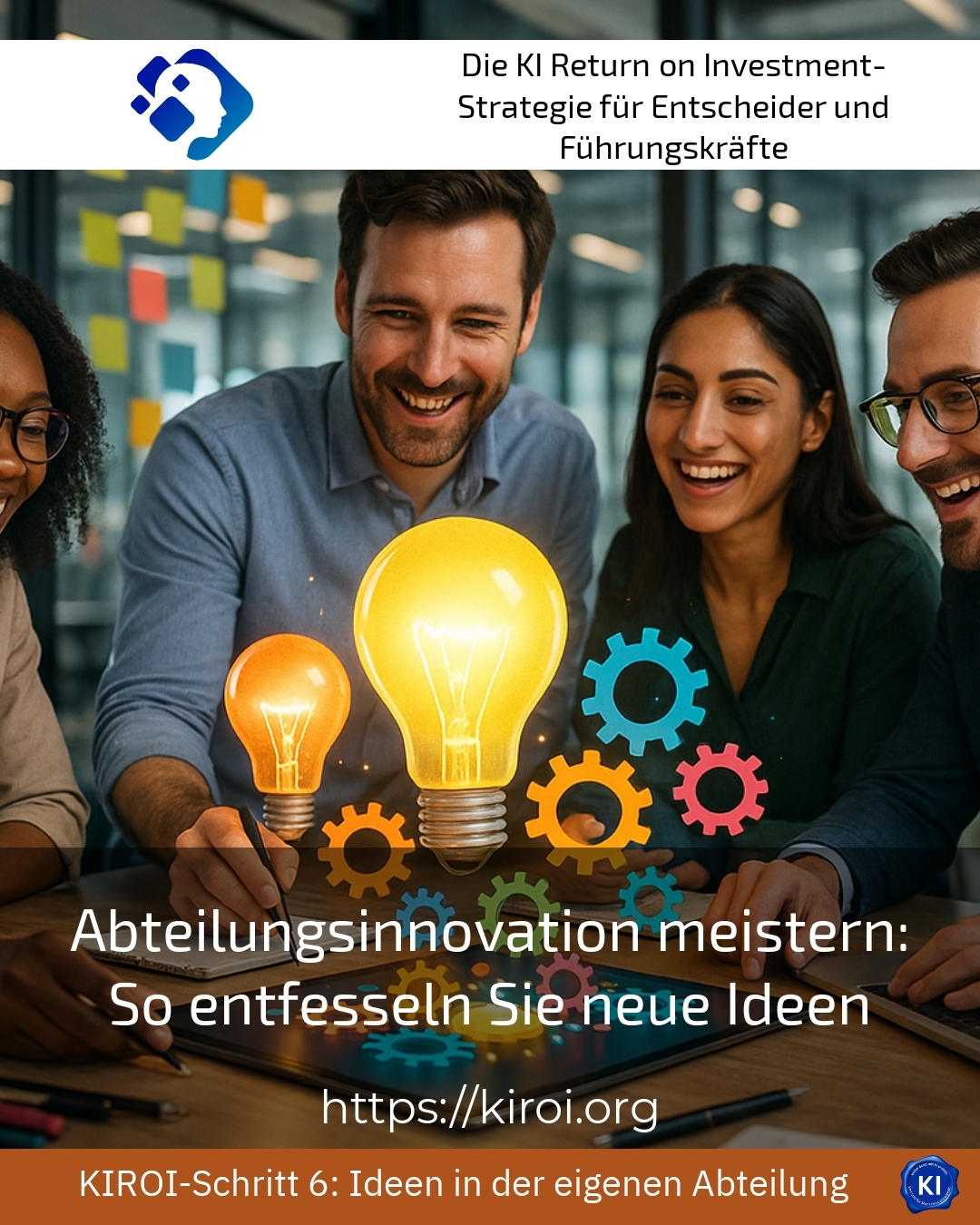
Imagine your department suddenly becomes the innovation engine for the entire company. Employees are brimming with ideas. Leaders are encouraging creative experiments. Does that sound utopian? Not at all! Because Mastering Departmental Innovation means more than just introducing new processes. It's about creating a culture that unleashes creativity. This transformation requires courage, perseverance, and the right momentum. In this post, you'll learn how to ignite precisely this change in your organisation.
Why creative renewal has become indispensable today
The business world is changing rapidly. Technological developments are significantly accelerating this change. Companies are under enormous competitive pressure. Those who stand still quickly fall behind. Therefore, organisations are looking for new ways to renew themselves.
Clients often report entrenched structures within their teams. They experience resistance to everyday changes. Employees feel unheard or uninvolved. Many leaders face these challenges on their journey. However, the good news is encouraging. With the right support, these hurdles can be overcome.
For example, a medium-sized manufacturing company struggled with declining motivation. The workforce worked in a predictable manner without their own initiative. Creative approaches only began to emerge through targeted workshops. A retail company introduced regular idea meetings and encouraged exchange. This led to employees developing innovative solutions for customer problems. A service company also benefited significantly from this approach. It established open feedback rounds and encouraged unconventional thinking.
Mastering Departmental Innovation through Cultural Change
Cultural change forms the foundation of all sustainable renewal. Without it, all measures remain superficial. Therefore, leaders should first work on the corporate culture. This means embodying values such as openness and a willingness to experiment. It also requires viewing mistakes as learning opportunities.
Transruptions-Coaching supports organisations in shaping this change. It guides leaders in developing new ways of thinking. The method provides impetus for sustainable change processes in everyday working life.
A technology company fundamentally transformed its corporate culture within a year. It introduced so-called innovation days and gave teams free project time. The results positively surprised even sceptical leaders. A financial services provider established a culture of learning from mistakes with regular retrospectives. This allowed employees to dare to propose and try out new approaches. A logistics company also focused on cultural change as a success factor. It created spaces for creative work and fostered cross-departmental collaboration.
Best practice with a AIROI customer
A long-established mechanical engineering company faced major challenges in modernising its working methods. Management recognised that existing structures hindered creative processes rather than promoting them. Therefore, the decision was made to receive comprehensive support through the transruptions coaching programme. Initially, we jointly analysed the existing communication channels and decision-making structures within the company. It emerged that many good ideas already existed but were never implemented. Employees did not feel empowered to contribute or pursue their suggestions. We therefore developed a multi-stage programme to foster initiative in all departments. This programme included workshops, mentoring sessions, and regular feedback rounds for all participants. After six months of intensive support, the first measurable successes were evident throughout the company. The number of improvement suggestions submitted increased threefold compared to the previous year. Furthermore, managers reported noticeably improved team dynamics and communication. Employee satisfaction increased significantly, which also led to a significant reduction in staff turnover.
Practical Methods for Creative Breakthrough
Alongside cultural change, teams need concrete tools and methods. These help in approaching and implementing creative processes in a structured way. Proven techniques can significantly boost the flow of ideas and open up new perspectives.
Design Thinking has established itself as a valuable tool in many organisations. This method places people and their needs at the centre. It promotes empathetic understanding and rapid prototyping of solutions [1]. An insurance company successfully used Design Thinking to redesign its customer service processes. The teams collaboratively developed customer-centric solutions in a very short time. A retail company employed the method to optimise its store concepts. A healthcare provider also benefited from this structured approach for process improvement.
Agile working methods also support continuous renewal within departments. Scrum and Kanban enable rapid adjustments to changing market conditions [2]. A media company introduced agile methods in its editorial department and increased productivity. The teams worked more autonomously and responded more flexibly to current developments. A software company combined agile practices with regular innovation sprints for better results. A consulting firm trained all employees in agile fundamentals and promoted self-organised teams.
So unleash new ideas by mastering targeted departmental innovation
Unleashing new ideas requires more than just good intentions and methods. It needs systematic approaches and continuous support for everyone involved. Leaders play a crucial role here as role models and enablers.
Psychological safety forms the foundation for creative development within a team [3]. Employees need to know that their ideas are valued without risk. Only then will they dare to express and try unconventional suggestions. A pharmaceutical company created safe spaces for experimental projects without pressure to succeed. This led to groundbreaking approaches for new business areas and products. An automotive supplier successfully established anonymous idea platforms for reserved employees. An energy company introduced regular brainstorming sessions with clear rules for appreciation.
Transruptions-Coaching professionally supports organisations through these profound change processes. It helps leaders understand and fulfil their role as innovation promoters. The method provides impetus for sustainable development and measurable progress in everyday life.
Best practice with a AIROI customer
An international consumer goods company wanted to fundamentally renew and accelerate its product development. The previous processes were lengthy and often resulted in outcomes that were out of touch with customers. As part of the transruption coaching, we developed a completely new approach model for the team. This model systematically and regularly integrated customer feedback into early development phases. We established cross-functional teams from marketing, development, and sales for better coordination. These teams worked in short cycles and regularly presented interim results to all stakeholders. Managers learned to delegate control and build trust in their teams. They became coaches who provided resources and removed obstacles. After one year, the time-to-market for new products had halved and improved. Customer satisfaction increased measurably because products were better aligned with needs. The company won several industry awards for its innovative development processes and products. Employees reported higher job satisfaction and greater engagement in their day-to-day work.
Using technology as a catalyst for creative processes
Modern technologies can significantly support and accelerate creative processes. They do not replace human creativity, but rather significantly expand its possibilities. The targeted use of digital tools creates new scope for innovative work.
Collaboration platforms enable cross-location, real-time collaboration for all teams [4]. A construction company used digital whiteboards for virtual brainstorming sessions with international partners. The results surpassed traditional in-person workshops in the quality and diversity of ideas. A telecommunications company employed AI-powered tools for idea evaluation and prioritisation. This allowed promising concepts to be identified and further developed within the team more quickly. A fashion company successfully used virtual reality for prototyping and customer feedback.
Data analysis helps to identify trends early on and to make well-informed decisions. A food company systematically analysed consumer data to identify new product categories. The insights gained were incorporated directly into creative development processes and product concepts. A sports equipment manufacturer combined market research with internal ideas for better results. A cosmetics company also used data to validate creative concepts before market launch.
Leaders as Enablers for Departmental Innovation Mastery
The role of the leader is undergoing a fundamental and significant transformation in innovative organisations. From being a decision-maker, they are becoming an enabler and coach for their teams. This change requires new competencies and a revised self-perception from all those involved.
Executives often approach us with questions about the correct leadership style. They want to know how to foster creativity without losing control. This concern is understandable but often unfounded with the right approach. Transruption Coaching professionally and empathetically supports executives in this personal development.
A chemical company intensively and practically trained all managers in modern leadership methods. Participants learned to delegate responsibility and build trust with their teams. An industrial company introduced regular leadership coaching for reflection and further development. A retail group successfully established mentoring programmes between experienced and new managers. These measures had a sustainable impact on the innovative capacity of the entire organisation.
Constructively use and overcome resistances
Changes often encounter resistance in organisations and teams. This resistance is natural and often contains valuable information for leaders. Instead of fighting it, leaders should use it as a resource and understand it.
A publishing house initially experienced strong resistance when introducing new working methods. Management listened actively and adapted their approach accordingly. This eventually won over the sceptics as key contributors to the change. A transport company integrated critics into pilot projects and constructively used their knowledge. An electronics company successfully introduced regular dialogue formats to address concerns.
Transparent communication forms the basis for successful change processes in organisations [5]. Employees must understand why changes are necessary and what they mean. They should also know how they can benefit from and contribute to them.
My AIROI Analysis
The systematic promotion of creativity and innovation within departments proves to be a crucial factor for success. Organisations that consistently pursue this path create sustainable competitive advantages for themselves. They attract talented employees and retain them long-term within the company.
My analysis shows that successful transformations always rest on and build upon several pillars. Cultural change, methodological competence, and technological support are interwoven in this process. Leaders play a key role as role models and enablers of creative processes.
Transruption coaching has proven to be valuable support for projects involving change. It provides the structured framework that organisations need for sustainable development. At the same time, it flexibly takes into account the individual needs and circumstances of each organisation.
The examples presented illustrate that success is possible with consistent implementation. Every organisation can find and follow its own path to creative renewal. What's important is to take the first step and persevere without giving up. Investing in creative skills pays off in the long term for everyone involved. Employees experience more purpose and engagement in their daily work. Companies improve their adaptability and future viability sustainably and measurably. The path may be challenging, but the results fully justify the effort.
Further links from the text above:
[1] Design Thinking Fundamentals – Interaction Design Foundation
[2] What is Scrum – Scrum.org
[3] Psychological Safety in Teams – Harvard Business Review
[4] The Future of Collaboration – McKinsey
[5] Transparent communication during changes – Forbes
For more information and if you have any questions, please contact Contact us or read more blog posts on the topic Artificial intelligence here.









 Deutsch
  English (UK)