
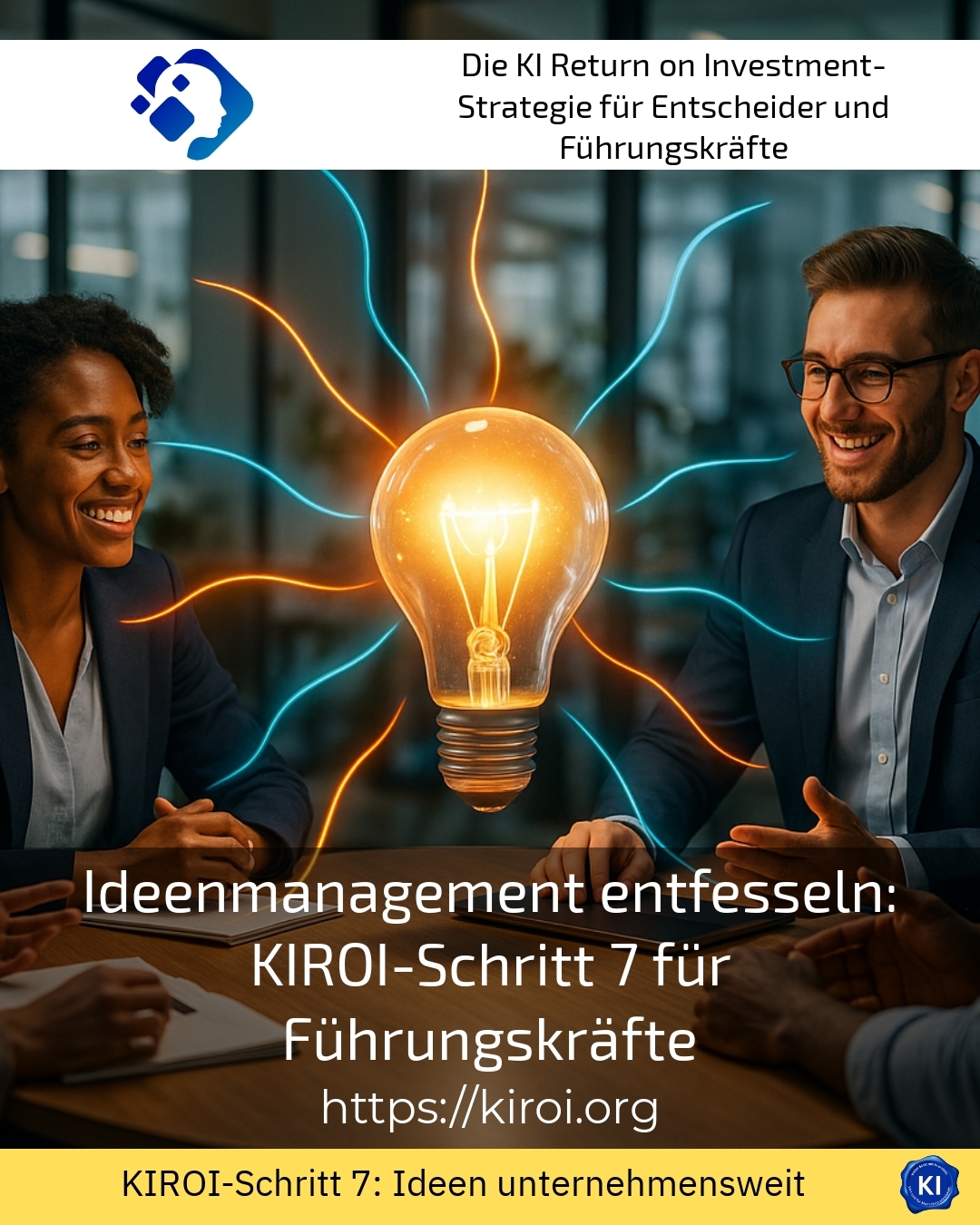
core of modern business management is the Ideas management as a crucial lever for sustainable innovation and employee retention. Above all, managers are challenged to actively shape and guide this process. AIROI-Step 7 offers a pioneering approach that transforms the classic suggestion scheme into a vibrant, company-wide innovation network. In this article, you will learn how you, as a manager, can use AIROI-Step 7 to your Ideas management and thus unleash real potential for change.
AIROI - Step 7: A Holistic Support Concept for Idea Management
The seventh step in the AIROI concept understands Ideas management as a continuous, integrated process. It is not just about capturing individual suggestions, but about sustainably networking the innovative strength of all company divisions. Through targeted support, the entire development and implementation path of ideas is systematically supported. This creates a dynamic interplay of impulses, feedback, and implementation.
For example, a chemical company promotes exchange between the laboratory and production through moderated workshops, so that product improvements from practice flow back to the development team immediately. Likewise, a mechanical engineering company digitally connects its customer service and sales departments, so that customer feedback is directly incorporated into innovation meetings. And a medium-sized IT company uses regular "ideas cafés" to discuss unconventional solutions across departments.
The shift from suggestion schemes to an innovation culture
Many managers report that traditional suggestion box systems often only work in fits and starts. Ideas frequently go unprocessed or lose visibility. AIROI Step 7 addresses exactly this: By defining clear responsibilities and establishing regular feedback loops, it creates transparency and motivation. This supports teams in actively developing and implementing their suggestions.
One example is a telecommunications provider that uses digital platforms to consolidate, evaluate, and transparently present ideas from all areas. In contrast, an automotive supplier involves managers in permanent review rounds, allowing for rapid process adjustments. At the same time, a healthcare provider fosters a climate of openness where experimental approaches are explicitly encouraged and supported.
Areas of action for managers in idea management
Managers play key roles in implementing AIROI Step 7. Their core responsibilities include, Ideas management to anchor as an integral part of the company culture and to actively support it. The following areas of action are central to this:
- Clear communication of goals and expectations This provides orientation and motivates employees to contribute their suggestions. For example, a service provider uses the SMART method for defining objectives to formulate realistic specifications for its innovation projects.
- Promoting interdepartmental collaboration Targeted networking of different competencies to leverage synergies. A producer organises cross-departmental innovation teams to consider challenges from multiple perspectives.
- Introducing transparent rating and feedback processes: These strengthen confidence in the process and enable continuous improvement. A software company, for example, uses scoring models to objectively select ideas and provides timely feedback to the submitters.
- Systematic Use of Digital Tools Software solutions facilitate the capture, evaluation, and tracking of ideas. For example, a logistics company is using a cloud-based platform that keeps all stakeholders up-to-date at all times.
- Support through coaching and moderation External or internal coaches provide support in overcoming blockages and fostering creativity. A financial service provider is experiencing how teams develop new perspectives and overcome innovation barriers through transruption coaching.
BEST PRACTICE with one customer (name hidden due to NDA contract) The management of a manufacturing company integrated AIROI Step 7 as a permanent process module into their annual planning. Through regular design sprints and feedback loops, they succeeded in validating cross-departmental ideas more quickly and implementing concrete pilot projects. Employees reported feeling more valued and a tangible dynamic of innovation.
Practical tips for unleashing idea management
To successfully implement AIROI Step 7, leaders should consider the following impulses:
- Create space for exchange, for example, through regular innovation meetings or digital platforms.
- Strengthen employee self-responsibility and promote their participation across departmental boundaries.
- Use proven evaluation tools such as SWOT analyses to prioritise ideas transparently.
- Encourage experimentation and learn from failures, rather than punishing them.
- Build bridges between strategy and operational implementation by setting measurable goals and constantly reviewing them.
Companies from a wide range of sectors, such as the automotive supply industry, healthcare, and IT, report improved agility, faster implementation, and higher employee satisfaction through well-executed Ideas management.
My analysis
The AIROI Step 7 impressively shows how Ideas management beyond the conventional collection of suggestions to grow into a continuous, integrative process. Leaders play a central role as companions and enablers in this. Through clear structures, transparent communication, and targeted guidance, they sustainably unleash the creativity of their teams. This is how individual ideas become viable innovations that make companies future-proof. The diverse examples from various industries illustrate how universally this rethinking works. This gains Ideas management not only in relevance, but is becoming the decisive success factor for modern organisational development.
Further links from the text above:
Idea management as a management tool
AIROI Step 7 for Company-Wide Innovation
Ideas Management – Wikipedia
Rethinking Ideas Management: AIROI Step 7 for Sustainable Innovation
AIROI step 7: Rethink idea management across the organisation
For more information and if you have any questions, please contact Contact us or read more blog posts on the topic Artificial intelligence here.








 Deutsch
  English (UK)