
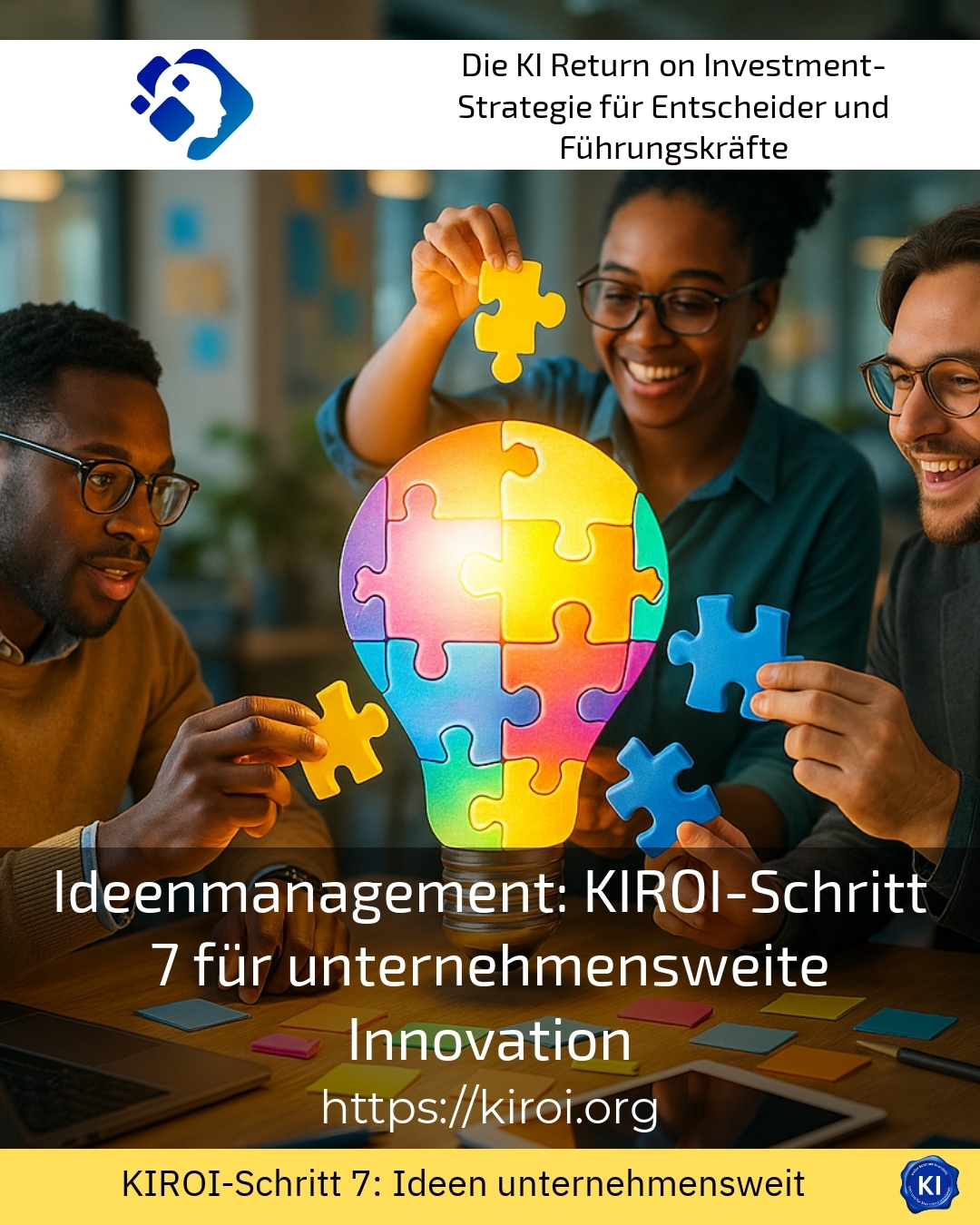
In a rapidly changing world, one thing is becoming increasingly clear: companies that purposefully harness their creative power will win. Idea management forms the core of sustainable competitiveness. Yet, many organisations face a major challenge. They collect suggestions and ideas for improvement, but these often disappear into drawers. This is precisely where a revolutionary approach comes in: the seventh step in the AIROI concept brings idea management to a completely new level. AIROI Step 7 transforms the classic suggestion system into a dynamic, continuous process. It connects all levels of the company and creates a culture where innovations truly flourish. This approach to idea management helps companies to unleash their full innovative potential and remain future-proof.
Ideenmanagement bezeichnet einen systematischen Prozess zur Sammlung, Bewertung und Umsetzung von Ideen. Modernes Ideenmanagement ist ein kontinuierlicher Zyklus, der darauf abzielt, die Innovationskraft und Wettbewerbsfähigkeit eines Unternehmens zu stärken.
Ideas management is no longer just about the classic suggestion scheme. The understanding has fundamentally changed. Today, ideas management encompasses the systematic and structured collection, evaluation, and implementation of ideas across the entire company. It's about much more than isolated measures. Modern ideas management is rather an ongoing, dynamic process. It actively involves all employees and utilises their collective intelligence. Especially in fast-paced industries such as software development, mechanical engineering, and logistics, it's evident: companies that manage ideas effectively innovate faster and motivate their teams sustainably.
The old approach was often too passive. People waited for employees to come up with ideas themselves. Sometimes these weren't even addressed. This led to frustration and demotivation. Clients often report that suggestions fall by the wayside or that there is never any feedback. Such a system significantly hinders innovative capacity. Modern idea management reverses this process. It creates space for continuous dialogue. Teams receive regular feedback. And leaders no longer act as passive observers, but as active promoters of innovation.
The role of AIROI-Step 7 in idea management
AIROI Step 7 is a holistic approach to transforming idea management. This step is understood as supporting projects related to idea management in all its facets. It focuses on the ongoing nature of the process rather than the isolated collection of suggestions. This is the fundamental difference.
A structured idea management process begins with the systematic collection of suggestions. These can come from employees, customers, or partners. In the next step, an interdisciplinary team evaluates the submissions according to clear criteria. Scoring models and SWOT analyses support this objective evaluation. It is then particularly important: continuous support. This is what AIROI step 7 distinguishes.
In practice, this means the following. Regular exchange rounds will be introduced. Employees will present their ideas and develop them further together. Managers will take a more active role as facilitators and idea generators. Experienced coaches will accompany the process, provide impetus, moderate discussions and continuously adapt the course. This creates a dynamic innovation cycle.
Practical implementation of idea management with modern tools
Digital transformation has also revolutionised idea management. Modern platforms such as Jira Product Discovery and Q-ideate help to bundle ideas centrally. All stakeholders can transparently see the status of suggestions. Which ideas are currently being reviewed? Which are in the implementation phase? This transparency is motivating and builds trust.
A software company in the Business Intelligence sector utilised such platforms and saw an immediate increase in idea submissions. The employees knew precisely that their ideas would be seen and acted upon. Not everything can be implemented, but the open communication made the process understandable.
A mechanical engineering company implemented a similar system, combining it with physical workshops. The results were impressive. Participation in idea management increased significantly. Innovative solutions were implemented more quickly. The support provided by experienced coaches was a crucial factor in this success.
Understanding idea management as a cultural change
Truly successful idea management is not purely a process matter. It is, above all, a cultural matter. Many companies are now recognising this. Idea management requires a foundation of mutual appreciation and trust. Employees must dare to submit ideas. They must experience that their suggestions are taken seriously.
This was not the case in a trading company for a long time. Employees on the ground floor had the best ideas for optimising warehouse logistics. But no one asked them. The classic processes bypassed their knowledge. When a new approach to idea management was implemented, everything changed. Suddenly, the warehouse staff's ideas were heard and turned into projects. The result was a 15 percent improvement in efficiency.
This shows that ideas management only works if the company culture supports it. Managers must act as role models. They must contribute and implement ideas themselves. Then they signal that innovation is important. Then other employees will also be brave enough to take action.
The four phases of the structured idea management process
Structured idea management typically follows four phases. These are structured like a funnel: the so-called idea funnel. This structure ensures that the most promising ideas are selected. Resources are allocated meaningfully. And the end result is genuine innovation.
Phase 1: Idea Generation and Documentation
It begins with the systematic collection of suggestions. Idea management thrives on receiving as many suggestions as possible. This requires open channels. Digital platforms play a role here. However, traditional formats for exchange, such as workshops and meetings, are also valuable. Every submitted idea is documented in a structured way. The name of the submitter, the problem, the proposed solution, and the expected benefit are core to every documentation.
An IT service provider introduced regular idea surgeries. Employees could discuss their suggestions directly with the innovation team there. This enormously reduced barriers. Suddenly, ideas flooded in that would never have been collected before.
Phase 2: Assessment and Selection
After data collection comes objective evaluation. Clear criteria are applied here. Does the idea align with the company strategy? Is it technically feasible? What benefits arise? What resources are needed? An interdisciplinary team evaluates according to unified standards. Scoring models help to minimise subjective judgments.
A pharmaceutical company here used a sophisticated SWOT analysis system. The strengths, weaknesses, opportunities and risks of each idea were systematically scrutinised. This created complete transparency. Even rejected proposals were turned down with clear reasoning. This built trust in the process.
Phase 3: Idea management through coaching and further development
The best idea is often not the best in its initial form. It needs further development. This is where coaching comes in. Experienced professionals work with the idea generators. They provide impetus. They ask critical questions. They help to refine the idea and clarify its benefits. This step strongly distinguishes modern idea management from traditional suggestion schemes.
A financial company established coaching teams for promising ideas. Regular exchanges took place. An idea generator from the credit department had a proposal for optimising application processing. With the support of the coaches, the raw idea was developed into a sophisticated concept. The implementation later saved hundreds of thousands of euros annually.
Phase 4: Implementation and Success Measurement
In the end, it comes down to concrete implementation. Projects are set up for selected ideas. Resources are provided. Milestones are defined. And of particular importance: success is measured. What benefit was actually realized? Was the planned effect achieved? This success measurement completes the cycle of idea management.
A logistics company implemented an idea that optimised route planning. The planned saving was 8 percent on fuel costs. The actual saving was 11 percent. This measurement was documented, communicated to the idea generator, and shared throughout the organisation. This motivated others to submit improvement suggestions as well.
Best practices for integrating idea management
There are various tried-and-tested ways to successfully introduce idea management into a company. These methods can be combined and adapted to specific needs.
Establish independent innovation teams
A proven method is the establishment of independent innovation teams. These work across departments. They have access to resources. They coordinate the entire idea management process. In the automotive industry, such teams have long been standard. They gather ideas from production, development, and sales. They evaluate these systematically. They oversee implementation projects.
A supplier of automotive components founded a team of five people from different departments. Within two years, the number of submitted ideas increased by 300 percent. More importantly, 40 percent of the ideas were implemented. This created real value.
Utilise standard assessment criteria
Ideas management requires clear rules. Standardised evaluation criteria are the foundation. They ensure fairness and transparency. Which aspects are important? Does it fit the strategy? Is it feasible? What ROI is generated? A point value is awarded for each criterion. In the end, this results in an objective ranking.
A consumer goods manufacturer developed a sophisticated scoring system with twelve criteria. Each criterion was weighted. The assessment was carried out by a designated panel. All employees were aware of the criteria. This created clarity and predictability. Nobody was surprised why an idea was accepted or rejected.
Exchange platforms create for continuous idea management
Ideas management needs places for exchange. These can be physical or digital platforms. Ideas are discussed on these platforms. Employees build on the suggestions of others. They give feedback. Together, they refine what could be implemented.
A consulting company introduced monthly innovation breakfasts. These sessions were for presenting and discussing ideas. The atmosphere was open and creative. Often, these discussions resulted in improved versions of the original ideas. The company also promoted an internal wiki, where ideas were documented and further developed. This combination of physical and digital exchange proved very effective.
Mastering the Challenges of Idea Management
Ideas management is not a flawless process. There are typical challenges that many companies are familiar with.
Tackling the flood of ideas
Some companies start their idea management with great enthusiasm. Suddenly, hundreds of suggestions are received. The system becomes overloaded. Ideas cannot be processed quickly enough. Frustration arises. Here, only clear structure and sufficient resources can help. The team must be able to evaluate every idea promptly.
An energy supplier experienced exactly this problem. In the first year, over 1500









 Deutsch
  English (UK)