
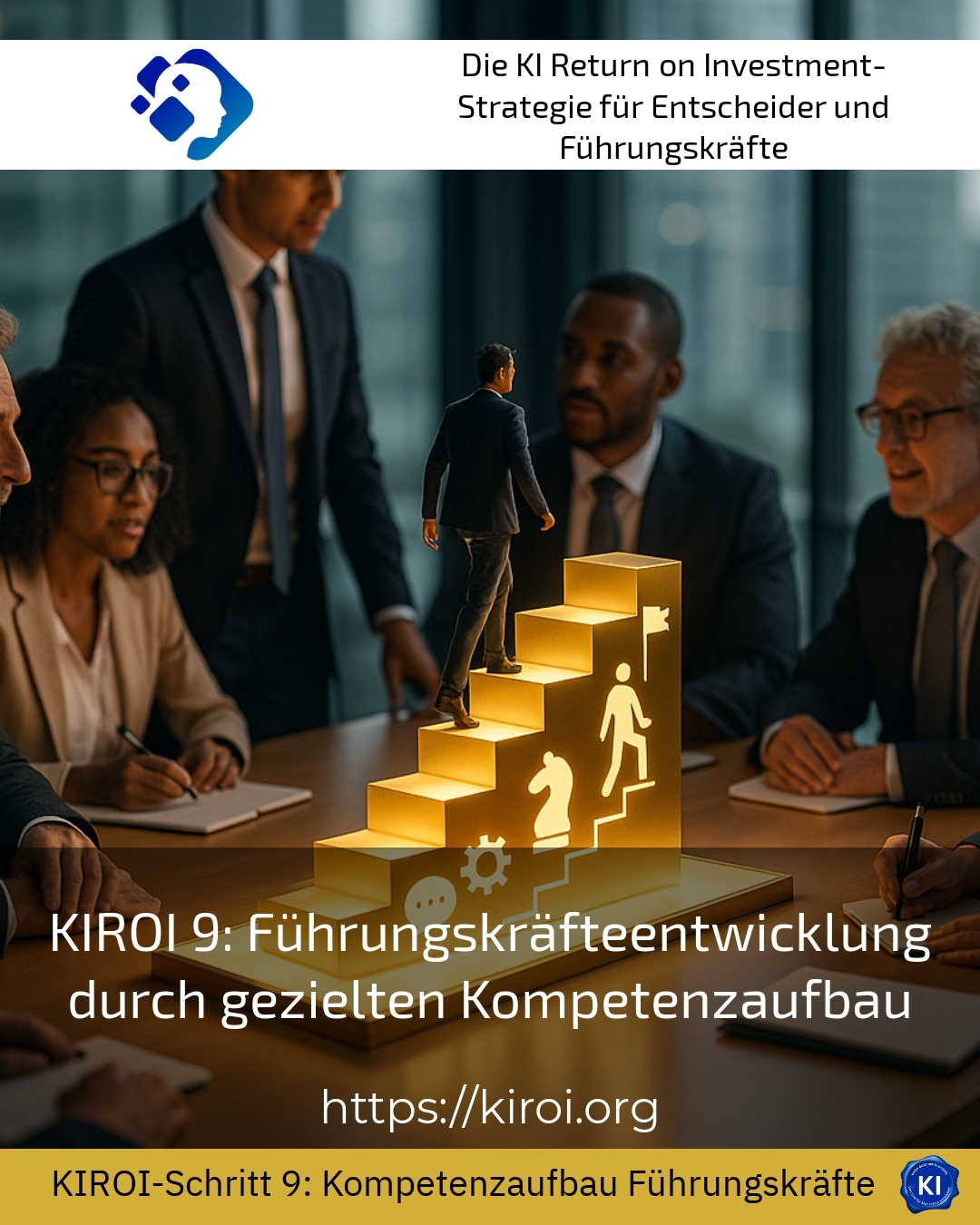
Leadership development is a key component in ensuring the performance and future viability of companies. Through targeted competency building in particular, leaders can be supported in mastering complex challenges and effectively managing their teams. In this article, you will gain practical insights and examples of how leadership development can be successfully achieved.
Leadership Development: Methods for Sustainable Competence Building
Those responsible for supporting leadership development rely on a variety of tools. These include both formal and informal learning methods. For instance, leaders benefit from seminars, coaching, and mentoring opportunities, but also seize learning opportunities in their day-to-day work. A manufacturing company, for example, uses job rotation to give leaders a better understanding of cross-functional relationships. At the same time, a start-up supports its young leaders through regular feedback discussions and coaching to strengthen their communication and conflict resolution skills.
Even international corporations like Siemens are integrating structured leadership programmes with digital modules and in-person workshops that specifically foster competencies in strategic management. Executive development thrives on the combination of these measures, which are tailored to the respective stage of development and individual needs.
Targeted Coaching: Individualised Support in Everyday Management
Coaching is considered an effective developmental tool to support leaders in solving specific problems. For example, a medium-sized IT company uses systemic coaching to help leaders understand the interdependencies within their teams. This allows leaders to specifically improve their team communication while simultaneously strengthening their leadership role.
Within the framework of goal-oriented coaching based on the GROW model, management at a consultancy firm sets clear objectives and develops concrete measures. Creative methods such as role-playing are also used in a pharmaceutical company to practically train negotiation situations. These approaches not only promote individual competence development but also stimulate innovative problem-solving.
Mentoring and peer learning processes in leadership development
Mentoring is a tried-and-tested method through which experienced leaders pass on their knowledge. For example, an industrial company has established an internal mentoring programme where senior managers support junior leaders over several months. This promotes both learning and trust, and creates a culture of continuous development.
In addition, many companies use peer coaching groups, which offer a space for exchange and reflection. In a service company, managers report that this form of learning creates new perspectives and allows challenging situations to be managed more effectively. Such collegial networks contribute to the deepening of leadership skills.
Practical Implementation: Learning at the Workplace and Off-the-Job
Learning directly at the workplace is a method that makes leadership development particularly effective and practical. A logistics company is introducing job rotation programmes to enable managers to work in different areas of responsibility. This broadens their understanding of the organisation and helps them develop more flexible solutions for complex situations.
At the same time, workshops held outside of the day-to-day work routine promote in-depth reflection and intensive learning. For example, a financial services provider further trains its managers in conflict management and leadership skills with practical seminars, making them more confident in handling challenging situations. This successfully bridges the gap between theory and practice.
BEST PRACTICE with one customer (name hidden due to NDA contract) A medium-sized technology company implemented a multi-level development programme for its managers, which combines online modules, in-person seminars and systematic coaching. This enabled the managers to expand both their technical and social competencies. Furthermore, the programme was designed so that participants independently ensured its transfer into daily work afterwards, which supported sustainable development.
Leadership development as a continuous process
Leadership development works best when understood as a continuous process. Companies benefit from clearly defining development goals and systematically planning measures, for example, through targeted monitoring and evaluation. A manufacturing company introduces feedback rounds after the completion of a leadership programme to assess learning outcomes and enable individual adjustments.
It is also important that leaders actively seize development opportunities. Clients often report that they receive valuable impetus from individual support within the framework of transruption coaching, especially when complex change processes are imminent and new leadership requirements arise in hybrid or agile contexts.
My analysis
Developing leaders through targeted competency building is indispensable today for responding professionally to dynamic market conditions and changing demands. Numerous methods – from coaching and mentoring to workshops and job rotation – offer diverse and individually adaptable ways to strengthen leaders. This not only leads to personal development but also to a positive transformation of the entire organisation.
With a systematic and practice-oriented approach, competencies can be soundly expanded and managers are empowered to fulfil their roles with greater confidence and impact. Sustainable support, for example through transruption coaching, aids in successfully mastering challenges and anchoring leadership development as a continuous process.
Further links from the text above:
How to achieve successful leadership development? – Methods, …
Coaching methods for everyday leadership
Leadership Development: Comprehensive Guide
Leadership Development: Methods and Concepts
Leadership Development: Trends and Measures for ...
Leadership Development: 6 Key Methods and…
Leadership Development – Concept, Methods, Definition…
For more information and if you have any questions, please contact Contact us or read more blog posts on the topic Artificial intelligence here.











 Deutsch
  English (UK)