
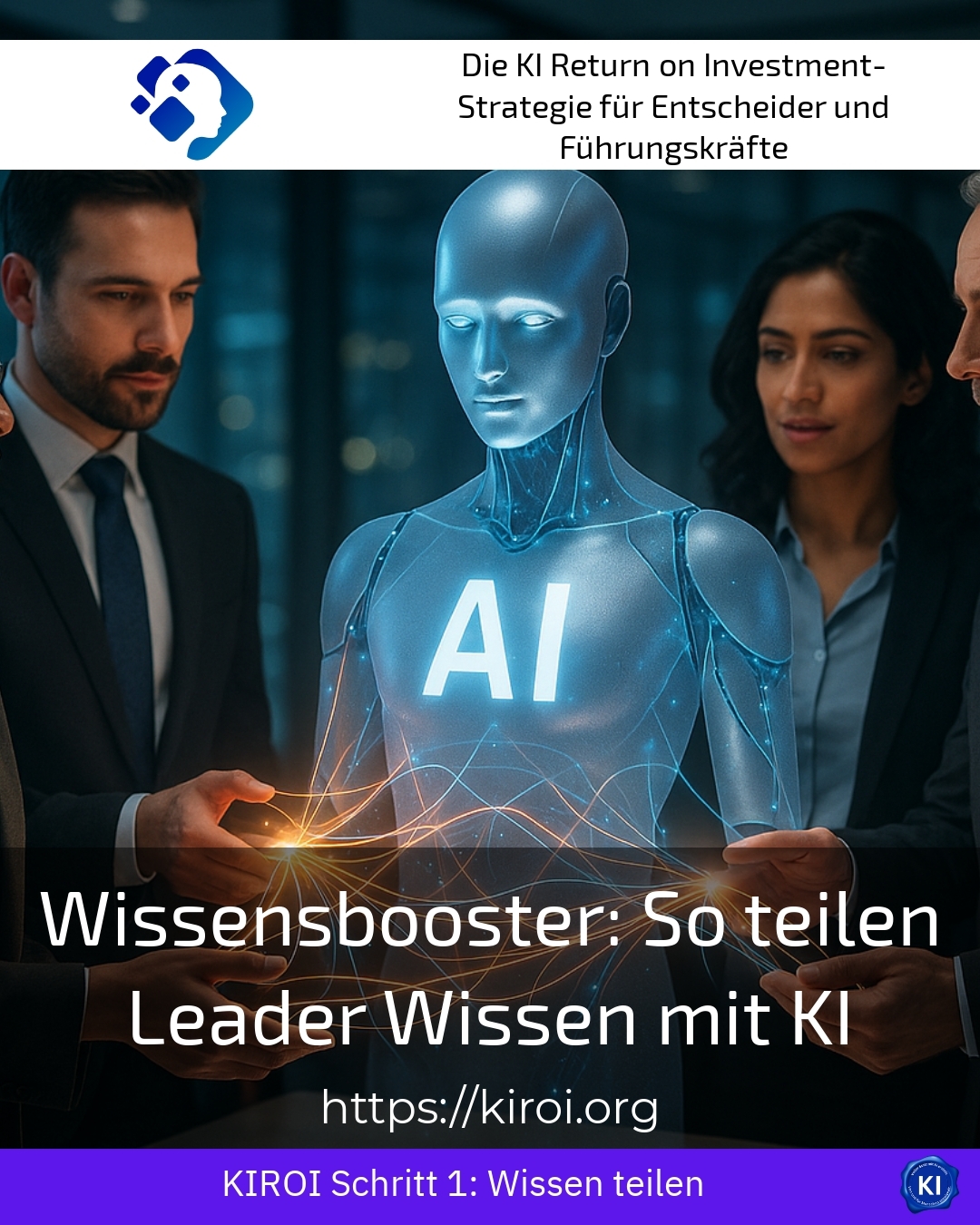
Imagine all of your organisation's expertise being available in seconds, and continually growing, without valuable expertise being lost when experienced employees leave the company. Exactly this Knowledge Booster: How Leaders Share Knowledge with AI revolutionises the way modern leaders systematically capture, structure, and share their knowledge. In a world where information is increasing exponentially and the half-life of expertise is rapidly decreasing, intelligent knowledge transfer is becoming a decisive competitive advantage. But how can decision-makers sustainably document their years of built-up expertise and make it accessible for future generations? The answer lies in a well-thought-out combination of human experience and technological support, which goes far beyond conventional knowledge databases.
The fundamental transformation of knowledge culture in organisations
Traditionally, knowledge transfer in companies took place via personal mentoring relationships, informal chats at the coffee machine, or formalised training programmes, which, however, could often only capture a fraction of the expert knowledge actually present. These methods undoubtedly have their value, as they foster interpersonal relationships and enable the exchange of nuances and contextual knowledge that is difficult to put into words. However, they reach their limits when managers with extensive experience retire or when teams work across different locations and time zones.
In the financial sector, for example, experienced risk managers possess an intuitive feel for market movements that has developed over decades of observation and that has traditionally been difficult to document. An investment banker recently reported how he uses intelligent systems to systematically record his decision-making processes in complex mergers and acquisitions, thereby enabling his team to carry out similar analyses. This change is also clearly evident in the pharmaceutical industry, where scientists systematically document their findings from failed experiments, thus helping future generations of researchers to avoid the same mistakes. In mechanical engineering, on the other hand, experienced engineers use this technology to capture their knowledge of fine-tuning complex production plants, knowledge that until now could only be passed on through years of collaboration.
The Knowledge Booster: How Leaders Share Knowledge with AI in Business Day-to-Day
The practical implementation of this new form of knowledge transfer initially requires a rethink by the leaders themselves, who must redefine their role as knowledge intermediaries. It is no longer about hoarding knowledge as a tool of power. Rather, the ability to effectively impart expertise becomes a quality hallmark of modern leadership. This understanding is gaining traction in many sectors due to increasing pressure from demographic change and a shortage of skilled workers.
In the logistics industry, dispatchers with decades of experience use these tools to document their knowledge of optimal route planning during unforeseen events such as traffic jams, severe weather, or vehicle breakdowns. The insurance industry also benefits considerably, as experienced claims handlers can systematically record their assessments of complex claims, thereby significantly shortening the onboarding time for new colleagues. In retail, experienced store managers share their knowledge of successful negotiation strategies with suppliers or the optimal presentation of goods during seasonal peaks, making the learning curve for new managers considerably steeper.
Best practice with a AIROI customer
A medium-sized company in the precision manufacturing sector faced the challenge that three of its most experienced master craftsmen would retire within eighteen months, each possessing unique knowledge regarding the fine-tuning of highly specialised machinery which was indispensable for critical production steps. transruptions Coaching supported the company in developing a structured process whereby these experts articulated and documented their knowledge in regular sessions. Intelligent systems were used to ask targeted follow-up questions, thereby uncovering implicit knowledge that the masters themselves considered self-evident and had therefore never explicitly formulated. The sessions were recorded and analysed, resulting in a comprehensive compendium that not only contained technical instructions but also decision trees for unusual situations and anecdotal reports of successful past problem-solving. Following implementation, the successor employees reported feeling significantly more confident, and the time to achieve full competence was reduced by approximately forty percent. Furthermore, a dynamic system was created which is continuously updated with new insights, thereby sustainably expanding the organisation's collective knowledge.
Strategic Implementation and Change Management
The successful implementation of such knowledge management systems requires far more than just technological investment, as it touches upon fundamental aspects of corporate culture and the individual self-perception of experts. Many managers initially feel a certain reluctance to systematically share their hard-earned knowledge because they fear it might jeopardise their own position or make them replaceable. These concerns are understandable and must be taken seriously. However, experience has shown that precisely the opposite happens.
In the telecommunications sector, for example, a network architect has taken on a completely new role as an internal consultant and quality guarantor through the systematic documentation of their knowledge, extending far beyond their original operational duties. In healthcare, experienced clinic managers use these methods to pass on their knowledge of efficient process design and crisis management, while also being valued as valuable mentors. The construction industry shows similar developments, where experienced project managers document their insights into the coordination of complex major projects, thereby becoming indispensable knowledge holders whose expertise remains in demand even after they leave operational business.
The Knowledge Booster: How Leaders Share Knowledge with AI and Create Sustainable Structures
The sustainability of a knowledge management system depends crucially on whether the documentation of knowledge can be established as an integral part of daily work, rather than being perceived as an additional burden that must be dealt with alongside actual day-to-day business. Successful organisations have recognised that reflecting on and articulating experiences not only serves knowledge transfer, but also helps the experts themselves to structure and refine their own thought processes.
In the energy sector, for instance, power plant engineers use regular debriefing sessions to document their experiences with critical situations, thereby building a collective memory that serves as a valuable resource for future events. The chemical industry has developed similar practices, where process engineers document their optimisations and make these findings available across different sites. In the field of renewable energies, experienced project developers share their knowledge of successful approval processes and stakeholder management, enabling new projects to be realised significantly faster. Transruption coaching helps companies to build such structures and overcome cultural resistance.
Best practice with a AIROI customer
An internationally operating consulting firm with several hundred employees faced the challenge that valuable project knowledge was regularly lost when consultants left the company or moved to other business areas, leading to the same mistakes being made repeatedly on similar mandates and valuable insights not being utilised. As part of transruption coaching, a concept was developed whereby structured knowledge extraction takes place after each major project. This goes far beyond conventional project closure reports and specifically asks for transferable insights, stumbling blocks, and innovative solution approaches. The intelligent tools used analyse the documented experiences and automatically link them with relevant previous projects, so that consultants can immediately access the collective knowledge of the entire organisation for new mandates. Particularly valuable was the capture of so-called negative knowledge, i.e. insights into which approaches did not work in certain situations and why, which is often as instructive as success stories. The implementation led to a measurable increase in customer satisfaction and a significant reduction in project overruns because typical pitfalls could be identified and avoided early on. Furthermore, employees reported an increased sense of appreciation because their experiences were now visibly and sustainably integrated into the organisation.
Ethical Dimensions and Responsible Handling
The systematic collection and transfer of expert knowledge raises important ethical questions that must not be overlooked in the enthusiasm for technological possibilities. Who owns the knowledge that an employee has accumulated over years? How is it ensured that the documentation is not misused for surveillance or control? These questions deserve careful attention and transparent answers.
In the automotive industry, progressive companies have developed clear guidelines setting out which types of knowledge may be documented and what boundaries should be respected, with employees actively involved in shaping these rules. The banking sector faces particular challenges regarding data protection and confidentiality, necessitating especially nuanced concepts that enable knowledge transfer while safeguarding sensitive information. In the field of management consulting, client confidentiality must be maintained while simultaneously disseminating methodological knowledge, which requires careful anonymisation and abstraction.
Knowledge Booster: How Leaders Share Knowledge with AI While Upholding Human Values
Amidst all technological enthusiasm, the human dimension must not be overlooked, as it is ultimately about making human knowledge and experience usable for other people, with technology merely serving as a tool and catalyst. Successful implementations are characterised by the fact that they do not replace personal encounters and direct exchange, but rather complement and enrich them. The documented findings become the starting point for in-depth discussions and not their substitute.
In the education sector, experienced teachers use these methods to share their pedagogical insights, with personal exchange with colleagues remaining central. The media industry demonstrates how experienced journalists can document their knowledge of research methods and ethical decision-making without diminishing the importance of editorial discussions. Finally, in the trades, traditional master-apprentice relationships are combined with modern documentation methods to create a hybrid model that unites the strengths of both approaches, enabling particularly effective knowledge transfer.
My AIROI Analysis
The systematic transfer of expert knowledge using intelligent technologies represents a paradigm shift that goes far beyond mere efficiency gains, touching upon fundamental questions of organisational development and corporate culture. In my work with various companies and leaders, it repeatedly becomes apparent that the greatest success factor is not the technology itself, but the willingness of those involved to understand knowledge as a common good and to place their own expertise at the service of the community. Organisations that successfully implement this cultural change develop remarkable resilience to personnel changes and a learning ability that clearly distinguishes them from less far-sighted competitors.
At the same time, I would like to warn against falling into technological solutionism and believing that the right software alone can solve all knowledge management challenges. The most valuable insights still emerge from direct human exchange, moments of joint reflection, and trusting collaboration between experienced and less experienced colleagues. Technology can support, document, and make these processes more accessible, but it cannot replace them. Leaders who have a Knowledge Booster: How Leaders Share Knowledge with AI Those who wish to implement successfully should therefore first invest in their company culture and understand technological tools as supporting infrastructure that strengthens human connections rather than displacing them. In this regard, transruption coaching helps organisations find a balanced path that leverages technological opportunities without losing sight of the human dimension [1] [2] [3].
Further links from the text above:
[1] McKinsey: The economic potential of generative AI
[2] Harvard Business Review: Knowledge Management
[3] Gartner: Knowledge Management Research
For more information and if you have any questions, please contact Contact us or read more blog posts on the topic Artificial intelligence here.






 Deutsch
  English (UK)