
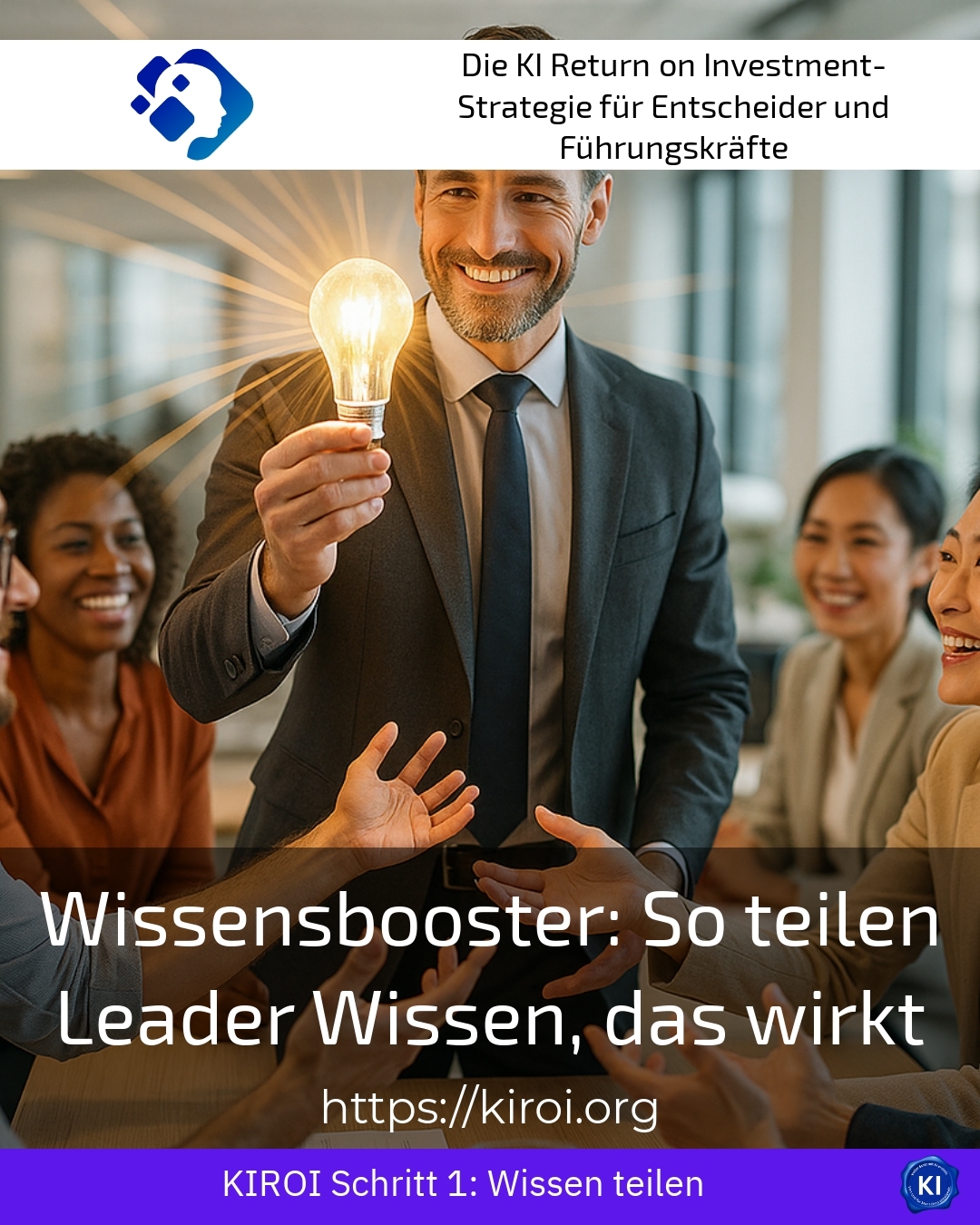
Imagine you possess an enormous reservoir of experience, insights, and strategic know-how that could transform your business, but this valuable knowledge remains untapped within your thoughts. This is precisely where the crucial knowledge booster comes in, as successful leaders understand that shared knowledge gains exponential power and empowers teams to achieve extraordinary results. The question, therefore, is not whether you should share your knowledge, but how you can do so in a way that has a lasting impact and elevates your organisation to an entirely new level.
Why a knowledge booster has become indispensable for modern leadership
In a world changing at breathtaking speed, targeted knowledge transfer is developing into one of the most valuable leadership skills of all. Leaders who share their knowledge systematically and effectively not only create more competent teams but also establish a culture of continuous learning at the same time. This culture, in turn, forms the foundation for innovation and adaptability.
Consider, for example, the situation of a medium-sized mechanical engineering company in the Black Forest. For decades, the technical managing director had developed a profound understanding of complex manufacturing processes. Only when he began to systematically pass on this knowledge to his department heads was the company able to increase its production efficiency by considerable percentages. Similarly, a Hamburg-based logistics company saw its founder share her insights on sustainable supply chain optimisation in regular workshops with the entire management team. The results exceeded all expectations, as the employees independently developed innovative solutions that built upon the shared knowledge.
A third example comes from the financial sector: The chief executive of a regional cooperative bank established a so-called reverse mentoring programme. In this programme, not only experienced executives shared their knowledge, but younger employees also contributed their digital skills. This bidirectional knowledge culture led to a remarkable strengthening of team cohesion and an accelerated digital transformation.
Best practice with a AIROI customer
An internationally operating pharmaceutical company faced the challenge of passing on the extensive expertise of its experienced research leaders to the next generation. Previous approaches had proven insufficient because knowledge was lost in isolated documents. As part of transruption coaching, we jointly developed a multi-stage knowledge activation programme. First, the leaders identified their core insights and formulated them into applicable principles. They then established structured dialogue formats in which this knowledge was conveyed in a contextual manner. The results surprised even the most sceptical participants, as the onboarding time for new scientists was significantly reduced. Furthermore, experienced leaders reported an increased sense of purpose in their roles. The programme has since been extended to other sites and serves as a role model for other departments.
The art of effective knowledge transfer as a knowledge booster
Effective knowledge transfer differs fundamentally from simply distributing information. It requires a deep understanding of how people learn and what motivates them. Leaders who master this art adapt their delivery methods to the needs of their target audience. They use stories instead of dry facts because narrative structures engage the brain in a unique way [1].
This is particularly evident in the automotive industry with a supplier from Baden-Württemberg. The production manager began to turn his daily rounds into learning moments. Instead of giving instructions, he asked targeted questions and shared relevant background information. This method impressively activated the critical thinking of his employees. Another example is provided by a Munich-based technology start-up, whose CEO introduced weekly open office hours. In these sessions, she not only shared strategic knowledge but also her personal experiences with setbacks and how she overcame them.
The situation is particularly impressive within a traditional family-run business in the food industry in Lower Saxony. The third generation of the entrepreneurial family established a format called "Wissensfrühstück" (Knowledge Breakfast), where various managers presented their expertise on changing topics once a month. This initiative not only promoted knowledge exchange but also significantly strengthened interdepartmental understanding and collaboration.
Psychological Foundations for Sustainable Knowledge Transfer
Neuroscience provides valuable insights into how knowledge is best anchored [2]. Emotional involvement plays a central role in this, which is why successful leaders connect their messages with personal experiences. The limbic system, our emotional centre, acts as a gateway to long-term memory. Information linked to positive emotions remains retrievable for significantly longer.
An energy supplier from North Rhine-Westphalia systematically uses these findings in its leadership development programmes. Experienced board members there share not abstract management theories, but concrete situations from their careers. They describe in detail what considerations they made at critical moments and what lessons they learned from them. This narrative approach creates a deeper connection to the knowledge being imparted.
A hotel chain with locations in German-speaking countries operates similarly, the founder of which regularly reports on his experiences in personal video messages. These authentic insights are far more impactful than standardised training materials. Employees often report that this personal approach enables them to identify more strongly with the corporate values.
Structures and formats for the knowledge booster in everyday leadership
The best will in the world to transfer knowledge vanishes without suitable structures and formats. Successful leaders therefore implement systematic approaches that make knowledge sharing a fixed component of everyday working life. Various formats prove their worth in this regard, each addressing different learning styles and different levels of knowledge depth.
A good example of this is a medium-sized software developer from Berlin who introduced so-called brown-bag sessions. During the lunch break, experienced developers share their specialist knowledge on specific technologies or problem-solving approaches. The informal atmosphere significantly lowers the inhibitions for questions and discussions. In contrast, an insurance group from Cologne established a more structured format in the form of quarterly knowledge academies. There, managers at all levels present their key findings from completed projects.
A medical technology company from the Lake Constance region is proving particularly innovative with its After-Action Review concept. After every major project, the teams involved conduct a structured reflection, analysing both successes and potential areas for improvement. The insights gained are fed into an accessible knowledge base, available to all employees [3].
Best practice with a AIROI customer
A trading company with a rich history spanning over a century was looking for ways to capture and pass on the implicit knowledge of its long-serving executives before their retirement. The challenge lay in the fact that much of this knowledge had never been explicitly articulated, having naturally developed over years of experience. In transruptions coaching, we developed a three-stage programme for knowledge exploration and transfer. First, we conducted intensive reflection discussions with the experienced executives to bring hidden knowledge treasures to light. We then structured these findings into transferable principles and actionable recommendations that could be applied independently of the specific situation. In the third step, we established tandem partnerships between experienced and emerging leaders, who worked closely together over a period of six months. transruptions coaching continuously supported this process, helping to overcome communication barriers between generations. Feedback from those involved indicated that this form of structured support offered significant added value compared to unassisted handover processes.
Digital Tools as Amplifiers for the Knowledge Booster
Digitalisation opens up entirely new possibilities for knowledge transfer, helping to overcome physical and temporal boundaries. Successful leaders use these tools strategically, without neglecting the personal aspect. Video conferencing, collaboration platforms, and knowledge management systems effectively supplement direct interaction.
For example, an internationally operating plant manufacturer from Bavaria relies on short video sequences in which experienced engineers explain complex technical contexts. These micro-learning units are available to all employees at any time and enable individual learning at their own pace. A consulting firm from Frankfurt, on the other hand, uses an internal podcast series in which partners share their insights from significant projects.
A fashion retailer based in Hamburg shows particular creativity by establishing an internal social network for knowledge sharing. Executives regularly post short contributions there on current challenges and their solutions. The comment function allows for a lively dialogue that further enriches the shared knowledge and integrates different perspectives.
Overcoming barriers and transforming resistance into engagement
The path to effective knowledge transfer is rarely straightforward and without obstacles. Many leaders initially hesitate to share their knowledge because they fear it will weaken their own position. This fear is based on a misunderstanding of the nature of power and influence in modern organisations. In reality, sharing knowledge strengthens one's own position because it builds trust and recognition.
A construction company from the Rhineland countered this resistance by explicitly recognising knowledge sharing in its promotion system. Managers who demonstrably passed on their knowledge successfully received preferential consideration in career decisions. This structural anchoring sustainably changed the company culture. A chemical group from Hesse, which introduced special awards for outstanding knowledge transfer, proceeded similarly.
A third example comes from a telecommunications provider whose leadership spoke openly about its own mistakes and the lessons learned. This role model encouraged other leaders to be equally transparent with their experiences. The resulting psychological safety formed the foundation for an open and honest exchange of knowledge at all levels [4].
My AIROI Analysis
A systematic review of numerous organisations of varying sizes and industries reveals a clear pattern: sustainably successful companies are characterised by a strong culture of knowledge sharing at leadership level. The knowledge booster acts not as a one-off event, but as a continuous process integrated into daily work. Leaders who generously and structurally share their knowledge create multiplier effects that extend far beyond the immediate recipients.
The analysed examples clearly show that successful knowledge transfer must fulfil several conditions: it requires suitable formats and structures that offer regular opportunities for exchange. It requires a corporate culture that ensures psychological safety and explicitly values the sharing of insights. Furthermore, it benefits from digital tools that help overcome physical and temporal barriers.
The "transruption" coaching support has proven to be a valuable asset in this context, as it helps leaders identify their often unconscious knowledge reserves and transform them into transferable formats. The knowledge booster only unfolds its full potential when it is underpinned by authentic commitment and supported by professional guidance. Investing in such development pays off in the long term because it sustainably enhances organisational intelligence and creates competitive advantages that are difficult to replicate.
Further links from the text above:
[1] Harvard Business Review – Leadership Insights
[2] Frontiers in Neuroscience – Research on Learning
[3] McKinsey – Organisational Performance Insights
[4] Gallup – Workplace Insights
For more information and if you have any questions, please contact Contact us or read more blog posts on the topic Artificial intelligence here.








 Deutsch
  English (UK)