
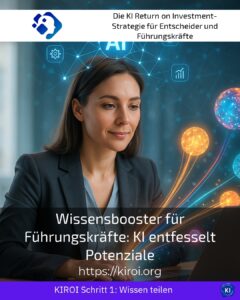
Imagine that untapped treasures of expertise lie dormant within your company, just waiting to be unearthed. Today, leaders face the fascinating challenge of systematically activating these hidden resources. The crucial Knowledge booster The solution lies not in external sources, but right outside one's own office door. Experienced employees carry expert knowledge acquired over decades within them, which often remains undocumented. This is precisely where a new type of leadership comes in, one that makes hidden expertise visible and utilises it sustainably.
Why hidden expertise is the underestimated success factor
In nearly every organisation, an invisible network of implicit knowledge exists, which has developed over years. This knowledge manifests in the way experienced project managers assess complex situations. It shows itself in how service staff intuitively ask the right questions. And it reveals itself in the small 'tricks of the trade' with which technicians elegantly solve difficult problems [1]. This expertise often evades formal documentation because it has become so taken for granted. The people concerned often no longer recognise the value their knowledge holds.
A prime example can be found in the manufacturing industry, where experienced machine operators can detect sources of error from the sound of the equipment. Similarly, in the financial sector, seasoned risk managers notice anomalies in data that algorithms overlook. In healthcare, experienced nurses, in turn, develop a knack for subtle changes in patients. These skills cannot simply be transferred into manuals. Instead, they require systematic approaches to make them usable for the entire team.
The Knowledge Booster as a Strategic Leadership Tool
Leaders who are genuinely Knowledge booster To act, one must first understand where expertise is hidden. This requires a fundamental shift in perspective on one's own workforce. Instead of primarily viewing employees as executors of instructions, they become valuable sources of knowledge. This transformation begins with genuine curiosity and real appreciation for the experiential knowledge of others. Leaders often report gaining completely new insights after this change in perspective.
This is particularly evident in the logistics sector, where experienced dispatchers plan complex routes more efficiently than any software system. In retail, long-serving store managers know exactly which products are in demand and at what times. The construction industry benefits enormously from foremen who recognise potential problems on the building site long before they occur. All this knowledge is worth its weight in gold and deserves systematic attention from company management.
Best practice with a KIROI customer
A medium-sized mechanical engineering company faced the challenge of several experienced service engineers retiring simultaneously. Management realised that irreplaceable knowledge would leave the company with these individuals. As part of the transruption coaching, a structured knowledge transfer process was established that went far beyond conventional handover procedures. Initially, the experienced engineers took younger colleagues along to particularly complex customer installations and explained their approach out loud. These so-called thinking-aloud sessions were recorded and subsequently analysed together. This revealed astonishing insights because the experts themselves were surprised by how much implicit knowledge they possessed. Additionally, regular storytelling sessions were established, where challenging situations from the past were discussed. The result was remarkable, as the onboarding time for new engineers was reduced by approximately forty percent. At the same time, the first-time fix rate for service calls significantly increased. The senior experts involved also reported an increased appreciation for their work.
Methods for activating hidden expertise in the team
The systematic exploration of hidden knowledge requires diverse methodological approaches that are adapted to the respective context. Reverse mentoring is a particularly effective approach in this regard, where junior employees train experienced colleagues in new technologies. In return, the experienced employees share their implicit knowledge, which would otherwise be difficult to impart [2]. This reciprocal relationship builds trust and opens doors for two-way knowledge exchange.
In the pharmaceutical industry, companies use so-called Knowledge Cafés to promote interdisciplinary exchange. Insurance companies rely on storytelling workshops where experienced claims adjusters report on unusual cases. Energy providers establish mentoring programmes where junior employees accompany experienced colleagues on complex projects. These methods complement each other and create a comprehensive ecosystem for knowledge transfer.
How leaders become genuine knowledge boosters
The transformation to a knowledge-activating leader requires concrete behavioural changes in everyday life. First, it is important to regularly ask open-ended questions that encourage reflection. Instead of direct instructions, phrasing such as: "What would you recommend in this situation?" is more suitable. This type of communication signals genuine interest in employees' knowledge. At the same time, it creates space for insights that might otherwise have remained hidden.
In the banking sector, successful branch managers practice regular reflection sessions after complex customer consultations. In the chemical industry, production managers establish short daily exchange rounds for process improvements. IT companies use so-called retrospectives to systematically document lessons learned after projects. All these practices have one thing in common: they create structured spaces for the exchange of experiential knowledge.
Best practice with a KIROI customer
An internationally active trading company wanted to systematically tap into the purchasing knowledge of its most experienced category managers. These experts possessed in-depth knowledge of supplier relationships, negotiation tactics, and market dynamics. As part of the transruption coaching, a multi-stage program was developed that combined various knowledge transfer methods. In the first phase, junior employees accompanied experienced managers to important negotiations and documented their observations. This was followed by structured debriefings in which the experts explained their decisions and assessments. Particularly valuable were the so-called "what-if" analyses, where alternative scenarios were played out. This method helped to translate the experts' intuitive knowledge into understandable decision-making logic. In addition, video tutorials were produced in which the experts reported on formative experiences. The documentation also finally included information on informal networks and unwritten rules of the market. The company now has a rich knowledge base that is continuously being expanded. New team members report a significantly shorter time to full productivity.
Typical obstacles and how leaders overcome them
When activating hidden expertise, leaders frequently encounter characteristic resistances and obstacles. Experienced employees often underestimate the value of their own knowledge because it has become second nature to them. Others hesitate to share their knowledge for fear of becoming replaceable. Still others simply find no time for systematic knowledge transfer alongside day-to-day business [3]. However, these obstacles can be constructively overcome with the right approaches.
In the automotive supply industry, companies overcome the time hurdle through fixed knowledge transfer slots in shift schedules. Consulting firms address concerns about replaceability through explicit recognition and career paths for knowledge holders. Telecommunications providers use gamification elements to make knowledge exchange more attractive. These industry-specific solutions demonstrate that creative approaches can overcome typical barriers.
The knowledge booster effect in corporate culture
When leaders consistently as Knowledge booster acting, the entire company culture changes permanently. Employees begin to perceive and proactively share their own knowledge differently. An atmosphere of continuous mutual enrichment and learning emerges. This cultural transformation requires time and consistent role-modelling by leadership. However, the investment pays off many times over because it unlocks the organisation's collective potential.
In the media industry, editorial teams report significantly improved collaboration between experienced and younger journalists. Hotel chains are seeing increased commitment when employees can actively contribute their service knowledge. Engineering firms are benefiting from shorter project timelines because experience from previous projects is systematically utilised. These examples illustrate the far-reaching impact of a knowledge-activating leadership culture.
My KIROI Analysis
The ability to systematically activate hidden expertise within a company is rapidly becoming one of the most important leadership skills of our time. From my consulting experience, I know that many organisations are sitting on enormous, untapped treasuries of knowledge. However, activating these resources requires more than goodwill or isolated measures. It demands a well-thought-out approach that intelligently combines various methods and initiates cultural changes.
I find it particularly noteworthy how underestimated the topic still is in many management levels. While large budgets flow into external training and consulting, internal experiential knowledge often remains unused. Yet, this is precisely where the key to sustainable competitive advantage lies, because this knowledge is unique and cannot be copied. Transruption coaching can support the establishment of the right structures and processes. It offers impulses for leaders who want to further develop their leadership style towards systematic knowledge activation.
Clients often come to me because they sense that important knowledge is being lost with departing employees. Others seek guidance because they want to better tap into the potential of their teams. The KIROI framework helps to tackle these challenges in a structured way and achieve measurable progress. The integration of digital tools with human-centred methods creates sustainable solutions.
Further links from the text above:
[1] McKinsey Insights on the Knowledge Economy
[2] Harvard Business Review on Knowledge Management
[3] Gartner Research on Knowledge Transfer in Organisations
For more information and if you have any questions, please contact Contact us or read more blog posts on the topic Artificial intelligence here.







 Deutsch
  English (UK)