
Why do so many leaders fail to unlock the full potential of intelligent systems for their business, even though the technology has long been available and opens up new possibilities every day?
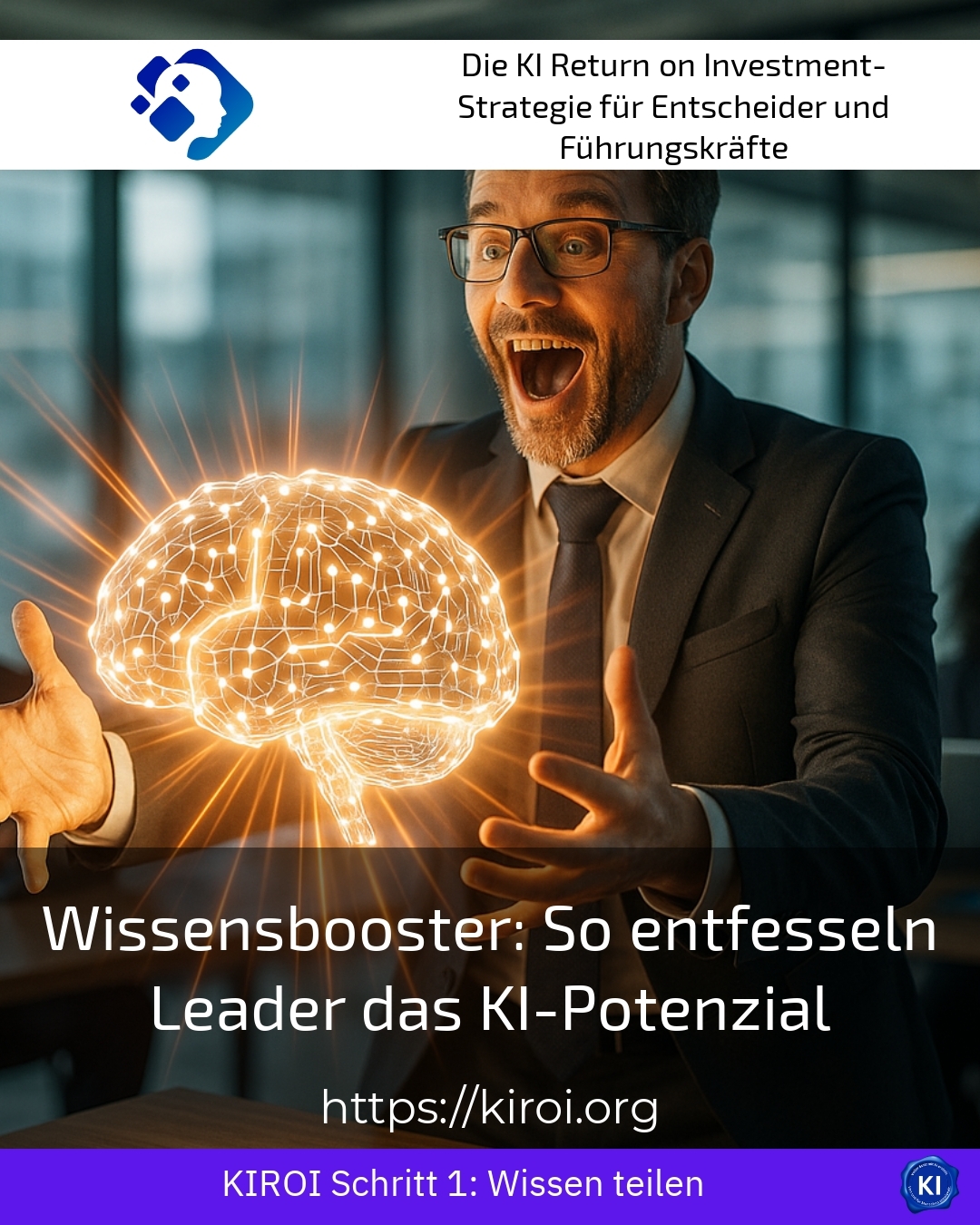
The answer rarely lies in the technology itself. Rather, there is a lack of a fundamental Knowledge booster, which empowers decision-makers to act strategically and with foresight. Because anyone wishing to successfully deploy intelligent technologies first needs a profound understanding of their own processes, corporate culture, and the specific challenges of their industry. Only then can leaders unleash the full potential of these transformative tools and generate sustainable competitive advantages. In this article, you will learn which concrete steps are necessary to gain this decisive knowledge advantage and position your organisation for the future.
Understanding the fundamental challenge of modern leadership
Today, leaders are facing a paradoxical situation. On the one hand, intelligent systems promise enormous efficiency gains and entirely new business models. On the other hand, many decision-makers report feeling overwhelmed and uncertain. The sheer volume of available tools and platforms makes it considerably harder to find one's bearings. Added to this is the enormous pressure to deliver results quickly.
A managing director of a medium-sized mechanical engineering company recently described his situation as „fog in the cockpit“. He had numerous production data at his disposal, but could not make sensible use of it. His engineers worked with state-of-the-art CAD systems, but the link to intelligent evaluation was missing. A sales manager in the financial services sector experienced a similar situation. She had access to extensive customer data, but could not derive precise predictions from it. And a logistics manager at a retail group was also struggling to integrate various data systems, even though all the information was theoretically available.
These examples illustrate a central problem. There is no shortage of technology or data. Rather, what is missing is the connecting knowledge that brings these elements together into a functioning whole. This is precisely where transruptions coaching comes in, supporting projects involving digital transformation. It assists leaders in recognising connections and making strategic decisions on a solid knowledge base.
The knowledge booster as the key to transformation
What distinguishes successful from less successful transformation projects? Clients frequently report that the decisive difference lies in the preparation. A targeted Knowledge booster enables leaders to ask the right questions. Because if you don't know what is possible, you can't ask for it specifically. And if you don't know the limits of the technology, you run the risk of developing unrealistic expectations.
This connection is particularly evident in the automotive industry. A head of development who understands the basic principles of machine learning is better equipped to lead his engineers. He knows which data are relevant for the predictive maintenance of production facilities. Likewise, he can assess what timeframe is realistic for implementation. In the healthcare sector, sound knowledge enables clinical managers to correctly classify the possibilities of diagnostic imaging. They understand why certain systems can provide support in diagnosis. At the same time, they recognise the limitations and the necessity of human expertise. In retail, on the other hand, purchasing managers with the corresponding background knowledge can better interpret demand forecasts and optimise ordering processes.
Best practice with a AIROI customer
A medium-sized company in the precision mechanics sector was faced with the challenge of modernising its quality assurance. The management had already launched several pilot projects, which, however, did not deliver the hoped-for results. As part of a transruptions coaching session, we first analysed the existing processes and identified knowledge gaps within the leadership team. It became apparent that while those responsible were technically proficient, they had little understanding of data-driven decision-making processes. We developed a bespoke training programme tailored to the specific needs of the company. The managers learned how to assess data quality and define relevant metrics. After six months of intensive support, the company successfully implemented an image recognition system for quality control. The scrap rate fell by more than twenty percent, and the employees actively supported the project because they understood the benefits. As the management confirmed afterwards, this success would not have been possible without the preceding knowledge building.
Knowledge booster for industry-specific applications
Every industry has its own challenges and potential. Therefore, effective knowledge development must always take the specific context into account. In the banking sector, for instance, it is often about risk modelling and fraud detection. Executives here require knowledge of statistical methods and regulatory requirements [1]. They need to understand how algorithms make decisions and where human control remains essential.
In the pharmaceutical industry, applications often focus on accelerating research processes. Laboratory managers and research directors benefit from knowledge of molecule simulations and drug predictions. They are then better able to assess which partnerships make sense and which internal competencies should be developed. In the energy sector, on the other hand, topics such as load forecasting and grid stability are to the fore. Technical directors who understand the fundamentals can make more informed decisions about investments in smart grids.
The construction industry also offers numerous application fields. Project managers are increasingly relying on digital twins and automated planning tools. A solid understanding of these technologies enables them to set realistic schedules and deploy resources more efficiently. In tourism, data-driven systems help with the personalisation of offers and dynamic pricing. Hotel managers who understand these principles can adapt their strategies accordingly.
Cultural transformation as a supporting process
Technological change rarely fails because of the technology alone. Much more frequently, cultural resistance and a lack of acceptance are the real hurdles. A Knowledge booster Therefore, leadership must also address this dimension. Leaders should understand how they can win over their teams for change. They need to take fears seriously while simultaneously generating enthusiasm.
An example from the media industry illustrates this aspect. A female editor-in-chief wanted to introduce intelligent tools for research and fact-checking. The editors initially reacted sceptically, fearing for their journalistic autonomy. It was only through intensive discussions and training that the benefits could be successfully conveyed. The tools now support research without replacing creative work. In the insurance industry, a board member experienced something similar when introducing automated claims handling. The clerical staff feared the loss of their jobs. However, through transparent communication and the creation of new, more demanding tasks, the transformation was successfully managed. In food production, too, a production manager initially encountered resistance when he wanted to introduce sensor-based quality controls. The experienced employees felt their expertise was being called into question. A cautious introduction focusing on the supporting function of the technology finally resolved these tensions.
Knowledge booster through structured learning paths
Effective learning requires structure and continuity. Sporadic workshops or one-off lectures are generally not enough. Instead, a systematic approach that combines different learning formats is recommended. For example, leaders can start with basic online courses that can be completed flexibly around their schedules [2]. These fundamentals are then deepened in interactive workshops where concrete use cases are discussed.
Practical projects, in which what has been learned is applied directly, are of particular value. A marketing director in the consumer goods industry reported that it was only through working on a real project that the interrelationships became fully clear to him. He had understood theoretically how recommendation systems work. However, it was only through practical implementation that he recognised the challenges involved in data preparation and integration. A human resources manager in the technology sector had a similar experience. She implemented a system to support the recruitment process and learned more in the process than in all previous training sessions combined. A purchasing manager in mechanical engineering also gained crucial insights through a pilot project on supplier analysis that permanently changed his strategic thinking.
Best practice with a AIROI customer
A retail company with several hundred branches wanted to optimise its inventory planning. Previous forecasts were based on simple statistical methods and regularly led to overstocking or stockouts. The management team had already selected a technology provider, but the project was not making progress. During transruptions coaching, it emerged that there were fundamental misunderstandings between the IT department and the purchasing department. Both sides used different terms for the same concepts and had different expectations of the project. We first conducted a joint training session that established a shared understanding. We then jointly defined clear goals and measurable success criteria. The management team learned to ask the right questions of the technology provider and to critically evaluate its proposals. Following implementation, the company was able to significantly reduce its inventory costs while simultaneously improving the availability of key products. The process took a total of eight months and was described by all participants as a learning journey that went far beyond the original project goal and culturally transformed the entire company.
Strategic partnerships and ecosystems
No company can build all competencies internally. Therefore, building knowledge also involves understanding strategic partnerships and ecosystems. Leaders should know when external expertise makes sense and how to evaluate it. They must critically review contracts with technology providers and formulate realistic expectations.
In the telecommunications industry, many companies collaborate with specialised start-ups. An innovation manager reported that only his in-depth expertise enabled him to identify promising partners. He was better able to assess the start-ups' technical presentations and ask substantive questions. In the healthcare sector, hospitals are increasingly cooperating with research institutions and technology companies. Hospital directors who understand the fundamentals can make such collaborations more productive and avoid pitfalls. In agriculture, too, new ecosystems are emerging comprising machinery manufacturers, data platforms and agricultural consultancies. Farm managers benefit from sound knowledge in order to navigate these complex relationships [3].
My AIROI Analysis
The experience from numerous transformation projects shows a clear pattern. Companies whose leaders invest in their own knowledge achieve more sustainable success when implementing intelligent systems. The Knowledge booster is not a one-off event, but a continuous process. It requires time, commitment and the willingness to question familiar thought patterns.
The results are particularly impressive when the acquisition of knowledge is combined with cultural transformation. Leaders who learn themselves and communicate this openly create a learning culture throughout the entire company. Employees feel encouraged to also try new things and ask questions. This is an essential prerequisite for successful transformations that go beyond individual projects.
Transruption coaching can effectively support this process. It provides impulses and structures that accelerate the acquisition of knowledge. At the same time, it takes into account individual starting points and industry-specific requirements. The combination of sound specialist knowledge and practical application has proven to be particularly effective. As a result, managers gain not only technical understanding, but also strategic competence for action. They are able to make informed decisions and safely guide their organisations through digital transformation.
Further links from the text above:
[1] BaFin on regulatory requirements for intelligent systems in the financial sector
[2] Coursera learning platform for data-driven methods
[3] DLG Information on Digitalisation in Agriculture
For more information and if you have any questions, please contact Contact us or read more blog posts on the topic Artificial intelligence here.








 Deutsch
  English (UK)