
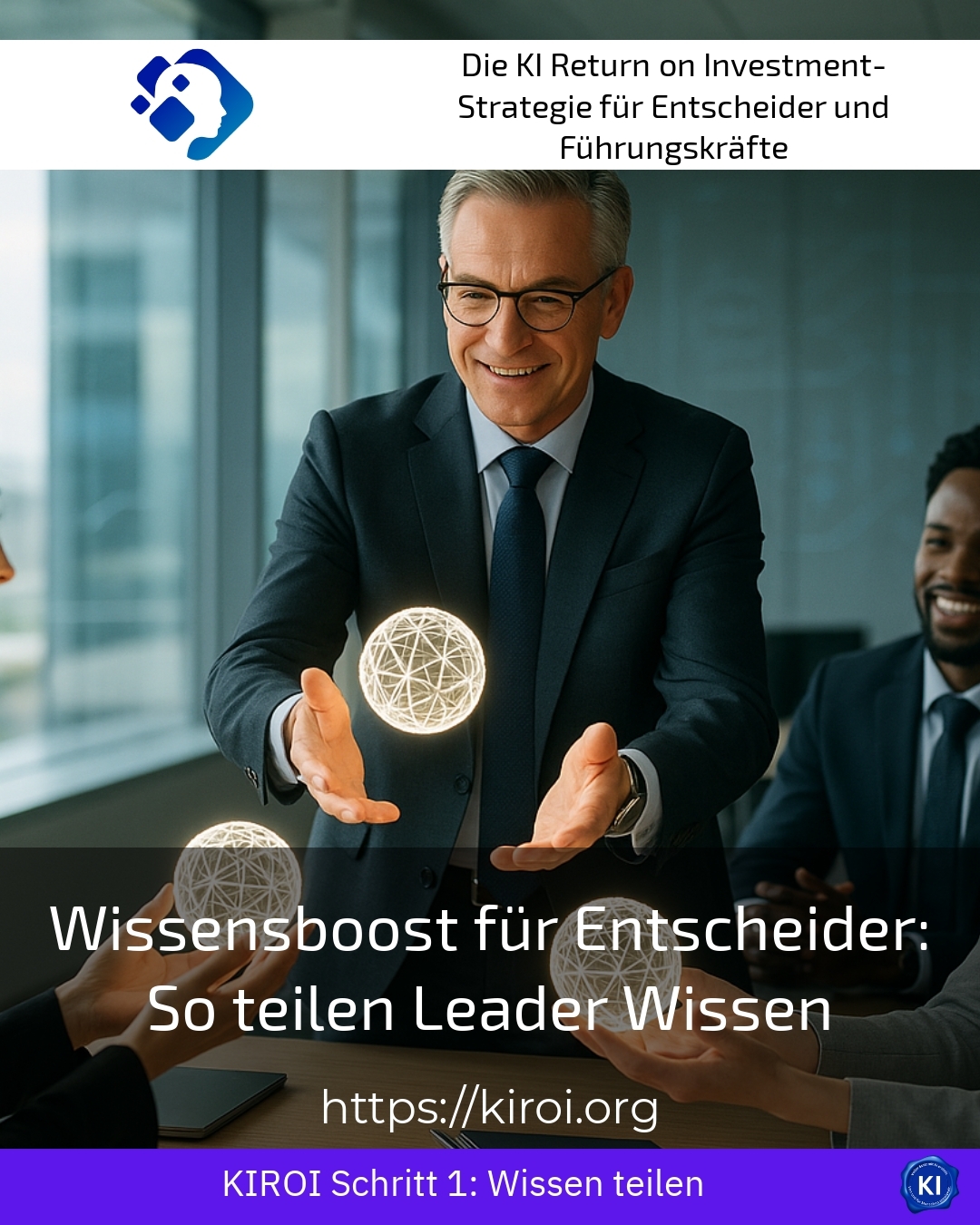
Imagine you could unleash the full potential of your leaders by perfecting a single skill. The Knowledge boost for decision-makers shows how leaders share knowledge while sustainably transforming organisations. In an era where information becomes obsolete faster than ever before, the ability to pass on knowledge in a structured way is becoming a decisive competitive advantage. Leaders who master this art create resilient teams and innovative cultures. This article reveals the mechanisms behind successful knowledge communication at the highest level.
Why strategic knowledge transfer has become essential for modern leaders
The dynamics of modern markets require decision-makers to fundamentally realign their communication strategies. Traditional hierarchies, in which information flowed strictly from top to bottom, have had their day. Instead, successful organisations are establishing multidirectional knowledge flows that permeate and enrich all levels. This is no longer just about the mere transmission of facts, but about creating a shared understanding of complex contexts [1].
We can observe this transformation particularly clearly in the technology sector. Software companies are implementing regular tech talks where senior leaders personally explain technical concepts. Cloud computing providers are hosting internal hackathons where executives work together with developers on solutions. Fintech start-ups are using transparent knowledge bases that all employees can access equally.
The financial sector has also recognised that exclusive knowledge silos belong to the past. Investment banks are training their managing directors in the art of structured storytelling. Insurance groups are establishing mentoring programmes that systematically transfer experiential knowledge to younger generations. Asset management companies are documenting decision-making processes in detail so that future leaders can learn from them.
Best practice with a AIROI customer
A medium-sized mechanical engineering company faced the challenge of securing the critical expertise of its departing executives. The management board recognised that more than forty percent of the management team would retire within the next five years. Together with transruptions-Coaching, the company developed a structured programme for knowledge preservation and transfer. First, we identified the critical knowledge areas that were indispensable for business success. We then conducted intensive interviews with the experienced executives to make implicit knowledge explicit. These insights were documented in a digital knowledge base and made accessible to successors. In addition, we established a tandem model in which experienced managers mentored their designated successors over a period of eighteen months. The result was impressive: the induction period for new managers was reduced by thirty-five percent. At the same time, employee satisfaction increased because knowledge was now more democratically accessible and no longer functioned as an instrument of power for individuals.
The knowledge boost for decision-makers: methods and techniques for effective knowledge transfer
Successful leaders use a wide repertoire of methods to pass on their insights. The choice of the right technique depends largely on the context, the target audience and the nature of the knowledge to be imparted. Fundamentally, we distinguish between explicit knowledge, which is easy to document, and implicit knowledge, which is anchored in experience and intuition [2].
In the healthcare sector, the concept of clinical case conferences has proved particularly effective. Chief physicians present complex treatment cases and explain their decision-making processes transparently. Nursing directors introduce regular reflection sessions in which teams learn from difficult situations. Hospital managers use simulation training to practice leadership decisions in crisis situations.
The retail sector is increasingly relying on digital learning platforms to impart knowledge. E-commerce companies are implementing micro-learning modules that train managers in short sessions. Store managers of large retail chains share best practices via internal social media channels. Purchasing managers document negotiation strategies in detailed guidelines for their successors.
The energy industry is experimenting with innovative formats for knowledge transfer. Utility company executives hold town hall meetings to explain strategic decisions. Renewable energy project managers use lessons-learned workshops after every completed project. Network managers create video tutorials in which they present complex technical concepts in an understandable way.
How leaders share knowledge through storytelling and narrative leadership
One of the most effective methods of knowledge transfer is structured storytelling. People remember stories much better than abstract data or facts. Leaders who frame their experiences in narrative forms significantly increase their listeners' receptiveness. This is not about entertainment, but about linking information with emotional anchors [3].
In the automotive industry, plant managers regularly use this technique. They recount past production problems and their solutions in the form of gripping stories. Sales directors describe formative customer encounters from which important lessons were drawn. Heads of development report on innovation breakthroughs and the detours that led there.
The logistics sector has also discovered storytelling as a leadership tool. Supply chain managers talk about crisis situations during global supply shortages. Warehouse managers share success stories about process optimisations that came about through employee ideas. Fleet managers report on unexpected challenges and creative problem-solving in day-to-day operations.
Best practice with a AIROI customer
An international pharmaceutical company commissioned transruptions-Coaching to develop a narrative leadership culture. The challenge was that leaders from different countries maintained diverse communication styles and often did not pass on knowledge systematically. We began with workshops in which we taught the fundamentals of business storytelling. The participants learned to transform personal experiences into structured narratives that inspire and inform others. Of particular importance was the development of a shared narrative about the corporate culture and its associated values. The leaders documented their most formative professional experiences in a digital story archive. This archive became a valuable resource for onboarding processes and leadership development. New managers were able to get a picture of the corporate culture using authentic stories. Furthermore, the regular storytelling sessions fostered informal exchange between different hierarchical levels. The company frequently reports a noticeably improved communication culture since the introduction of the programme.
Digital tools as catalysts for the knowledge boost of modern leaders
Digitalisation has revolutionised and expanded the possibilities for passing on knowledge. Modern technologies make it possible to share expertise across spatial and temporal boundaries. In the process, new formats and channels are emerging that can usefully complement and in some cases replace traditional methods. The art lies in selecting the right tools for the respective purpose [4].
The media sector is experimenting intensively with new digital formats. Publishing directors are producing internal podcasts in which they discuss strategic topics. Editors-in-chief use video blogs to explain editorial decisions transparently. Executives in advertising agencies rely on digital whiteboards for collaborative creative sessions.
These technologies are also being used intensively in the education sector. University rectors are introducing virtual office hours for staff at all levels. Headteachers are sharing best practices via educational learning platforms. Continuing education providers are documenting expert knowledge in interactive online courses for their own management teams.
The tourism sector uses digital tools for knowledge transfer in a variety of ways. Hotel managers create video tutorials on service excellence standards. Tour operators maintain comprehensive knowledge databases on destinations and customer expectations. Airlines implement gamified learning platforms for their leadership development.
Artificial intelligence as support for sharing leadership knowledge
The integration of Artificial intelligence in knowledge management systems opens up completely new possibilities. Intelligent algorithms can deliver relevant knowledge to the right people at the right time. Chatbots answer standard questions and relieve managers of repetitive explanation tasks. Analytical tools identify knowledge gaps and suggest targeted learning measures [5].
In the chemical industry, it supports Artificial intelligence the sharing of knowledge in an innovative way. Research leaders use AI-powered systems to document complex experiments. Production managers rely on intelligent assistants that retrieve experiential knowledge in a context-aware manner. Safety officers implement systems that learn from past incidents and provide preventive advice.
The real estate sector is also discovering the potential of intelligent knowledge systems. Property developers are using AI tools to analyse past construction projects and their success factors. Facility managers are implementing predictive systems based on empirical data. Estate agency firms are relying on intelligent matching algorithms for knowledge transfer between experienced and new consultants.
Best practice with a AIROI customer
An industrial automation technology group approached transruptions-Coaching with a complex challenge. The company possessed enormous expert knowledge, which was, however, hidden within isolated departments and the minds of individual specialists. Together, we developed a strategy for the systematic capture and distribution of this valuable knowledge. We began by analysing existing knowledge flows and identified critical bottlenecks. Subsequently, we implemented an AI-supported knowledge management system that intelligently links and suggests relevant information. Managers were trained to input their expertise into the system in a structured format. The function that automatically suggests similar past problems when new challenges arise proved to be particularly valuable. The system learns continuously from interactions and becomes increasingly precise in its recommendations over time. The implementation led to a measurable reduction in problem-solving times and a higher rate of innovation. Clients frequently report a new culture of openness and shared learning.
Cultural prerequisites for sustainable knowledge transfer in organisations
Technology and methods alone do not guarantee successful knowledge transfer. The crucial foundation is an organisational culture that promotes and rewards the sharing of knowledge. In many companies, however, structures that encourage the hoarding of information still exist because an informational advantage is perceived as a personal benefit. Transforming this culture requires conscious efforts at all levels [6].
The consultancy sector has explored this cultural dimension intensively. Partners at large consulting firms lead by example and share their methods openly. Junior consultants are encouraged to ask critical questions of experienced colleagues as well. Knowledge sharing is explicitly factored into appraisal and promotion criteria.
New forms of knowledge culture are emerging in the food industry. Product developers document failed recipe variants just as carefully as successful innovations. Quality managers introduce open error discussions that are free from apportioning blame. Purchasing managers share negotiation experiences in regular peer learning groups.
The telecommunications industry is working intensively on cultural change. Leaders are being appointed as knowledge ambassadors who actively promote exchange. Transparent information portals are replacing closed email distribution lists and exclusive meetings. Regular cross-departmental knowledge sharing is being established as a fixed part of the working day.
Psychological safety as the foundation of the knowledge boost for decision-makers
Without psychological safety, knowledge transfer remains superficial and incomplete. Employees must be able to trust that admitting ignorance will have no negative consequences. Managers play a central role in creating this space of trust. They must demonstrate vulnerability themselves and make their own learning processes transparent [7].
In the aviation industry, psychological safety has been a central topic for decades. Pilots openly report their own mistakes in standardised reporting systems. Technicians are encouraged to document even unusual observations. The concept of a just culture has established itself as a model for other industries.
Banking is increasingly implementing similar principles. Risk managers are promoting a culture where concerns can be raised without fear of retaliation. Compliance departments are creating anonymous channels for sharing sensitive information. Leaders are being trained to respond to mistakes with curiosity rather than criticism.
The construction industry is also recognising the importance of psychological safety. Site managers are introducing safety briefings in which near misses are openly discussed. Architects are sharing design errors from past projects as valuable learning opportunities. Project controllers are establishing retrospectives in which teams learn together from experience.
My AIROI Analysis
The intensive examination of the subject of strategic knowledge transfer in executive suites reveals fundamental changes in the way modern organisations function and thrive. In my assessment, we are only at the beginning of a profound transformation that will fundamentally redefine the relationship between leadership and knowledge. The traditional notion that power is based on exclusive access to information is giving way to a new logic in which influence arises from the ability to multiply knowledge. Leaders who sleep through this development will lose relevance in the medium term, while those who actively shape it will be able to lead their organisations into a successful future.
The analysis clearly shows that technological solutions alone are not enough to establish sustainable knowledge transfer. Rather, the decisive factor is the combination of suitable tools, well-thought-out processes and, above all, a supportive culture. Support through transruptions coaching can help organisations to align all three dimensions with one another and exploit synergies. The external perspective proves particularly valuable in this regard, uncovering blind spots and providing new impetus. The practical examples presented show that measurable successes are possible when companies take a systematic approach. The Knowledge boost for decision-makers is not a one-off measure, but a continuous process that requires attention and resources. However, the investment is worthwhile, because knowledge-sharing leaders create more resilient, innovative and ultimately more successful organisations. The future belongs to those who have understood that shared knowledge is multiplied knowledge.
Further links from the text above:
[1] Harvard Business Review – Knowledge Management
[2] McKinsey – The Organisation Blog
[3] Forbes – Leadership Insights
[4] MIT Sloan Management Review – Knowledge Sharing
[5] Gartner – Knowledge Management Research
[6] SHRM – Creating a Knowledge Sharing Culture
[7] Amy Edmondson – Psychological Safety
For more information and if you have any questions, please contact Contact us or read more blog posts on the topic Artificial intelligence here.









 Deutsch
 English (UK)