
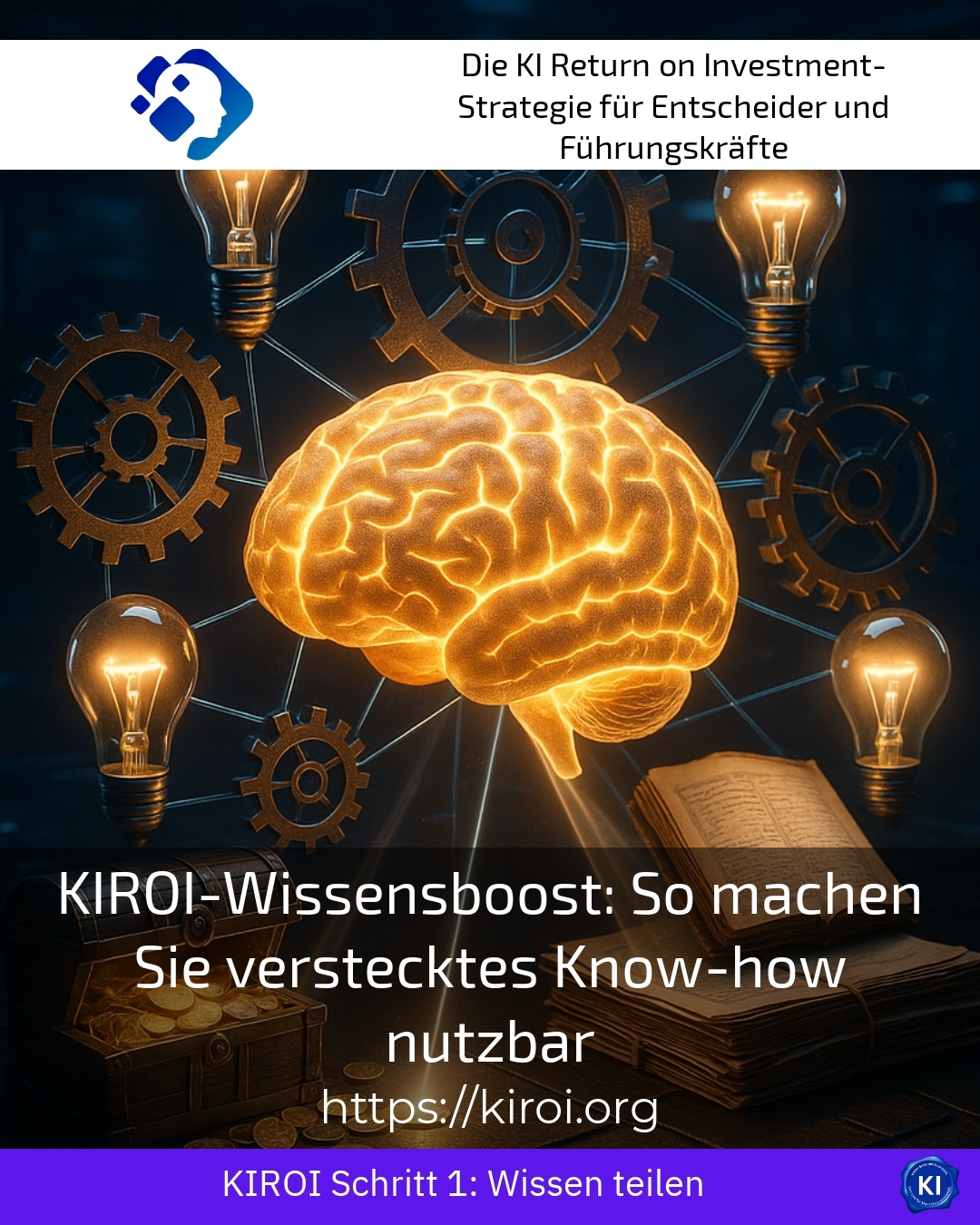
Have you ever wondered why some companies seem to effortlessly generate innovations while others, despite highly skilled teams, stagnate? The answer often lies in a phenomenon that many executives underestimate: the invisible treasure trove of knowledge that resides in the minds of employees. AIROI Knowledge Boost offers a systematic approach to identify, structure, and leverage this hidden know-how for the entire organization. In a time when experiential knowledge is increasingly lost due to fluctuation and demographic change, the ability to transform knowledge becomes the decisive competitive advantage.
Why hidden knowledge is the biggest risk
In almost every company, there exists an invisible layer of knowledge that is not recorded in any database. Experienced professionals carry with them decades of accumulated practical knowledge. This knowledge manifests itself in small gestures, intuitive decisions, and proven problem-solving strategies. When these people leave the company, a painful gap often arises. New colleagues have to repeat mistakes that were long ago resolved. Processes that once functioned smoothly suddenly become stalled. For example, a medium-sized engineering company reported that an experienced toolmaker had left, whose departure increased the rejection rate by twenty percent. No one had documented his implicit knowledge about the optimal setting of the CNC milling machines. A car supplier experienced a similar situation when the long-time quality manager retired. The complaint rate increased significantly within a few months. Situations like these illustrate just how important structured knowledge transfer really is.
AIROI The knowledge boost as a strategic method
The AIROI Knowledge Boost It pursues a holistic approach to knowledge activation. This involves more than just the technical capture of information. Rather, the focus is on transforming implicit knowledge into explicit knowledge. This process requires both technological support and cultural changes. Companies must first understand where their hidden knowledge actually resides. Subsequently, suitable methods for externalization can be developed. For example, a chemical company relied on structured interviews with experienced laboratory managers. The insights gained were translated into interactive learning modules. A logistics service provider developed a mentoring program in which route experts passed on their knowledge to junior staff. The results were impressive: shorter onboarding times and fewer errors in route planning. Examples like these show how systematic knowledge transfer brings tangible benefits.
Best practice with a AIROI customer
A medium-sized company in the industrial manufacturing sector faced a significant challenge, as almost thirty percent of its experienced production employees would retire within three years. The management recognized early on that without targeted measures, a massive loss of knowledge was imminent. As part of a transruptive coaching project, a comprehensive knowledge map was initially created. This identified critical knowledge areas and their holders within the company. Subsequently, the team conducted structured knowledge surveys in which experienced professionals shared their expertise in moderated sessions. The combination of narrative interviews and practical demonstrations proved particularly valuable. The knowledge gained was translated into an internal knowledge platform that new employees can consult at any time. In addition, short video tutorials were created in which experienced colleagues explained complex hand-holding techniques. After eighteen months, the company reported a forty percent reduction in the onboarding time for new production employees. The error rate for critical manufacturing steps also decreased significantly. The project illustrated how important early engagement with knowledge management is in reality.
Technological tools for AIROI the knowledge boost
Modern technologies support knowledge transfer in many ways. Intelligent systems can, for example, recognize patterns in communication data. They identify which employees are frequently asked for advice. This indicates hidden knowledge sources that do not appear in any organizational chart. A pharmaceutical company used appropriate analytical tools to track hidden experts. The results significantly surprised management. An inconspicuous laboratory assistant turned out to be a central point of contact for complex analysis questions. His knowledge was subsequently systematically recorded and shared. An energy provider relied on an intelligent knowledge database with semantic search. Employees can there ask questions in natural language. The system provides appropriate answers from the entire corporate database. Additionally, it suggests relevant experts who can further assist with more complex topics. Such technologies make the AIROI Knowledge Boost especially effective.
Cultural prerequisites for sustainable knowledge transfer
Technology alone is not enough for successful knowledge management. The corporate culture must actively encourage and reward the exchange of knowledge. However, in many organizations, knowledge is understood as a means of power. Those who know a lot enjoy a certain protection against obsolescence. This attitude prevents the open exchange of knowledge and harms the company in the long run. An insurance company recognized this problem and responded with cultural measures. It introduced an incentive system that explicitly rewarded the sharing of knowledge. Employees received recognition for shared insights and answered questions. A construction company established regular knowledge breakfasts where teams exchanged experiences. The informal atmosphere lowered barriers and fostered dialogue. A telecommunications provider created the role of the knowledge coach, who supported departments in externalizing knowledge. These cultural measures often prove crucial for sustainable success.
Practical steps for implementation
Implementing systematic knowledge management requires a structured approach. First, the company should conduct an inventory of existing knowledge. In doing so, critical knowledge areas that are particularly relevant to business success are identified. Next, knowledge carriers are assigned to these areas. An industrial company in the plant construction sector began by analyzing its core processes. For each process, the key knowledge areas were defined. A food manufacturer relied on knowledge audits in its production facilities. This revealed discrepancies between documented and actually used knowledge. A financial services provider developed a competency matrix that captures the knowledge profiles of all employees. This enables the targeted search for expertise for specific questions. Transruptions coaching accompanies companies through these steps and provides valuable insights for implementation.
Best practice with a AIROI customer
An international technology company faced the challenge of sharing knowledge about complex software systems across different locations. The previous documentation was incomplete and often outdated, which led to new project members needing long onboarding periods. As part of the support, a multi-stage concept was developed that encompassed both technical and organizational components. First, the company established a wiki system with clear structure guidelines and responsibilities. Each project team had to appoint a knowledge officer who maintained the documentation. Additionally, the company introduced monthly knowledge-sharing sessions where teams presented their findings. These were recorded and archived in a video library. A particularly innovative approach was the introduction of knowledge sprints, where teams specifically worked on specific knowledge areas. After a year, project managers reported a significantly improved knowledge transparency across locations. The onboarding time for new developers was reduced by about a third, because relevant information was now more easily accessible.
Challenges and solutions for AIROI boosting knowledge
The hidden knowledge activation brings typical challenges. Many companies fail because they lack the time for knowledge transfer. Operational tasks often take priority over long-term knowledge projects. A trading company solved this problem by setting fixed knowledge times. Every Friday afternoon, teams dedicated themselves exclusively to knowledge exchange. An advertising agency integrated knowledge moments into their regular project closures. Each completed project ended with a structured lessons-learned session. An engineering office established the principle of knowledge standing, in which experienced employees mentored younger ones. These tandems worked together on real projects and continuously exchanged knowledge. The time investment paid off in higher efficiency and fewer errors. Clients and customers often report initial resistance that dissolves through visible successes.
Measurement and continuous improvement
Successful knowledge management also requires appropriate metrics and regular review. Companies should define which metrics can measure knowledge success. An electronics manufacturer, for example, measures access rates to its knowledge database. In addition, it records the speed of resolution for technical problems. A consulting firm evaluates how often shared insights are reused in new projects. An automotive manufacturer conducts regular knowledge surveys that reveal gaps and areas for improvement. These measurements enable continuous optimization of knowledge strategies. AIROI Knowledge Boost Therefore, it also includes tools for measuring success and for further development.
My AIROI Analysis
The exploration of hidden corporate knowledge vividly illustrates the untapped potential lurking in many organizations. The systematic extraction of this knowledge requires a combination of technological tools, cultural changes, and strategic approaches. What is particularly remarkable to me is the realization that mere documentation is not enough. The lively exchange between people remains central to successful knowledge transfer. Companies that act early gain significant competitive advantages. They shorten onboarding times, avoid costly mistakes, and foster innovation through combined knowledge. The accompanying support provided by experienced coaches helps overcome typical stumbling blocks. This is not about quick solutions, but about sustainable change. Demographic change makes the issue increasingly urgent for almost all industries [1]. Anyone who starts today with structured knowledge transfer will secure the ability to act tomorrow. The examples presented illustrate that practical success is possible and measurable. The key remains the willingness to understand and maintain knowledge as a shared asset.
Further links from the text above:
[1] McKinsey – Knowledge management and organizational performance
For more information and if you have any questions, please contact Contact us or read more blog posts on the topic Artificial intelligence here.








 Deutsch
 English (UK)