
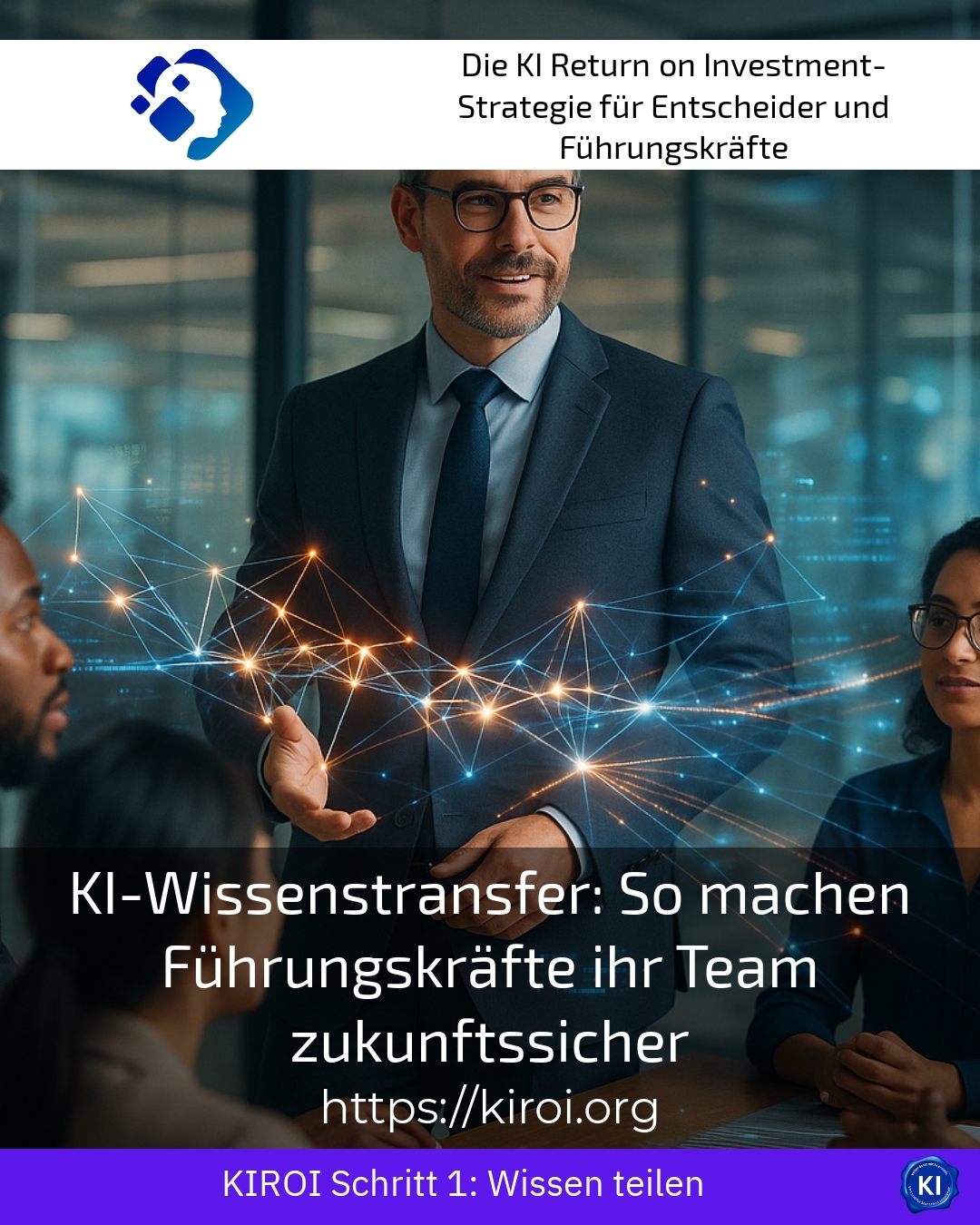
The digital transformation is fundamentally changing companies and presenting leaders with new challenges. AI knowledge transfer developing into a crucial success factor for future-proof organisations. Teams that do not systematically build competencies in dealing with intelligent systems today will lose out tomorrow. But how can leaders take their employees on this journey? Which concrete strategies are proving effective in practice? And why do so many initiatives fail, even though the necessity has long been recognised? This article shows you practically proven ways, as a leader, to successfully guide your team into the future.
The strategic importance of AI knowledge transfer in modern organisations
In almost all industries, artificial intelligence is fundamentally changing the way we work. Leaders therefore face the demanding task of systematically imparting knowledge. This is not just about technical skills. Rather, teams must develop a deep understanding of new ways of working. Many companies underestimate the time required for this transformation. They focus on technology and forget about the people.
For instance, in the financial sector, banks employ intelligent systems for fraud detection. Employees need to understand how these algorithms make decisions. Only then can they correctly interpret and contextualise the results. In healthcare, intelligent assistants support the diagnosis of complex clinical pictures. Doctors and nurses require solid knowledge to use these tools effectively [1]. In the retail sector too, automated recommendation systems are completely revolutionising the customer experience.
The challenge lies in taking into account the different levels of knowledge within the team. Some employees bring prior technical knowledge with them. Others meet new technologies with scepticism or even fear. Leaders must understand this heterogeneity as an opportunity. They can use experienced team members as multipliers. At the same time, they should create safe learning environments where mistakes are permitted. This fosters a culture of continuous learning.
Best practice with a AIROI customer
A medium-sized insurance company faced the challenge of qualifying its team of approximately two hundred employees to handle intelligent claims processing systems. Management recognised early on that a simple training measure would not be sufficient. As part of a transruption coaching support programme, we jointly developed a multi-stage concept that combined individual learning paths with collective spaces for experience. First, we identified so-called pioneers within the company who were particularly open to new technologies. These individuals received intensive basic training and were subsequently employed as internal mentors. In parallel, we introduced regular reflection sessions where the entire team could exchange experiences. The establishment of a digital experimentation room, where employees could try out new functions without performance pressure, proved particularly effective. After about six months, acceptance of the new systems had significantly increased. Processing times for standard cases decreased by more than thirty percent. At the same time, employees reported increased confidence in using digital tools. This project impressively demonstrates how well-thought-out knowledge transfer can bring about sustainable change.
Practical approaches to effective AI knowledge transfer in leadership everyday life
Successful knowledge transfer always begins with the leadership itself. Only those who understand the basics of intelligent systems can credibly guide others. This doesn't mean leaders need to become programmers. Rather, it's about a conceptual understanding of the underlying mechanisms. How do algorithms make decisions? What data do they need for that? Where are the limits of automated processes?
In the logistics sector, intelligent systems optimise complex supply chains in real-time. Managers need to be able to explain to their teams why specific route suggestions are made. In mechanical engineering, networked sensors predict maintenance requirements with high accuracy. Technicians require background knowledge to be able to interpret these predictions [2]. In the media sector, intelligent assistants create initial text drafts for news articles. Journalists need to understand how they can meaningfully develop these drafts further.
One proven approach is so-called reverse mentoring. In this process, younger, digitally affine team members pass on their knowledge to more experienced colleagues. These, in turn, share their industry expertise and process knowledge. This creates a reciprocal learning process from which all participants benefit. Hierarchy takes a back seat. Instead, the focus is on shared knowledge acquisition.
Designing AI knowledge transfer through structured learning formats
Teams also need structured learning opportunities alongside informal exchange formats. Various approaches have proven effective in practice. Microlearning, for example, enables employees to acquire new knowledge in short units. Five to ten minutes daily are often sufficient. These compact learning snacks can be easily integrated into daily work routines.
In the automotive industry, manufacturers train their workshop employees with interactive simulations. This allows them to get to know complex diagnostic systems without risk. In the energy sector, network operators train their teams to handle intelligent load management systems. Virtual scenarios prepare them for critical situations. In the hotel industry, receptionists practice using intelligent booking systems with case studies.
The key here is the combination of theory and practice. Abstract knowledge alone rarely leads to sustainable behavioural changes. Only when employees can directly apply new insights do they become permanently embedded. Therefore, leaders should regularly create opportunities for teams to try out what they have learned. Mistakes are also allowed to happen. They are often the most effective teachers.
Best practice with a AIROI customer
A pharmaceutical company with international operations wanted to qualify its research department for the use of intelligent analysis systems. The particular challenge lay in the high level of technical specialisation of the scientists involved. They possessed in-depth domain knowledge but were partly sceptical of automated analysis methods. As part of the transruption coaching support, we developed a tailor-made transfer concept that took the existing expertise as its starting point. We initially organised dialogue rounds between the researchers and external experts in machine learning. It became apparent that many concerns were based on misunderstandings. The scientists feared that their expertise might be devalued. Through targeted clarification, we were able to largely allay these concerns. In a second step, we set up so-called experiment teams, which tackled concrete research questions with the support of intelligent systems. The results were regularly presented and discussed in plenary sessions. After about eight months, the initial scepticism had transformed into productive curiosity. Several research projects were significantly accelerated by the use of new analysis methods. The company reported a perceptibly increased innovative strength.
Creating cultural prerequisites for sustainable knowledge transfer
Technical qualifications alone do not guarantee successful change. At least as important is an organisational culture that fosters and demands continuous learning. Leaders decisively shape this culture through their own behaviour. When they themselves embody curiosity and a willingness to learn, this is contagious for the entire team.
In the telecommunications sector, leading providers are relying on so-called innovation labs. These allow employees to test new technologies in a protected environment. In the food industry, quality managers use intelligent systems for process control. They are encouraged to contribute unconventional application ideas as well [3]. In the education sector, teachers are experimenting with adaptive learning systems that individually adjust to pupils.
An open error culture is indispensable in this regard. Teams must know that experiments are also allowed to fail. The most valuable insights often arise from failures. Leaders should therefore regularly talk about their own mistakes and learnings. This signals that perfection is not a prerequisite for commitment. Instead, the willingness to venture into new territory counts.
Constructively address resistance and embed KI knowledge transfer sustainably
Not all employees greet changes with enthusiasm. Some fear job losses. Others feel overwhelmed by the speed of change. Still others fundamentally doubt the benefits of new technologies. These resistances are normal and understandable. They deserve serious consideration.
In the banking sector, experienced advisors are concerned about their role in the age of automated investment recommendations. In tax consulting, staff are wondering what tasks will remain for them in the future. In the legal profession, lawyers are observing with mixed feelings how intelligent systems are accelerating legal research.
The key lies in honest communication. Leaders should talk openly about upcoming changes. They must not make false promises. At the same time, they can highlight the new opportunities that arise. Clients often report that their concerns significantly decrease after intensive discussion. Support from experienced coaches can provide valuable impetus.
In practice, it's evident that employees who are involved in change processes from an early stage develop less resistance. They feel taken seriously and can actively contribute to shaping the changes. Participation formats such as future workshops or design thinking sessions support this process. This often leads to innovative ideas that management might not have come up with on their own.
My AIROI Analysis
The systematic transfer of knowledge about intelligent systems is developing into the core competence of future-proof organisations. Leaders who actively shape this process give their teams a crucial competitive advantage. This goes far beyond technical training. Instead, companies must develop a holistic learning culture that fosters curiosity and takes fears seriously.
From my consulting experience, I know that successful knowledge transfer always begins with people. Technology is merely a tool. What's crucial is how employees use and develop this tool. Leaders play a central mediating role in this. They translate strategic objectives into concrete recommendations for action. They create safe spaces for experimentation. And they provide their teams with direction in uncertain times.
The examples presented from various industries show that there is no one-size-fits-all solution. Every organisation must find its own way. External support, such as transruption coaching, can offer valuable assistance in this regard. It brings in external perspectives and helps to recognise blind spots. At the same time, it sustainably strengthens internal change management expertise.
Looking ahead, the demand for systematic knowledge transfer is set to increase further. Intelligent systems are developing rapidly. What is considered cutting-edge technology today could be standard tomorrow. Organisations must therefore learn to learn continuously. Leaders have the task of enabling and supporting this process. Those who take on this challenge will successfully lead their team into the future.
Further links from the text above:
[1] McKinsey – The economic potential of generative AI
[2] PwC Germany – Artificial Intelligence in Business
[3] Harvard Business Review – Artificial Intelligence Research and Insights
For more information and if you have any questions, please contact Contact us or read more blog posts on the topic Artificial intelligence here.








 Deutsch
  English (UK)