
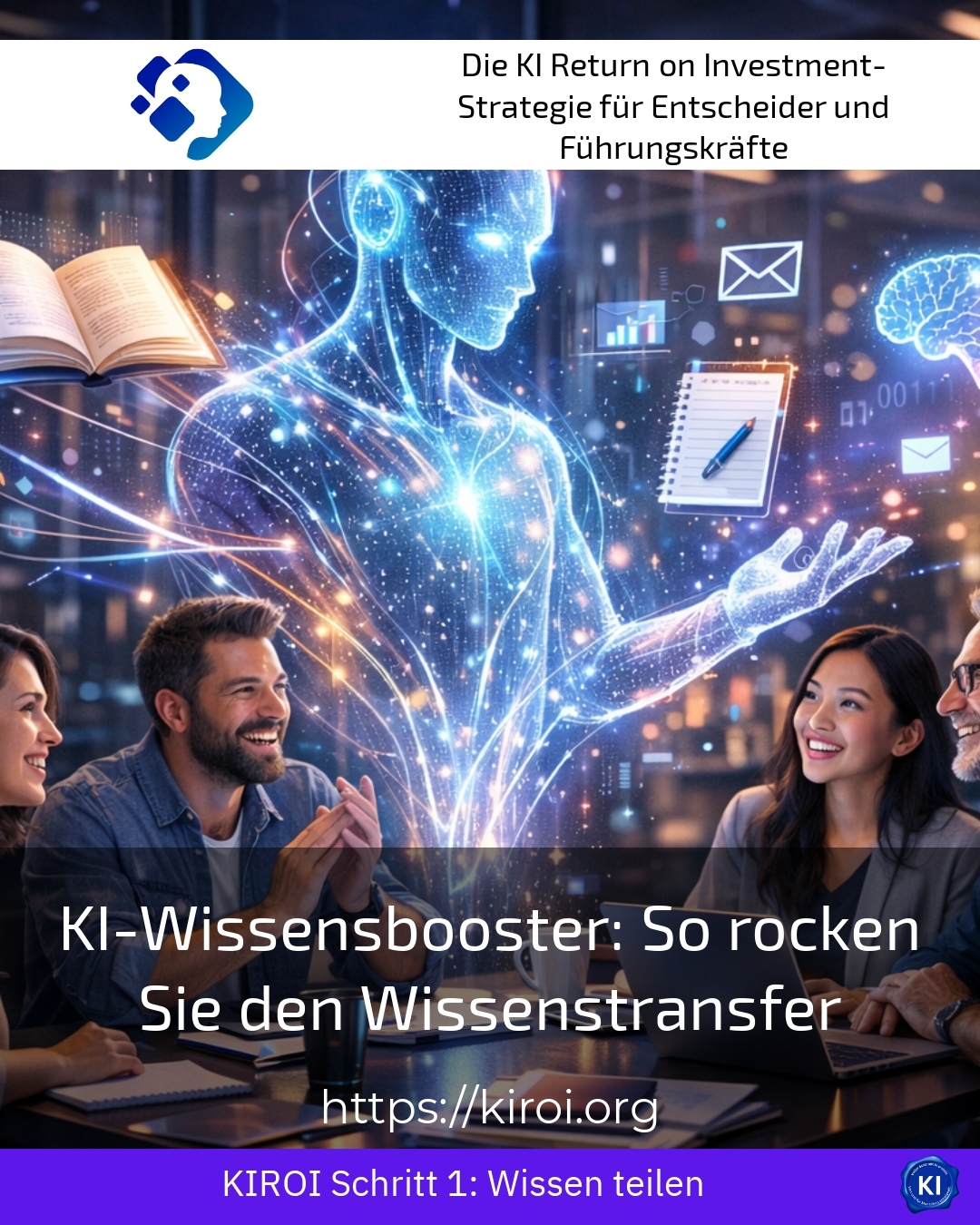
Have you ever wondered why some companies seemingly effortlessly retain all their expert knowledge, while others, upon the departure of key employees, are left in a veritable knowledge gap? This question concerns executives in almost every industry, and the answer often lies in a well-thought-out AI Knowledge Booster, which revolutionizes the transfer of experiences, insights, and best practices. In a time when information grows exponentially and at the same time ages faster than ever before, organizations face the enormous challenge of not only storing valuable know-how but also making it intelligently accessible. transruptions coaching accompanies companies in implementing these complex transformation projects strategically and sustainably.
The invisible knowledge gap in modern organizations
Many companies systematically underestimate the value of the implicit knowledge of their employees. Experienced professionals carry with them decades of accumulated expert knowledge. This knowledge is often undocumented. It exists in the form of intuition and experience. When these people retire, they leave irreplaceable skills behind. For example, a manufacturing company lost critical knowledge about machine settings. The long-time technician had all the details memorized. After his departure, the defect rates increased significantly.
Another example is evident in the area of customer support. Sales representatives often know their customers’ informal preferences intimately. This information is rarely available in CRM systems. New colleagues have to start from scratch. This costs time and harms the customer relationship in a lasting way. In healthcare, meanwhile, experienced caregivers rarely document their observation techniques. Young colleagues only learn about them after years. Patient care suffers significantly from this inefficient transfer process.
Best practice with a AIROI customer
A medium-sized mechanical engineering company with about three hundred employees faced a critical situation because about fifteen experienced designers would retire within two years. The management recognized early on that these experts possessed decades of accumulated specialized knowledge that was not systematically recorded anywhere. As part of a transruptive coaching project, we jointly developed a strategy for intelligent knowledge capture. The designers conducted structured conversations with intelligent systems that converted their experiences into usable formats. The capture of problem-solving strategies, which were used in the face of unusual customer requirements, proved particularly valuable. The system learned to identify typical error sources and generate preventive solution suggestions. After about eight months, the company had a dynamic knowledge database that actively supported new employees. According to the company, the onboarding time was reduced by about forty percent. At the same time, the experienced colleagues reported that the documentation process helped them better structure their own knowledge.
The AI knowledge booster as a strategic instrument
Intelligent systems can now answer far more than simple search queries. They understand relationships and recognize patterns in complex data sets. AI Knowledge Booster It acts as a dynamic mediator between existing knowledge and current issues. It continuously adapts to new information. In the financial sector, banks use such systems to analyze regulatory changes. Compliance departments receive context-specific interpretation aids. This significantly reduces error rates and significantly speeds up decision-making processes.
In the logistics industry, intelligent assistants support route planning. They take into account the experience of experienced dispatchers. Weather conditions, traffic patterns, and customer-specific time windows are automatically factored in. The result is optimized routes with fewer empty runs. In retail, on the other hand, such systems help with assortment planning. They analyze purchasing behavior and regional preferences simultaneously. Store managers receive informed recommendations for local adjustments as a result. These examples clearly demonstrate the wide applicability of modern knowledge transfer technologies.
How AI knowledge booster transforms learning processes
Traditional training follows a rigid scheme without individual customization. All participants receive the same content at the same pace. Intelligent systems, on the other hand, enable personalized learning paths. They detect knowledge gaps and adapt content accordingly. For example, an insurance company introduced adaptive training modules. New employees learned complex claims settlement procedures faster and more effectively. According to company reports, the error rates in processing decreased significantly.
Interesting application possibilities are also being demonstrated in the trade sector. Trainees can virtually simulate complex repair processes. The system provides context-based feedback. Master companies often report increased training quality. In the hospitality industry, such solutions support the onboarding of new service staff. They not only provide facts but also behavioral recommendations for various situations. Guests benefit from consistently high-quality service.
Best practice with a AIROI customer
A large tax consulting firm with multiple locations struggled with a typical problem of knowledge transfer: the uneven distribution of specialized knowledge among individual partners and employees. Clients with complex international structures were always referred to the same few experts, which led to bottlenecks and overload. transruptions coaching accompanied the firm in implementing an intelligent knowledge management system that analyzed tax case documentation and developed learning-based decision-making tools. The system systematically captured precedents, arguments, and government decisions. This provided younger colleagues with access to experience that previously existed only in the minds of senior partners. Particularly impressive was the development of an interactive question-and-answer system that suggested relevant previous cases and solution approaches for complex matters. According to the firm, the processing times for international tax matters were significantly shortened. At the same time, client satisfaction increased, as competent advice was also provided when the main contact person was absent.
Mastering implementation challenges
The introduction of intelligent knowledge transfer systems rarely stems from the technology itself. More often, organizational and cultural barriers are the real stumbling blocks. Employees sometimes fear that documentation of their knowledge will make them obsolete. This concern must be taken seriously and addressed. Successful projects therefore rely on transparent communication from the outset. They clearly and explicitly emphasize the added value for all involved parties.
A pharmaceutical company initially faced resistance in the acquisition of knowledge. Experienced laboratory managers saw their expertise at risk. It was only when management clarified that the system was intended to facilitate work that the mood changed. In construction, similar patterns were observed in project documentation. Project managers perceived additional recording tasks as a burden. The solution lay in spoken-language-based systems that enabled documentation during work. In the healthcare sector, on the other hand, the emphasis on patient benefit significantly helped increase acceptance.
Technical integration with existing systems
Many organizations already have various software solutions for different purposes. ERP systems, document management, and communication tools often form a heterogeneous ecosystem. An effective AI Knowledge Booster must take into account these existing structures [1]. It should be able to intelligently link existing data sources. In the automotive supplier sector, the value of such integration was particularly evident. Quality data from production was linked with design knowledge. This enabled preventive problem detection even before serial errors occurred.
An energy provider systematically integrated maintenance protocols with expert knowledge. The system learned to recognize critical conditions early and generate actionable recommendations [2]. Interesting applications are also being seen in the field of public administration. Case workers receive contextualized guidance on relevant regulations and precedents. Processing quality improves while training costs tend to decrease. These examples vividly illustrate the potential of thoughtful integration strategies.
Measurable successes and realistic expectations
The effectiveness of knowledge transfer initiatives can certainly be quantified. However, this requires a well-thought-out system of indicators from the very beginning. Onboarding times, error rates, and employee satisfaction are typical indicators. For example, a chemical company documented the time it took to independently operate complex systems. After introducing the intelligent support system, this phase was significantly shortened, according to the company. At the same time, the number of operating errors in the onboarding phase decreased significantly.
In the field of business consulting, law firms often measure the re-use rate of project experiences. Intelligent systems typically significantly increase this rate [3]. This reduces redundant work and increases the profitability of projects. In retail, on the other hand, success can be measured by the speed of new store openings. When knowledge is systematically transferred, new locations achieve their target performance more quickly. These measurable successes often justify the initial investment in modern knowledge transfer solutions.
Best practice with a AIROI customer
An internationally operating engineering firm specializing in bridge construction faced the challenge of preserving the knowledge of its most experienced structural engineers while simultaneously making it available for projects in different countries. The previous practice of personal mentoring reached its limits due to the global expansion, as the experts could not be present in multiple locations simultaneously. As part of transruptions coaching, we developed a multi-stage concept for knowledge digitalization that took into account the specific requirements of the construction industry. First, we conducted structured knowledge interviews with the senior structural engineers, which were analyzed and categorized by intelligent systems. The recording of decision-making processes in unusual geological conditions or historical building materials proved particularly valuable. The resulting system assists younger engineers in pre-dimensioning and points out potential problems before complex calculations are performed. After about a year of use, the company reported a significant increase in planning efficiency while simultaneously reducing the error rate in early project phases. The experienced experts estimated the relief from routine requests and were able to focus more on complex special cases.
The human component remains indispensable
Despite all technological possibilities, knowledge transfer remains a profoundly human process. Intelligent systems can structure and make information accessible. However, interpretation and creative application remain a human domain. AI Knowledge Booster It does not replace personal relationships between mentor and mentee; rather, it adds an additional dimension of availability. In the trade sector, this is particularly evident in the transmission of expert knowledge.
An experienced carpenter cannot convey the correct woodworking techniques through descriptions alone. The haptic experience must be supplemented by verbal instruction. However, intelligent systems can effectively communicate theoretical foundations and error-avoidance strategies. In the medical field, such solutions significantly support the training of doctors [4]. However, they do not replace the clinical insight of experienced mentors. In the creative field, too, clear limits are evident in automated knowledge dissemination. Design principles can be systematized, but aesthetic judgment requires human development.
My AIROI Analysis
Examining numerous projects in the field of intelligent knowledge transfer reveals some recurring patterns of success that appear relevant for organizations of different sizes and sectors. First, it should be noted that successful implementations always begin with a clear strategic goal that goes beyond pure technological enthusiasm. The question of the concrete business benefit must be answered before selecting technical solutions. Organizations that follow this sequence often report more sustainable success than those that proceed technology-driven.
Another critical success factor lies in the early involvement of the knowledge holders themselves. These individuals not only possess the knowledge to be transferred, but also valuable insights into its practical application. Their active participation in the design process enhances both the quality of the captured content and its subsequent acceptance within the company. transruptions has experienced in numerous projects that this participatory component is often underestimated.
Technological development is advancing continuously, and the possibilities of intelligent knowledge transfer systems are expected to continue growing. At the same time, the requirements for data protection and the ethical use of such systems are increasing. Organizations are well advised to consider these aspects from the outset and establish appropriate governance structures. Integrating knowledge transfer solutions into existing workflows also requires a realistic assessment of the change management costs, which often exceed the mere implementation of technology. Overall, the analysis shows that intelligent knowledge transfer solutions offer significant potential, but this can only be fully exploited through careful planning and consistent implementation.
Further links from the text above:
[1] Gartner: Definition and Trends of Knowledge Management
[2] McKinsey: The Economic Potential of Generative AI
[3] Harvard Business Review: Knowledge Management Articles
[4] WHO: Digital Health and Knowledge Transfer
For more information and if you have any questions, please contact Contact us or read more blog posts on the topic Artificial intelligence here.







 Deutsch
 English (UK)