
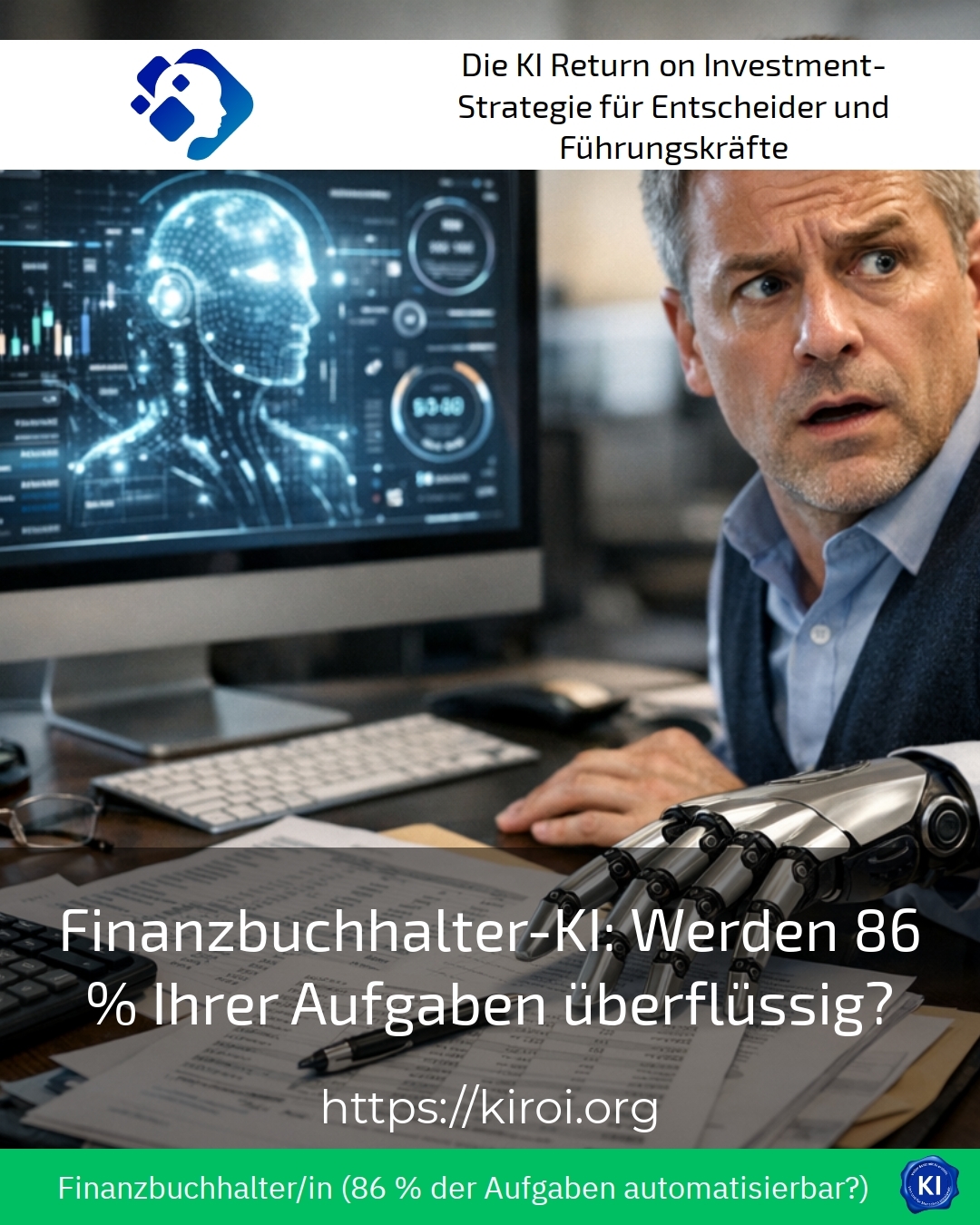
Are you soon going to be replaced by a machine that does your work faster and more flawlessly? This question currently concerns countless professionals in the commercial sector, because technological development is advancing relentlessly. The Job Futureometer of the Institute for Labor Market and Occupational Research [1] provides alarming figures that prompt to think. According to this platform, up to 86 percent of tasks in certain accounting professions could be automated. The Financial accounting AI This is at the center of a discussion that is unsettling many people. At the same time, it opens up completely new perspectives for those who are willing to adapt.
Understanding the digital transformation in accounting
The figures from the Job Futureometer are based on a scientific analysis of individual core activities in various professions, examining which of these could already be replaced by technology today. In the case of credit management, for example, systems are now able to automatically capture incoming invoices, extract relevant data and reconcile them with orders. In the case of debtor management, intelligent reminder systems monitor payment entries and independently send reminders. Even the complex reconciliation of accounts, which previously required hours of concentration, is now handled by specialized software solutions with impressive precision. A medium-sized company in the manufacturing sector recently reported that the monthly reconciliation time could be reduced from three days to a few hours. The expense reporting process, traditionally a time-consuming process, is revolutionized by mobile applications that capture, categorize, and record receipts. Additionally, modern systems enable automatic VAT filing, with all relevant bookings being aggregated and submitted to the tax authorities.
What tasks the financial accounting AI already handles
The daily work in accounting consists of many repetitive tasks that are excellent candidates for automation. The recording of business transactions follows clear rules and patterns that can be automatically captured by machines. The maintenance of master data, i.e., the creation and updating of supplier and customer data, is increasingly handled by intelligent systems that combine information from various sources. In payment processing, algorithms monitor cash flow, optimize payment times, and automatically use discount periods. An example from the retail sector shows how thousands of daily transactions can be recorded without human intervention. Plant accounting, with its complex depreciation calculations, is also increasingly being handled by software. Even the preliminary annual closing work, which involves creating allocation entries and provisions, is now significantly supported by intelligent systems. One trading company was able to reduce the closing time by almost half through the use of such technologies, which freed up significant resources.
The human component remains indispensable
Despite all technological advancements, there are areas where human expertise remains indispensable, because complex decisions require judgment and experience. Consulting management on tax and financial matters requires a deep understanding of entrepreneurial contexts. Communicating with accountants, tax advisors, and auditors requires social skills and negotiation skills. In special cases such as corporate mergers, spin-offs, or international business transactions, automated systems reach their limits. Interpreting changes in legislation and their impact on accounting practices remains a deeply human task. A company in the logistics sector found that in times of crisis, the experience of long-standing employees was invaluable. The development of controlling concepts and strategic financial planning require creativity and entrepreneurial thinking. Furthermore, employee management plays a central role in larger accounting departments, which cannot rely on technology alone.
Best practice with a AIROI customer
A medium-sized mechanical engineering company with approximately 450 employees faced the challenge of setting up its accounting department for the future, as two experienced colleagues would retire within the next few years. As part of a transruptive coaching program, we supported the company in analyzing existing processes and jointly identified automation potential that should not put anyone out of work. The credit accounting was supported by an intelligent invoice entry system that automatically captured and pre-entered incoming documents. The remaining employees henceforth focused on quality assurance, resolving special cases, and strategic supplier evaluation. Monthly reporting, which previously took several days, now takes place almost in real time through automated dashboards. The freed up time is invested by the team in analyzing deviations and developing recommendations for management action. After a year, employees reported a significantly higher level of job satisfaction because monotonous tasks were eliminated. The management now receives more meaningful reports and can react faster to changes. This case demonstrates impressively how technology and human expertise can work together when the transformation process is professionally supported.
The financial accounting AI as a tool rather than a substitute
The perspective we use to view technological changes decisively determines their impact on our professional lives. Those who perceive the new possibilities as a threat will react defensively and may miss important developments. Those who recognize the opportunities, on the other hand, can take an active stance and benefit from the changes. In the area of payroll and salary accounting, for example, systems take over the calculation, while people take on the role of advising employees and resolving complex cases. In retail cash register accounting, automated systems ensure seamless documentation, while professionals analyze and resolve discrepancies. Intercompany coordination within corporate structures is facilitated by specialized software, but the coordination between different country subsidiaries still requires human communication skills. A company in the pharmaceutical industry uses intelligent systems for complex cost accounting documentation, allowing employees to focus on strategic planning.
Developing new competence profiles for the future
The transformation of the professional image requires a realignment of one’s own skills, with technical competence increasingly becoming important. Understanding the functioning of digital systems, their configuration and monitoring will become a core competency that determines professional success. Analytical skills are gaining in importance, as the interpretation of data and the derivation of action recommendations become more important than mere data collection. In the field of grant accounting, for example, systems help with documentation, while people take on the strategic planning and submission of applications. Project accounting in construction benefits from automated systems, but negotiating with clients remains a human domain. In consolidating group financial statements, software supports the technical implementation, while professionals resolve the complex accounting issues. Clients we support in transformation projects often report that initial skepticism has given way to genuine enthusiasm. The combination of traditional expertise and digital competence creates a profile that is highly sought after in the labor market.
Practical steps for personal development
Preparation for the changing work environment begins with an honest assessment of one’s own activities and their potential for automation. Those who analyze their daily tasks quickly realize which areas are at risk and where their strengths lie. Participation in training in digital technologies is a worthwhile investment in one’s own future. An example from the real estate industry shows how employees in the property management department have developed their role from accountant to financial advisor. The utility bill calculation is largely automated, while advising owners on investment decisions takes center stage. In the nonprofit sector, systems support grant accounting, but advising on funding programs requires human expertise. The tax declaration for capital companies is prepared using intelligent systems, while strategic tax planning remains a field for skilled professionals. Transruptional coaching can help identify and systematically pursue individual development paths.
Best practice with a AIROI customer
A tax advisory firm with 25 employees recognized early on that the business model would fundamentally change as routine tasks could increasingly be automated. As part of a AIROI transformation supported by technology, we jointly developed a new service portfolio that relies on consulting and strategic guidance. The monthly financial accounting for clients was largely automated through digital interfaces with their back-office systems, allowing data to be imported directly. The freed up time is now being used by employees to conduct business advisory discussions that offer real added value to clients. Annual financial reporting is supported by intelligent systems that perform plausibility checks and highlight potential risks. The staff have developed into sparring partners for entrepreneurial decisions, which has significantly strengthened client retention. The firm has seen higher client satisfaction and was able to increase its fees for value-added advisory services. This transformation process shows how a perceived threat can turn into a real opportunity when change is actively managed.
The financial accounting AI in the context of societal changes
Technological developments in accounting are part of a comprehensive societal transformation that affects almost all professional fields. The shortage of skilled workers in many industries leads to the fact that automation is not only desired but urgently needed. In public administration, for example, digital systems enable the processing of funding despite scarce human resources. Cash management in municipalities is supported by automated systems, while employees can focus on citizen advisory services. In healthcare, digital billing systems relieve administrative staff, allowing them to spend more time on patient care. The demographic development increases the pressure on companies to streamline their processes and deploy available workforce for value-added activities. A manufacturing company reported that automated invoicing enables the owner to focus more strongly on their core business. Social acceptance of digital solutions has increased significantly over the past few years, accelerating the transformation process.
My AIROI Analysis
The analysis of the available data and practical experiences from numerous transformation projects yields a differentiated picture that does not inspire panic or carelessness. The figure of 86 percent of activities that can be automated is a wake-up call that calls for action, but does not constitute a guarantee against job losses. On the contrary, the practical experiences show that companies that invest early in technology and employee development emerge stronger from the transformation. The role of professionals in accounting is transforming from mere data processing to analysis, consulting, and strategic planning, which can mean a real enhancement. Coaching during a transruptive transformation can help structure and successfully implement this change without overstraining the employees. Technological development offers the opportunity to be freed from monotonous routine tasks and to focus on more demanding tasks. Those who seize this opportunity and actively work on their own development will also be in demand in an increasingly digitized working world. The future belongs to those who can combine human judgment with technical understanding and are willing to learn for a lifetime. Financial accounting AI will not replace human judgment, but will serve as a tool for qualified professionals who prove their value through expertise and consulting skills.
Further links from the text above:
[1] Job-Futuromat of the Institute for Employment Research
For more information and if you have any questions, please contact Contact us or read more blog posts on the topic Artificial intelligence here.






 Deutsch
 English (UK)