
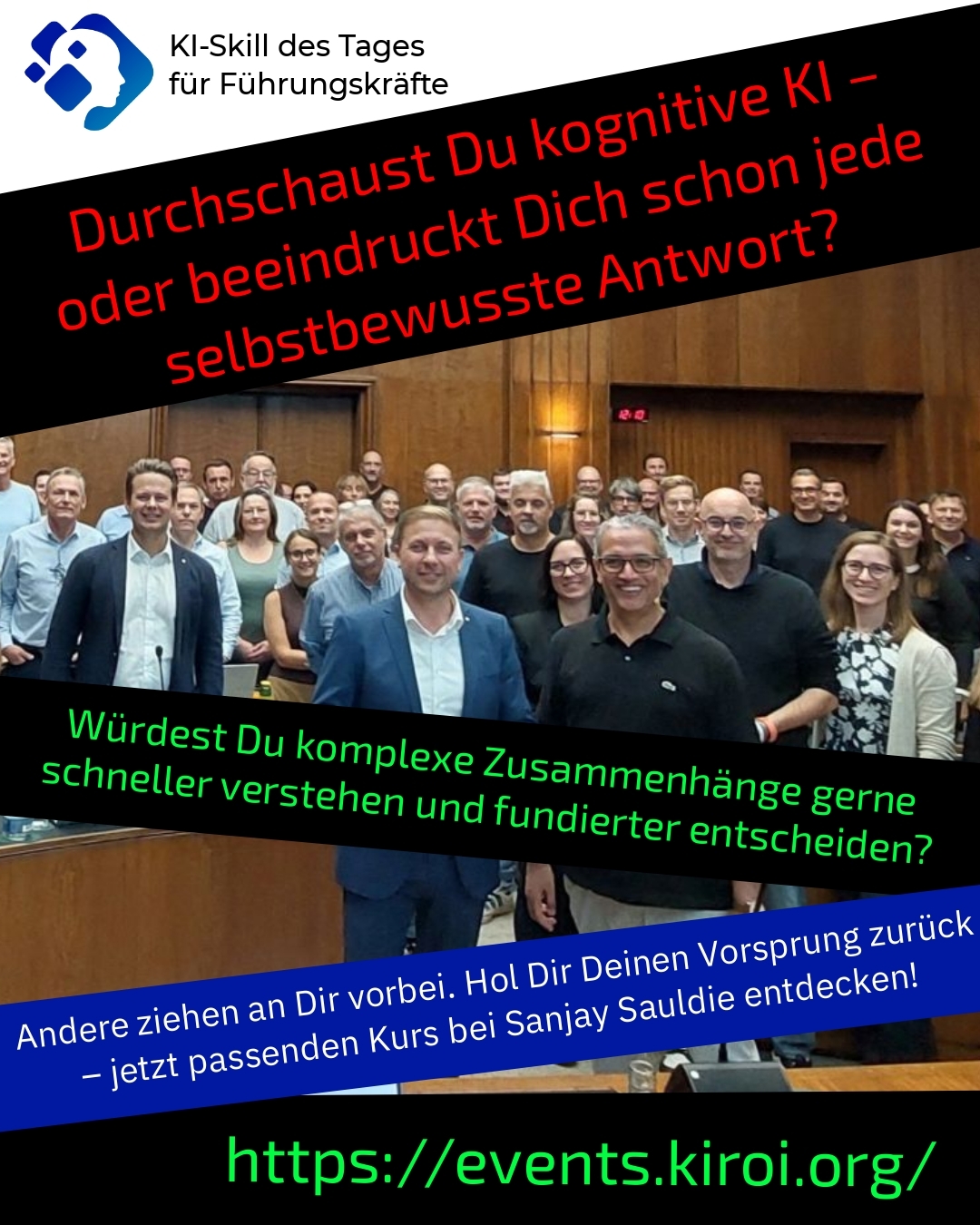
Have you ever wondered if you really understand what lies behind a surprisingly intelligent response from a machine? In a world where Cognitive AI As artificial intelligence increasingly permeates our daily lives, a crucial question arises: Are you aware of cognitive AI – or are you already impressed by every confident answer? This question may seem initially uncomfortable, but it touches upon a core aspect of our modern existence, as we interact daily with systems that provide us with answers of which we often cannot assess the quality. The ability to distinguish between genuine intelligence and clever simulation is becoming an increasingly key skill of our time, and that is precisely why it is worth delving deeper into this fascinating topic.
The Illusion of Certainty: Why self-confident answers can deceive us
Humans naturally tend to give more credence to statements made with confidence. This phenomenon is particularly evident in the field of business consulting. A consultant who presents his recommendations with absolute conviction often appears more competent than someone who admits uncertainty. It is precisely this psychological tendency that machine systems take advantage of. They present their findings without hesitation and without the human signs of uncertainty. This leads us to often consider their answers more reliable than they actually are.
In the financial sector, analysts face this challenge daily. When an automated system generates a forecast for stock prices, it often sounds absolutely and thoroughly. However, it is based on historical data and statistical patterns that cannot guarantee future developments. Similarly, in the legal field, automated contract reviews are increasingly gaining traction. The systems mark potential risks with apparent precision, even though they can never fully grasp the context of a business. This phenomenon is also evident in medical diagnostics. Imaging procedures with intelligent analysis provide findings that sometimes seem more convincing than the assessment of experienced radiologists.
Best practice with a AIROI customer A medium-sized company in the mechanical engineering sector had implemented a system for automated quote generation that calculated prices and delivery times based on past projects. Initially, employees relied blindly on the figures because they seemed so precise and were supported by professional graphics. However, after several lost orders, management realized that the system could not take into account specific customer requirements and current market conditions. As part of an transruptions-We worked together on coaching projects to develop criteria that employees can now systematically use to assess when to follow the automated suggestions and when to prioritize their own assessments. This new awareness not only led to an improved order rate, but also strengthened the competence of the entire sales team, which now handles technological tools more confidently and understands their limitations.
Do you use cognitive AI in your professional life?
The ability to critically question machine systems requires a fundamental understanding of their functioning. It is not about becoming a programmer or understanding complex algorithms. Rather, we need an awareness of how these systems arrive at their results and what limitations they have. In the HR industry, recruiters increasingly use automated systems to pre-screen applicants. These systems analyze resumes and evaluate candidates based on predetermined criteria. However, they do not recognize exceptional career paths or hidden potential that an experienced recruiter would intuitively perceive.
In marketing, a similar dynamic is evident in audience analysis. Automated tools promise precise insights into customer behavior and buying motives. They deliver impressive dashboards with colorful charts and concrete recommendations for action. However, these recommendations are based on correlations, not a solid understanding. An experienced marketing manager at a consumer goods manufacturer recently told us that his system recommended a campaign for young parents, while the actual target audience was grandparents who bought gifts for their grandchildren. The logistics industry offers further insightful examples. Route optimization systems calculate the most efficient routes for delivery vehicles. However, they rarely take into account local knowledge about construction sites, difficult parking situations, or customer preferences regarding delivery times.
Developing critical thinking as a new core competence
The development of a critical approach to machine systems begins with the right question-keeping. Instead of simply accepting results, we should systematically question the data basis on which a recommendation is based. In the banking sector, forward-looking institutions have begun to specifically train their employees in this skill. Credit analysts are now not only learning to interpret automated credit assessments, but also to recognize their limitations. A clerk in a regional bank told us how he approved a loan application despite a negative system recommendation because he knew the local circumstances of the applicant. The loan was repaid without any problems.
In the insurance industry, claims adjusters are increasingly using automated damage assessment as a starting point rather than a final judgment. They have learned that while the systems can quickly process standardized cases, they regularly reach their limits in complex damage situations. One insurance broker reported on a case where the system classified a water damage as minor, while on-site, massive consequential damage to the building structure was clearly evident. The real estate industry is also experiencing a change in how it handles automated assessment tools. Experienced brokers use these systems as a first point of reference, but they are increasingly relying again on their market knowledge when determining the final price.
Finding the balance between trust and skepticism
Neither blind trust nor blanket rejection leads to a productive approach to intelligent systems. The art lies in making situational decisions about when machine support is valuable and when human judgment remains indispensable. In the pharmaceutical industry, researchers have found this balance in drug discovery. They use computer-assisted simulations to pre-select potential compounds, but rely on their scientific expertise and intuition in the final evaluation. In retail, innovative companies rely on a combination of automated inventory forecasting and experiential customization by store managers who are familiar with local specifics.
When you master this balance and understand that both approaches have their merits, you can see cognitive AI at work. In the automotive industry, this principle is impressively demonstrated in quality control. Automated image recognition systems identify surface defects with impressive accuracy. Yet experienced quality inspectors retain the final say, because they recognize subtle deviations that no system can detect. The food industry has drawn similar conclusions. There, sensor-based systems support quality control, while trained inspectors continue to issue final approval.
Best practice with a AIROI customer A leading company in the renewable energy sector faced the challenge of its maintenance technicians blindly following the recommendations of a predictive maintenance system. The system analyzed sensor data from wind turbines and predicted necessary maintenance work. In several cases, however, this led to unnecessary interventions, because the system interpreted temporary anomalies as permanent problems. As part of our transruptions-Together, we developed a training program that enabled technicians to critically evaluate system recommendations. The employees learned which factors the system takes into account and which it must overlook due to its structure. They developed checklists for the plausibility check and established an exchange of experiences among colleagues. The result was a reduction in unnecessary maintenance efforts by over thirty percent while maintaining plant availability. The technicians also reported higher job satisfaction because they now perceived themselves as competent decision-makers rather than mere executors of a system.
Practical strategies for everyday life
The conscious handling of machine systems can be improved through concrete strategies. First and foremost, it is advisable to always seek a second opinion when making important decisions, whether from colleagues or alternative sources of information. In journalism, reputable newsrooms have internalized this principle. They use automated fact-checking tools, but always verify critical information through independent research. The advertising industry takes a similar approach when planning campaigns. Creative directors are inspired by data-driven analyses, but make final creative decisions based on their experience and their sense of trends.
Take your existing skills to the professional level – just as over 8,000 people from over 500 companies have already done with Sanjay Sauldie! Visit events.airoi.org and discover how you can systematically expand your expertise in using modern technologies. In the education sector, the added value of such further training is particularly evident. Teachers who have learned to critically use automated assessment systems can better prepare their students for a world where this skill will be indispensable. The tourism industry also benefits from trained staff. Travel consultants who understand how booking systems generate recommendations can offer their customers tailored alternatives.
AIROI My analysis
After intensive discussion on this topic, it becomes clear that the ability to critically evaluate machine systems is becoming a central skill of our time. By mastering cognitive AI, you gain a decisive competitive advantage in almost every professional field. The presented examples from different industries illustrate that neither blind trust nor blanket rejection represent effective strategies. Instead, we need a differentiated approach that leverages the strengths of automated systems while simultaneously recognizing their limitations.
Companies and individuals who master this balance will prove to be resilient and future-oriented. They will make better decisions because they view machine recommendations as valuable insights, not as unassailable truths. transruptions-Coaching has proven to be an effective format for supporting teams and leaders in this process of developing their skills. The experiences from numerous projects show that people are fundamentally capable of learning and open to this new perspective when they are appropriately supported. The crucial insight is that confident responses deserve our attention, but not automatically our trust. Only when we have learned to look beyond the surface can we fully harness the potential of modern technologies without being blinded by their apparent perfection.
Further links from the text above:
[1] AIROI Events – Training in digital skills
For more information and if you have any questions, please contact Contact us or read more blog posts on the topic Artificial intelligence here.






 Deutsch
 English (UK)