
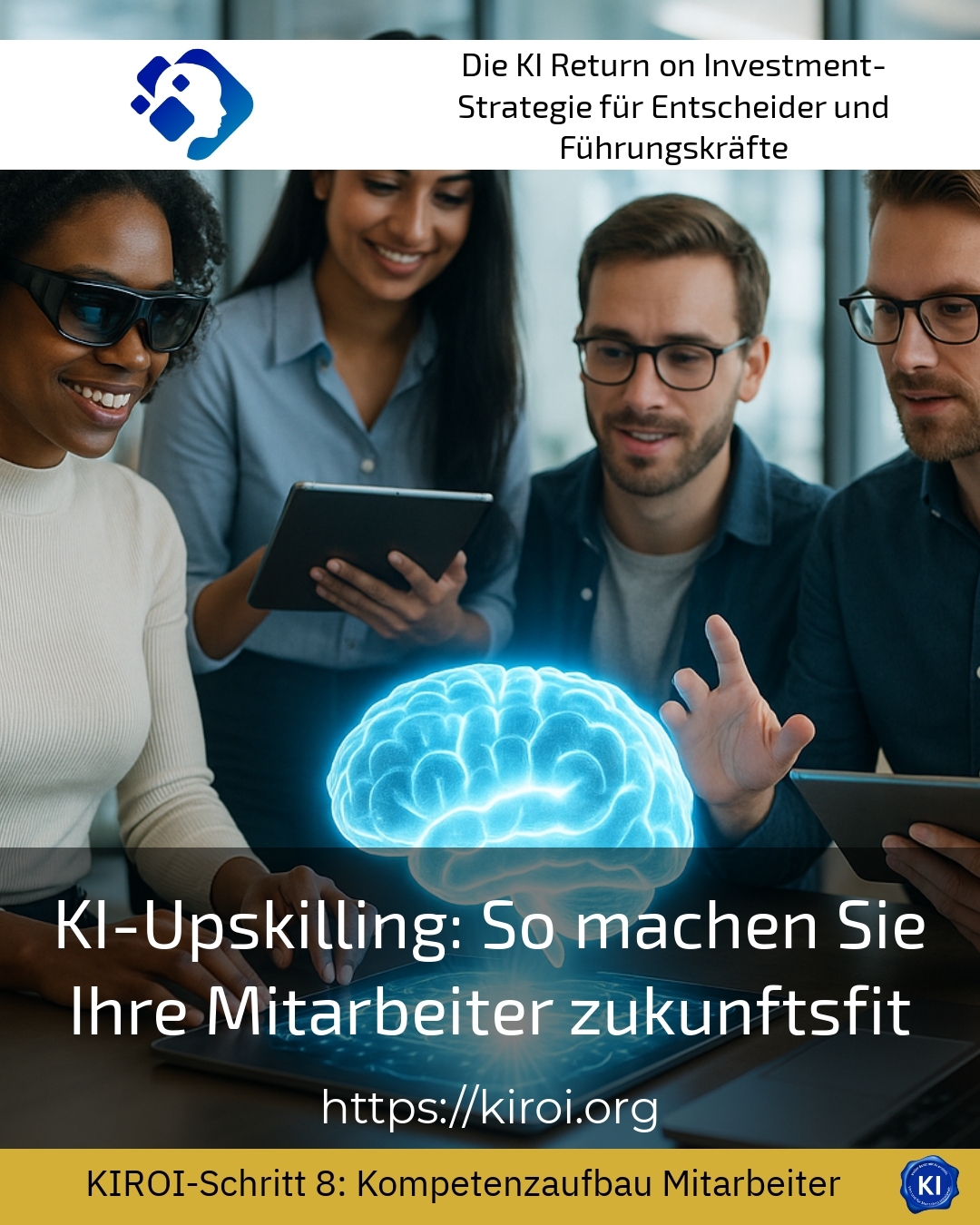
The digital transformation is fundamentally and rapidly changing our world of work. Companies face a crucial question: How do we prepare our teams for this new era? AI Upskilling: How to Make Your Employees Future-Ready – this challenge is occupying leaders across all sectors. As intelligent systems take on more and more tasks, the demand for people with the relevant skills is growing exponentially. Those who do not act today risk losing out tomorrow. The good news, however, is that there are proven ways to systematically develop workforces and equip them for the future.
Why AI upskilling has become indispensable today
The world of work is undergoing profound change. Intelligent algorithms and automated processes are transforming virtually every professional field. For example, the retail sector is increasingly relying on automated warehouse management systems. These identify ordering patterns and optimise supply chains independently. At the same time, banks and insurance companies are using intelligent analysis tools. These assess risks and detect fraud patterns in fractions of a second. In healthcare too, learning systems are supporting diagnoses and therapeutic decisions.
This change doesn't just affect technical professions. Marketing teams today work with tools that can predict customer behaviour. HR departments use systems that pre-sort and analyse job applications. Intelligent sensors are even being used in agriculture. These measure soil moisture and automatically control irrigation systems. Small and medium-sized enterprises are increasingly discovering applications for machine learning. For example, craft businesses are optimising their route planning with algorithmic solutions.
This development creates both opportunities and challenges for businesses. Those organisations that upskill their workforces in good time will gain a competitive advantage. In contrast, companies without appropriate further training strategies risk being left behind. Studies by McKinsey and the World Economic Forum clearly demonstrate this trend [1]. They predict that numerous jobs will undergo fundamental changes. New job profiles will emerge, while others will lose importance.
AI Upskilling as a strategic success factor for companies
Successful further training strategies begin with an honest assessment of existing competencies. Many companies underestimate the skills their employees already possess. An experienced accountant brings analytical thinking skills. A sales representative intuitively understands customer relationships and communication patterns. These existing strengths form the foundation for further qualifications.
This is particularly evident in the manufacturing industry. Machine operators know their equipment inside out. They immediately notice unusual noises or vibrations. This experiential knowledge is invaluable for predictive maintenance systems. The combination of human expertise and algorithmic analysis creates real added value. The situation is similar in the customer service of modern telecommunications companies. Experienced service agents understand customer needs and emotional nuances. They can train chatbot systems and improve their responses.
The logistics sector offers further striking examples of successful skills development. Dispatchers today use intelligent route planning systems. They learn to use and further develop these tools optimally. This is not about displacing human labour. Rather, new areas of responsibility are emerging that require higher qualifications. Warehouse logistics specialists are becoming data analysts who monitor and optimise inventory systems.
Best practice with a KIROI customer
A medium-sized logistics company with around two hundred employees faced an important decision. Management planned to introduce an intelligent warehouse management system. Initially, many employees feared their jobs might be at risk. Transruptions coaching supported the entire change process intensively from the outset. First, we conducted workshops to address fears and show perspectives. In doing so, we identified hidden skills within the workforce that had previously gone unused. A long-serving warehouse manager turned out to be a talented process optimizer with strong analytical skills. After appropriate training, he took on the role of internal system administrator. A picker with good communication skills trained her colleagues. Within eight months, the company developed a completely new learning culture. Today, employees frequently report increased job satisfaction and new development opportunities. Productivity rose by a considerable twenty percent after the introduction of the new system.
Practical steps on the path to a learning organisation
Building future skills requires a systematic and well-thought-out approach. First, it's essential to objectively assess the current level of skills. Structured competency analyses and individual discussions with managers can support this. Subsequently, tailored learning paths can be developed for different employee groups. Not every employee needs the same knowledge or skills.
In the automotive industry, pilot projects show promising results in upskilling. Production employees are learning how to use collaborative robot systems in multi-stage programmes. They understand the basic principles of machine learning and can make adjustments. In the pharmaceutical industry, companies are training their laboratory staff to use analysis platforms. These can recognise patterns in experimental data and significantly accelerate research processes. The energy sector is further training technicians for intelligent grids and smart grid technologies.
Learning formats that combine practical application with theoretical knowledge are particularly successful. Purely online courses often only achieve limited impact and are frequently abandoned. Blended learning concepts with face-to-face sessions and digital elements are more effective. Mentoring programmes, where experienced colleagues share their knowledge, complement formal training. Peer learning groups promote exchange and strengthen the sense of community.
AI Upskilling: How to make your employees future-proof – with the right mindset
Technical skills alone are not enough for sustainable success. Developing an open and willing-to-learn attitude is at least as important. Many employees have reservations about new technologies. These concerns are understandable and should be taken seriously. A respectful approach to uncertainty creates the basis for real change.
In the banking sector, customer advisors often initially view intelligent advisory systems with scepticism. They fear being replaced or devalued by algorithms. Successful transformation projects address these anxieties directly and transparently. They present concrete examples of how humans and machines can collaborate. The algorithm takes over routine analyses and calculates scenarios. The advisor interprets the results and conducts empathetic customer conversations.
Similar patterns are emerging in the media and communications industries. Editors are using text generation tools that can produce drafts, which they then use as a starting point and creatively refine. Graphic designers employ image generation systems for initial concept visualisations. Final design work remains a human domain, requiring artistic judgment. This way of working necessitates new skills, such as prompt engineering and critical evaluation of results.
Leaders as role models in digital transformation
The role of senior management in transformation processes cannot be overstated. Leaders significantly shape their organisations' learning culture through their behaviour. When they themselves attend training courses, it signals an appreciation for lifelong learning. If they embrace new tools, it encourages even hesitant team members.
In industrial companies, formats such as reverse mentoring programmes are particularly successful. In these programmes, younger employees train experienced managers in the use of digital tools. This strengthens intergenerational exchange and breaks down hierarchical barriers. In retail, progressive companies are using similar approaches for their transformation projects. Store managers learn from digitally savvy sales assistants and vice versa.
The construction industry shows how traditional sectors can successfully evolve. Site managers are using intelligent project management platforms for complex projects. They coordinate trades with algorithmic support and avoid scheduling bottlenecks. Architects are employing parametric design tools that automatically generate design variations. This integration requires continuous upskilling at all levels of the company.
Best practice with a KIROI customer
A long-established trading company with multiple locations decided to undertake a comprehensive digital realignment. The management recognised that the existing processes were no longer up to date. Transruptions coaching supported this ambitious project over a period of fifteen months. We began with a detailed analysis of the existing competencies throughout the company. In doing so, we discovered that considerable untapped potential lay dormant within the workforce. A sales assistant had acquired programming skills in her free time and had already developed her own applications. A branch manager brought experience from a previous career as a data analyst. We deliberately integrated these hidden talents into the company's transformation teams. At the same time, we developed tiered training programmes for different employee groups and requirement profiles. Beginners received introductory courses on understanding intelligent systems and how they work. Advanced learners worked on specific use cases from their immediate day-to-day work. The company has established a permanent learning culture that extends beyond the original project. Today, employees independently experiment with new tools and contribute innovative ideas.
Sustainable anchoring of skills in everyday business life
One-off training sessions often fizzle out in day-to-day operations without any lasting effect. Real competence development requires continuous practice and practical application. Therefore, integrating learning moments into the regular working day is recommended. Short daily or weekly learning units often achieve better results than multi-day intensive seminars.
The insurance industry is experimenting with innovative microlearning formats for its field staff. These individuals receive brief learning impulses daily on their mobile devices. The content directly relates to current customer inquiries and product developments. Administrative staff use learning platforms that recommend personalised content based on usage behaviour. In the healthcare sector, clinics are adopting similar approaches for their medical personnel.
The chemical industry serves as an exemplary case of how technical training can be linked with safety aspects. Laboratory technicians learn how to handle automated analysis systems under real-world conditions. Simulation environments allow for risk-free experimentation with complex processes and scenarios. In food production, companies train their quality inspectors in the use of image recognition systems.
Measuring success and continuous improvement of qualification measures
Every investment in employee development should be able to deliver measurable results. This isn't just about participant numbers and course completions. More relevant are metrics such as the practical application of learned skills in daily work. Employee satisfaction and their self-assessment also play important roles.
In the telecommunications industry, companies measure the impact of training on tangible business outcomes. They analyse whether skilled employees can resolve more complex customer issues more quickly. In e-commerce, retailers investigate whether trained teams can provide better recommendations for product optimisation. The transport industry assesses whether skilled dispatchers can make more efficient routing decisions.
Feedback loops are crucial for the continuous improvement of qualification programmes. Regular participant surveys provide valuable insights into strengths and weaknesses. Management feedback complements the employee perspective with important additional observations. Together, this information enables the ongoing development of learning offerings.
My KIROI Analysis
The systematic upskilling of workforces for handling intelligent systems is no longer an option. It has become a strategic necessity that determines future viability. My experience from numerous support projects reveals recurring patterns and success factors. Companies that invest in competence development early on and holistically benefit in multiple ways. They gain not only technical skills but also more motivated and loyal employees.
The KIROI methodology offers a structured framework for such transformation projects. It considers and integrates the technical, cultural, and human dimensions equally. The human element is always at the centre of all efforts and measures. Technology is a tool and an enabler, never an end in itself. This attitude fundamentally distinguishes successful transformation projects from those that have failed.
For the coming years, I expect a further acceleration of technological development. The integration of intelligent systems will become more commonplace and taken for granted in many areas. At the same time, the need for people who can use these tools responsibly is growing. The combination of technical understanding and human competencies will become the decisive success factor. Organisations that set the right course today will be among the winners tomorrow. Transruption coaching supports companies in navigating this path successfully and sustainably.
Further links from the text above:
[1] McKinsey: Insights into the Future of Work
For more information and if you have any questions, please contact Contact us or read more blog posts on the topic Artificial intelligence here.











 Deutsch
  English (UK)