
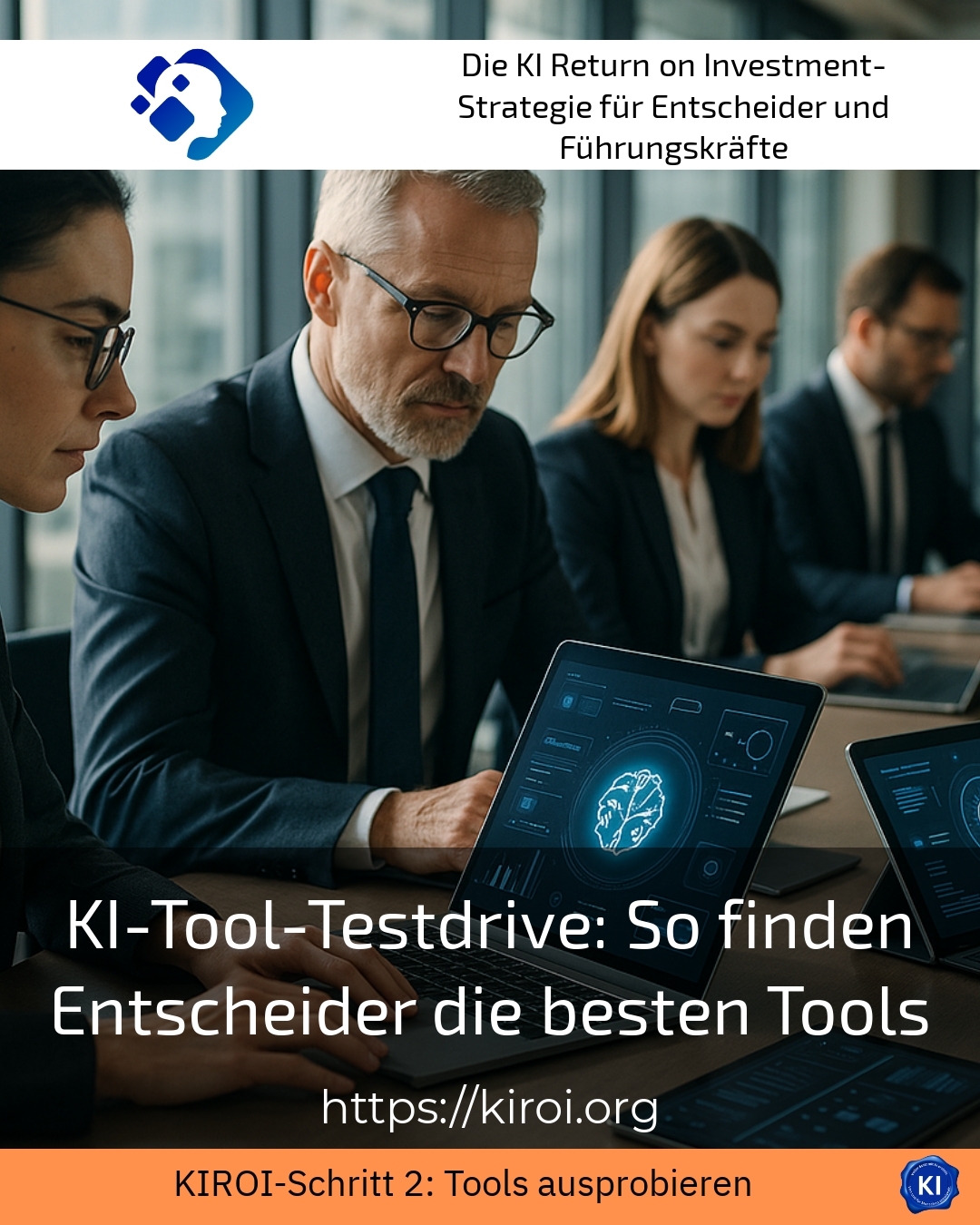
Imagine you're standing in front of a vast toolbox filled with hundreds of gleaming instruments, but no one explains which one is actually suitable for your task. This is precisely how many leaders feel today when searching for the right digital solution for their company. The AI Tool Test Drive: How decision-makers can find the best tools will become a core competence at a time when new applications are entering the market weekly. This is no longer just about technical gimmicks. Rather, these tools determine competitiveness, efficiency, and ultimately business success. But how do smart minds navigate this jungle? How do they separate hype from real added value? And which strategies have proven their worth in practice? These questions concern decision-makers across all industries. The answers to them can make the difference between a smart investment and an expensive mistake.
The Challenge of Systematic Selection
The landscape of intelligent tools has changed dramatically in recent years. Previously, there were few providers with clearly defined functions. Today, thousands of solutions exist for almost every conceivable use case. This diversity brings opportunities, but also significant risks. Decision-makers often report feeling overwhelmed by the sheer number of options [1]. The AI Tool Test Drive: How decision-makers can find the best tools therefore begins with a fundamental stocktake. First, managers must clearly define their actual needs. A marketing department requires different functions than the HR department. A manufacturing company has different requirements than a service provider. This differentiation sounds trivial but is astonishingly often neglected.
In the manufacturing industry, for example, companies rely on predictive maintenance solutions. These systems analyse machine data and detect potential failures early on. An automotive supplier was able to reduce its unplanned downtime by more than thirty percent in this way. In the retail sector, on the other hand, demand forecasting applications dominate. Large retail chains use these tools to optimise their inventories. A leading food retailer reports significantly reduced spoilage of fresh produce. In the healthcare sector, intelligent systems assist with image analysis in diagnostics. Radiologists work with assistance solutions that highlight abnormalities in X-ray images. These examples impressively demonstrate the breadth of possible applications.
Best practice with a AIROI customer A medium-sized engineering company faced the challenge of modernising its production planning and approached us for professional guidance through this process. Management had already considered several solutions but felt unsettled by the differing promises of providers and didn't know which tool they could truly trust. As part of the transruption coaching, we jointly developed a structured evaluation process that focused on the company's specific requirements and defined clear evaluation criteria. We first identified the critical success factors and weighted them according to their relevance to operational business, taking into account both short-term and long-term perspectives. Subsequently, selected employees tested three different applications under realistic conditions over a period of six weeks, systematically documented their experiences and provided regular feedback. The results surprised all involved, as the initially favoured solution fell significantly short of expectations in practice and revealed considerable weaknesses in terms of user-friendliness. Instead, a lesser-known provider impressed with intuitive operation and excellent support, which ultimately tipped the scales in favour of their decision. The company now saves several hours weekly on production planning and reports significantly improved utilisation of its manufacturing capacities.
Criteria for a successful AI tool test drive
A methodically conducted trial run follows clear principles. These principles distinguish professional evaluation from random experimentation. Firstly, every test drive needs measurable success criteria. What exactly should the solution improve? How can this progress be quantified? Without such benchmarks, evaluations remain subjective and of little significance. Furthermore, test scenarios must reflect the real working situation. A tool that shines under laboratory conditions may fail in everyday use. Therefore, the involvement of those employees who will work with it daily is indispensable. Their perspective provides valuable insights that are often overlooked at the management level [2].
In the financial sector, banks for example have established strict test protocols for fraud detection. These protocols simulate various attack scenarios under controlled conditions. A large private bank tested several systems in parallel over several months. The results showed significant differences in detection accuracy. In the logistics sector, companies focus on route optimisation and resource planning. A parcel delivery service carried out a comprehensive comparison of different planning tools. The test phase included different delivery areas with different requirement profiles. In the area of customer service, companies evaluate intelligent assistant systems for their service departments. A telecommunications provider opted for a multi-stage selection process. Employees evaluated usability, response quality and integration into existing systems.
The Role of Company Culture in AI Tool Test Drives
Technical suitability alone does not guarantee success when introducing new tools. Cultural fit plays an at least equally important role in sustainable implementation. Companies with an open error culture achieve better results during implementation. Employees there feel comfortable raising difficulties and contributing suggestions for improvement. In contrast, resistance often arises in hierarchically structured organisations. Leaders frequently underestimate the influence of these soft factors. They focus on functionalities and overlook the human dimension. Even the most powerful system is of little use if it is rejected by its users.
This connection is particularly evident in the insurance industry. Traditional insurers often struggle with the digital transformation of their workforce. Consequently, a large property insurer invested in both technology and training concurrently. This led to a noticeable increase in acceptance. In the media sector, editorial teams are experiencing similar dynamics when introducing assistance solutions. Journalists sometimes fear being replaced by automated systems. One publishing house countered these fears through transparent communication and involvement. In the education sector, universities are experimenting with intelligent tutor systems for their students. Lecturers must redefine their roles in this process. One university supported this change with comprehensive workshops on reorientation.
Best practice with a AIROI customer A retail company with several hundred branches wanted to optimise its personnel planning using intelligent tools but faced considerable resistance from the workforce, who feared for their jobs and were sceptical of the project. Works councils expressed concerns regarding surveillance and performance monitoring, leading to the project being put on hold and alternative approaches being sought. As part of our support, we initially organised a dialogue between all parties involved to bring together the different perspectives and develop a shared understanding of the opportunities and risks. We facilitated workshops where both the potential and limitations of the technology were openly discussed, and all participants were able to voice their concerns freely. Together, the parties developed a code of conduct for the use of the system, which defined clear boundaries and guaranteed the protection of employee interests. The pilot phase subsequently began with volunteer pilot branches, whose employees supported the project from the outset and actively engaged with it. The positive experiences of these pioneers gradually convinced even the sceptics, so that the solution is now in widespread use. The example impressively demonstrates how important the involvement of all stakeholders is for project success and that technical solutions only work if they are accepted by the people who have to work with them on a daily basis.
The structured evaluation process in the AI tool test drive
A professional evaluation process is divided into several sequential phases. The first phase covers requirements analysis and a market overview. Decision-makers gather relevant information on available solutions. Industry reports, comparison portals, and recommendations from industry colleagues provide initial guidance [3]. The second phase involves a preliminary selection based on defined exclusion criteria. These criteria can include budget, security requirements, or integration capabilities. Typically, the list of candidates is reduced to three to five options. The third phase comprises the actual practical test under realistic conditions. This phase should be long enough to obtain robust findings.
In the pharmaceutical industry, such processes are subject to particularly strict regulations. Companies must document how systems were validated. A pharmaceutical group developed a multi-stage testing procedure for new applications. The compliance department documented and supported every step. In the energy industry, security of supply and stability are paramount. Energy suppliers initially test new tools in isolated environments. A grid operator simulated various load scenarios before introducing a forecasting solution. In the construction industry, planning tools are increasingly gaining importance. Construction companies evaluate solutions for project management and resource control. A large construction company tested various systems in parallel at different construction sites.
Avoiding typical pitfalls
Experienced managers are aware of the most common errors when selecting tools. The first pitfall lies in unrealistic expectations regarding performance. Supplier marketing promises should always be critically questioned. Companies often report that advertised functionalities were not available in practice. The second pitfall concerns underestimating the implementation effort. The purchase is often only a fraction of the total costs. Training, customisation and ongoing support add up significantly. The third pitfall lies in neglecting data security. Sensitive company data requires the highest protection standards. Not every supplier meets these requirements satisfactorily [4].
In legal advice, law firms have strict confidentiality requirements, for example. An association of large commercial law firms developed joint security standards. These standards now serve as a benchmark for the entire industry. In the healthcare sector, particularly strict data protection rules apply to patient information. Hospitals and practices must observe these requirements with every introduction. A clinic chain established its own audit process for all new applications. In public administration, award guidelines also play an important role. Authorities must design procurement processes to be transparent and comprehensible. A municipal administration developed a guideline for digital procurement.
Integration into existing processes
Even the best tool only shows its benefit when integrated successfully. Existing workflows must be adapted or redesigned. This adaptation requires time, resources, and often patience. Management should plan a realistic timeframe from the outset. Staff need sufficient opportunity to familiarise themselves with the new capabilities. Rushed introductions regularly lead to frustration and rejection. A phased approach has proven effective in practice. Initially, pilot groups can gain initial experience. Their findings then feed into the broader rollout.
In the automotive industry, established manufacturers have built complex IT landscapes. Integrating new solutions requires particular care there. One automotive group opted for a modular approach for its implementation. In retail, systems often need to communicate with legacy applications. Technical integration frequently presents a challenge there. A retail group invested heavily in interface development. In tourism, various systems work together, from booking to settlement. Tour operators pay particular attention to seamless data flows between applications. A hotel chain gradually harmonised its different systems over several years.
Best practice with a AIROI customer An internationally operating consulting firm wanted to support its project documentation with intelligent tools but was struggling to find a solution that was compatible with its existing systems and met strict security requirements. The different locations used different software environments, which further complicated the situation and initially made a unified approach seem impossible. As part of our support, we first carried out a comprehensive inventory of the existing system landscape to obtain a complete picture of the technical framework conditions. We identified interfaces and potential integration points that served as the basis for selecting suitable solutions and made the project's complexity manageable. Together with the IT department, we defined minimum requirements for compatibility and security that all applications under consideration had to meet. The subsequent testing phase focused on three solutions that fulfilled these criteria and offered promising functionalities. The finally selected application impressed with its flexible integration possibilities and high adaptability to different working environments. The rollout was implemented on a site-by-site basis over a period of nine months, with the experiences from each site feeding into the training concepts of the subsequent ones, continuously improving the overall process.
My AIROI Analysis
The systematic evaluation of intelligent tools is one of the central leadership tasks of our time, and this task will become even more important in the future. Decision-makers who approach this professionally provide their company with a sustainable competitive advantage, which is reflected in efficiency, innovation and employee satisfaction. The AI Tool Test Drive: How decision-makers can find the best tools is not a one-off event, but a continuous process that should be integrated into strategic planning. The technology landscape is evolving rapidly, and what is considered innovative today may already be obsolete tomorrow. Therefore, companies need in-house, ongoing evaluation capabilities to keep pace with this dynamic.
From my many years of experience supporting such projects, I have drawn several key insights that I would like to share here. Firstly, many companies significantly underestimate the human factor when introducing new technologies, focusing too heavily on technical aspects. The best tools fail if they are not adopted by the workforce or if the introduction is poorly communicated. Secondly, a thorough testing phase pays off in the long run and saves considerable costs that would arise from wrong decisions. The investment in a structured evaluation process is well-placed and quickly amortises. Thirdly, companies benefit from external support, which brings an unbiased perspective and can uncover blind spots. As a transruption coach, I support organisations in successfully shaping their digital transformation and making the right decisions. The combination of methodological expertise and industry-specific knowledge creates the basis for well-founded decisions that have a sustainable impact.
Further links from the text above:
[1] McKinsey: The State of AI
[2] Harvard Business Review: Technology Insights
[3] Gartner: IT Research and Advisory
[4] Federal Office for Information Security
For more information and if you have any questions, please contact Contact us or read more blog posts on the topic Artificial intelligence here.








 Deutsch
  English (UK)