
How can successful leaders avoid costly misjudgments when introducing intelligent software solutions into their corporate processes?
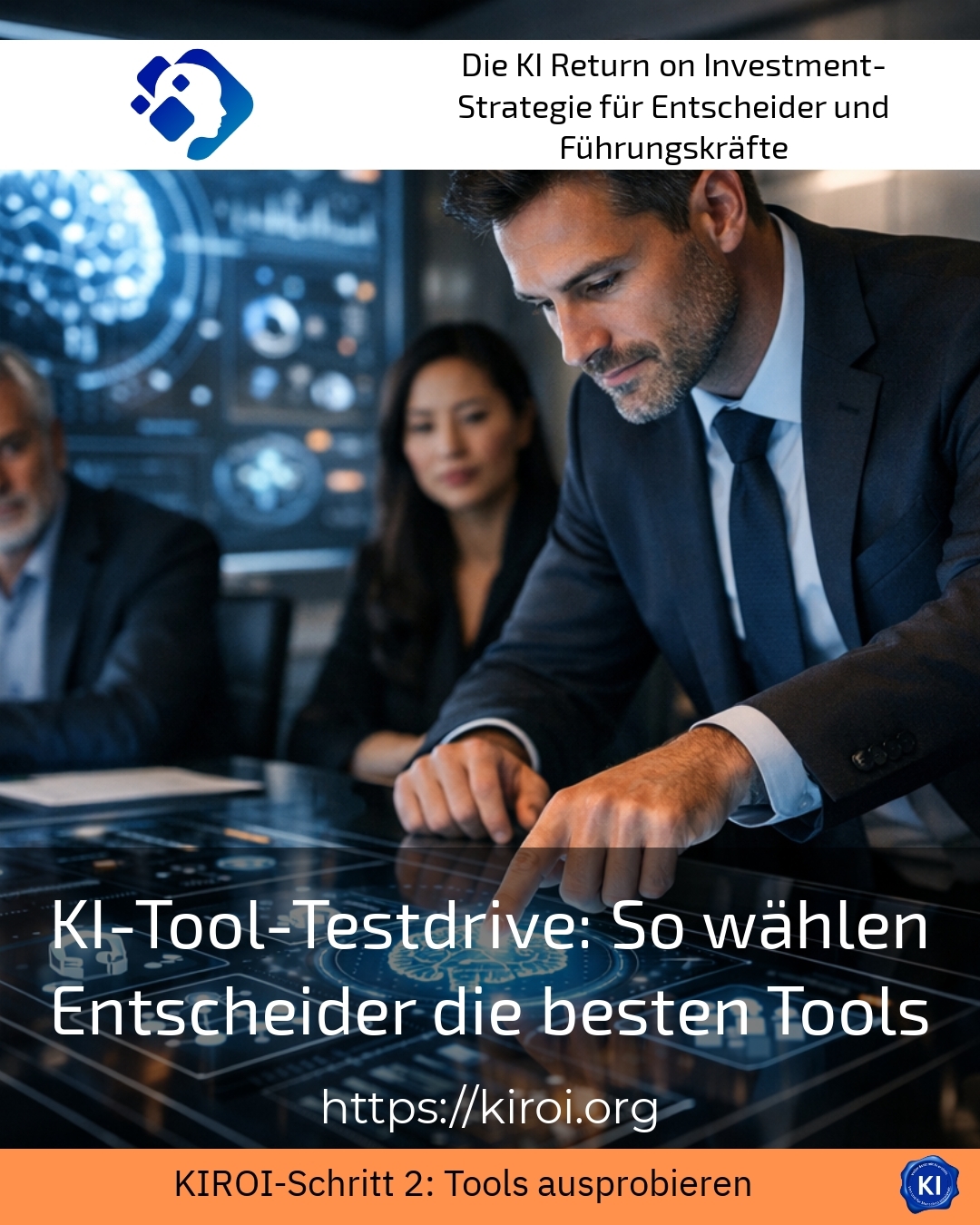
Choosing suitable digital tools presents decision-makers with significant challenges, because the market is characterized by an almost overwhelming variety of providers. A systematic approach is essential to ensure that the right tools are selected. AI tool test drive It enables decision-makers to make informed decisions and minimize both financial and operational risks. Especially in times of rapid technological development, companies need structured evaluation methods that go far beyond superficial product comparisons. The following sections provide a comprehensive guide that combines proven strategies with concrete industry examples.
The strategic importance of systematic tool evaluation
Companies invest considerable sums in digital transformation projects. Clients often report on failed implementations. These failures often stem from insufficient preliminary checks. A well-thought-out AI tool test drive it prevents such costly errors in a lasting way.
In retail, for example, companies are increasingly relying on automated inventory management solutions. The drugstore chain dm has implemented intelligent forecasting systems. These systems analyze purchasing behavior and continuously optimize supply chains. The grocery retailer REWE also uses algorithmic decision-making tools for assortment optimization. The fashion retailer Zalando relies on personalized recommendation systems that personalize the shopping experience.
In the financial sector, intelligent analytics tools support risk assessment in credit decisions. Deutsche Bank uses automated compliance review systems. Insurance companies such as Allianz rely on loss prediction tools. These applications significantly speed up processing times and reduce human error rates.
Best practice with a AIROI customer A medium-sized logistics company faced the challenge of making its route planning more efficient while simultaneously reducing fuel costs and shortening delivery times. As part of a structured evaluation process, the company tested three different optimization solutions over a twelve-week period under real operating conditions. The management team defined clear success criteria in advance and accompanied the entire process with regular status meetings. Through this methodological approach, the team was able to recognize early on that one of the solutions offered impressive features but was not compatible with the existing warehouse management system. The solution ultimately selected resulted in a reduction in average delivery times by fourteen percent and a fuel savings of eight percent within the first operating quarter. This result would not have been achieved without the systematic testdrive approach, because hidden integration problems only become visible in practical use.
Criteria for a successful AI tool test drive
Choosing suitable evaluation criteria forms the foundation of any successful tool evaluation. Decision-makers should consider technical, economic, and organizational aspects. This holistic approach prevents subsequent surprises in production operations.
Technical integration capabilities are of paramount importance. Existing IT infrastructures must be compatible. Interfaces to existing systems require special attention. In healthcare, for example, new diagnostic tools must be able to communicate with hospital information systems. At Charité Berlin, extensive interface tests were conducted for the introduction of imaging analysis tools. The University Hospital Hamburg-Eppendorf evaluated speech recognition systems for documentation purposes. The Helios Kliniken tested scheduling optimization at several locations in parallel.
Economic viability requires a realistic overall cost assessment. License costs are only a part of the financial expenses. Training costs, customization costs, and ongoing support must be factored into the calculation. Implementation times also have a significant impact on the economic calculation.
Organizational framework conditions for the AI tool test drive
The human component is often underestimated in technology decisions. Employee acceptance determines the success or failure of an introduction. Training needs must be assessed realistically. Resistance to change requires professional change management.
In the manufacturing sector, companies such as Siemens were early adopters of employee participation. In the introduction of predictive maintenance systems, technicians were actively involved in testing phases. BASF accompanied the implementation of process optimization tools with extensive training programs. The automotive supplier Bosch established pilot teams that tested new analysis tools under real production conditions.
Best practice with a AIROI customer An energy provider planned the implementation of an intelligent grid management system to optimize load distribution and to detect potential disruptions in the distribution network early on. The project team deliberately chose an extended testing phase that included extreme scenarios such as peak load times and unusual weather conditions. During this phase, the technicians identified several scenarios in which the system generated unexpected recommendations that required human review. These findings led to the implementation of additional plausibility checks and release mechanisms before critical switching decisions could be automated. The transruptive coaching accompanied this project as structured support in defining test criteria and interpreting the results. After completing the testing phase, the company was able to transfer the system to production with significantly higher confidence, because potential risk scenarios had already been identified and addressed.
Structured approach to vendor evaluation
A methodically-based evaluation process follows defined phases. The requirements analysis forms the starting point for all activities. Market research and pre-selection reduce the number of relevant providers. Detailed evaluations and pilot projects provide reliable decision-making bases.
In the media sector, publishers such as Axel Springer have established systematic evaluation processes for editorial tools [1]. Der Spiegel tested various research assistants under real journalistic conditions. Süddeutsche Zeitung evaluated translation tools for international reporting. These media companies recognized early on the need for thorough pre-checks.
In the education sector, universities such as the Technical University of Munich are implementing structured pilot projects [2]. The University of Heidelberg tested adaptive learning systems in selected study programs. The FernUniversität Hagen evaluated automated feedback systems for written assignments. These educational institutions are demonstrating exemplary approaches to technology decisions.
Risk minimization through phased introduction
Step-by-step implementation approaches significantly reduce project risks. Pilot areas enable controlled learning under real conditions. Insights from early phases improve subsequent rollout steps. However, this approach requires careful planning and patience.
In the construction industry, companies such as Hochtief have occasionally pursued implementation strategies for project management assistants. Strabag initially tested construction site monitoring systems on individual large projects. Züblin evaluated calculation tools in selected branches before the company-wide rollout took place.
The real estate sector is experiencing similar developments. JLL uses intelligent valuation assistants for commercial real estate. Engel & Völkers is testing matching algorithms for customer requests. Vonovia relies on predictive maintenance planning for its residential property portfolio.
Best practice with a AIROI customer An international hotel chain evaluated various revenue management systems for dynamic price optimization based on booking occupancy, competitive prices, and seasonal factors. The project team conducted a three-month AI tool test drive By testing in five locations with different market characteristics to assess the adaptability of the solutions under different conditions. The test results revealed significant differences in forecast accuracy between urban business hotels and rural holiday resorts. This insight led to the decision to deploy two different solutions for different hotel categories, rather than implementing a unified platform. The differentiated approach enabled optimal coverage of the specific requirements of each hotel type and led to an average revenue increase of eleven percent in the first year after full implementation.
Long-term perspectives and development trends
Technological development is advancing continuously. Tools that seem to be leading today may be overtaken tomorrow. Decision-makers must therefore consider flexibility and future-proofing when selecting them. Open architectures and standardized interfaces are gaining in importance.
In the telecommunications sector, providers such as Deutsche Telekom and Vodafone have adopted scalable platform approaches [3]. These enable the integration of new functionalities without requiring fundamental system changes. Telefónica Deutschland continuously evaluates the possibilities for expanding existing installations.
The transport sector is experiencing similar developments. Deutsche Bahn is testing various approaches to capacity optimization. Lufthansa is evaluating predictive maintenance systems for its aircraft fleets. DHL is focusing on continuously improving its sorting and routing algorithms.
Building competence as a success factor in the AI tool test drive
Technology expertise within the company enables informed decisions. External dependencies should be reduced wherever possible. Internal experts understand company requirements better than external consultants. Combined teams of internal and external specialists often deliver optimal results.
In the pharmaceutical sector, companies such as Bayer and Merck have established their own competence centers. These units evaluate and support the introduction of technology across the company. Boehringer Ingelheim specifically invests in the further training of existing employees.
In mechanical engineering, companies like Trumpf are demonstrating exemplary approaches. KUKA has systematically expanded its internal expertise in automation solutions. Festo combines its own development capabilities with external partnerships for specialized applications.
My AIROI Analysis
The systematic evaluation of intelligent tools represents a critical success factor for companies of all industries and sizes, because the consequences of incorrect decisions in this area can have significant financial and operational impacts. My consulting practice clearly shows that organizations that conduct structured testing phases and define clear success criteria achieve significantly better implementation results than companies that make decisions based on product presentations and references. AI tool test drive As a methodological approach, it enables decision-makers to identify risks early and evaluate solutions under realistic conditions, before extensive resources are committed.
I consider it particularly important to involve later users in the evaluation process, because their acceptance and expertise decisively determine the success of an implementation. Technically brilliant solutions regularly fail due to organizational hurdles and resistance that could have been avoided through early involvement. The industry examples presented in this article vividly illustrate that successful companies view technology decisions as strategic decisions and maintain appropriate diligence. For the years to come, I expect further professionalization of evaluation methods, as the complexity of solutions and the interdependencies with existing systems will continuously increase.
Further links from the text above:
[1] Axel Springer Innovation Hub
[2] TU Munich Innovation and Digitalization
[3] Deutsche Telekom Digital Transformation
For more information and if you have any questions, please contact Contact us or read more blog posts on the topic Artificial intelligence here.










 Deutsch
 English (UK)