
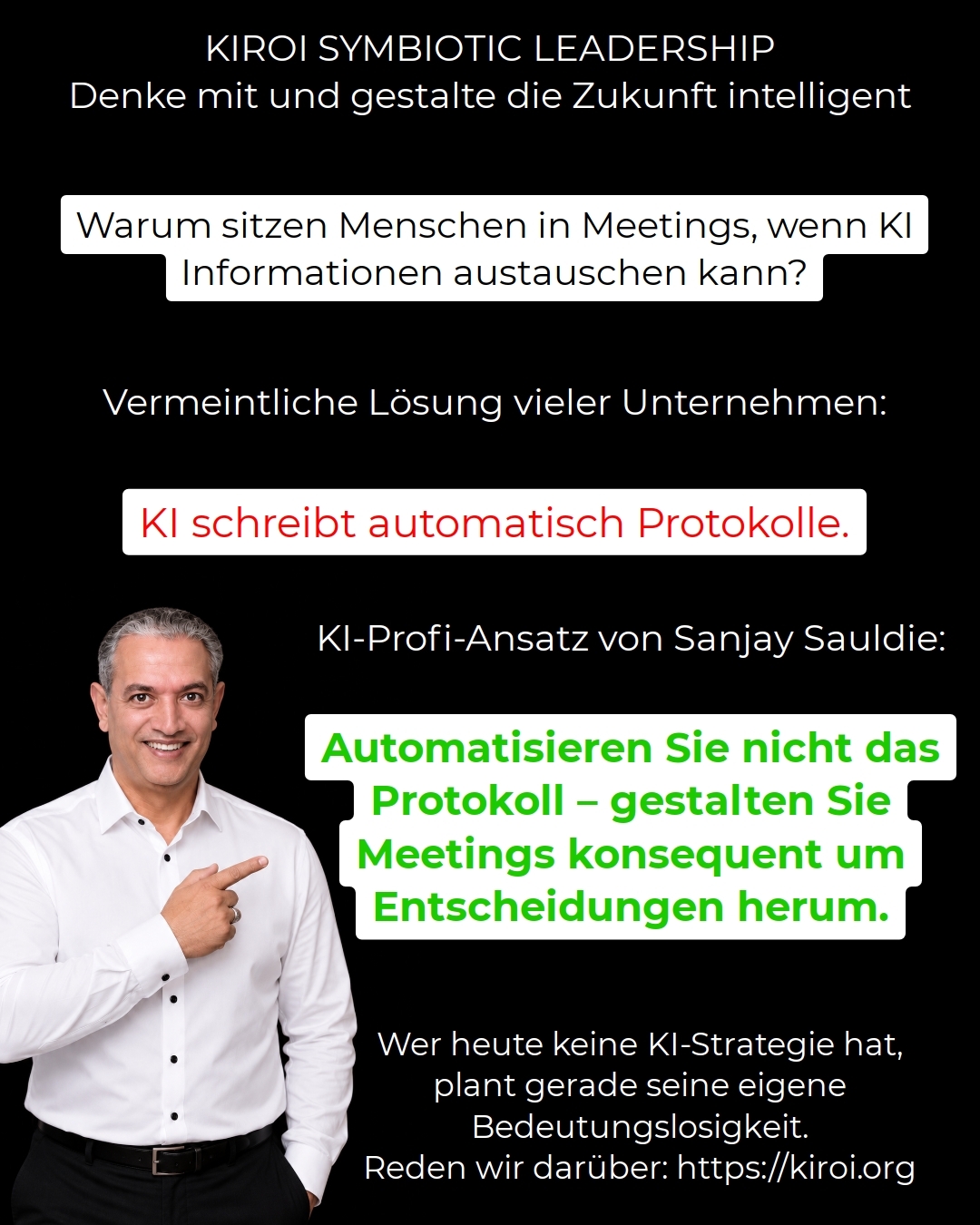
Have you ever wondered why your calendar fills up with meetings when intelligent systems could already exchange information in seconds? This question is currently on the minds of many executives who recognize that AI automatically writes minutes While it represents a tempting automation, it does not solve the real problem of the meeting culture. In a world where digital assistants can transcribe and summarize conversations, it seems paradoxical that people sit in conference rooms for hours exchanging information that could just as well flow through digital channels. But the solution lies not in the mere automation of existing processes, but in a fundamental redesign of what we understand by productive collaboration.
The dilemma of average companies: When AI writes protocols automatically
Most organizations respond to the inefficiency of their meeting culture with a straightforward step. They implement intelligent transcription tools that capture every spoken word and convert it into structured documents. This approach seems logical at first glance because it saves time in the post-meeting process and ensures that no important information is lost. However, upon closer inspection, a fundamental misunderstanding emerges. The automation of recording merely optimizes the symptom, while the underlying disease remains untreated.
Let’s consider the typical situation in a medium-sized manufacturing company. There are weekly coordination meetings where department heads report on the status of their projects. An intelligent system records these reports and automatically creates a summary. The executives receive them via email and can read them if necessary. The problem here is obvious. Why should twelve people be sitting in the same room at the same time when the same information could be shared asynchronously? The technology has automated the recording, but the fundamental question about the purpose of the meeting remains unanswered [1].
Another example is seen in development departments. There, teams are already using advanced systems that not only transcribe but also extract tasks and assign responsibilities. The efficiency of documentation has thus been multiplied. Nevertheless, executives often report that the perceived productivity has barely improved. Meetings take just as long as before, only that at the end there is a perfect record. This highlights an important insight. The quality of documentation does not necessarily correlate with the quality of decision-making [2].
Why automation alone is not enough
The temptation is to address every problem with technological solutions. When meetings are too long and unproductive, it seems logical to at least simplify the follow-up work. This mindset, however, ignores a fundamental aspect of human collaboration. The true value of a meeting lies not in the information exchanged, but in the decisions that are made together. If intelligent systems create perfect protocols but fail to produce better decisions, they merely increase the efficiency of an ineffective process.
In the logistics industry, this phenomenon is particularly evident. There, dispatchers use coordination rounds daily to plan capacity and identify bottlenecks. Automatic protocol systems reliably record these conversations. However, the actual decisions about route changes or resource shifts are often made only hours later, because the meeting itself does not provide a clear structure for decision-making. The technology documents the conversation, but it does not transform it.
Best practice with a AIROI customer
A medium-sized company in the industrial manufacturing sector approached us with a specific request that many organizations share. The management level had already implemented an intelligent transcription system that reliably created records and automatically sent them to all participants. However, the management team spent more than fifteen hours per week in various coordination rounds without feeling that this led to better decisions. As part of our support, we first analyzed the structure of all regular meetings and categorized them according to their primary purpose. It turned out that over sixty percent of the meeting time was spent on purely informational communication, which could have easily been conducted asynchronously. The remaining time was often characterized by unclear discussions in which no defined decision goal existed. Together with the leadership team, we developed a new format that consistently revolved around one or more concrete decisions for each meeting. Status reports were migrated to digital dashboards that everyone could access at any time. Meeting time was reduced by more than half, while the number of decisions actually made significantly increased. The leadership team often reported that they felt more focused and productive because each meeting had a clear purpose.
The AIROI solution: Decision-oriented transformation instead of protocol automation
The AIROI approach fundamentally differs from the strategy of accelerating existing processes through technology. Instead of automating the protocol, we question the raison d’être of each individual meeting. The central thesis is as follows. If a meeting does not require a decision that can only be made through synchronous human interaction, then it should not take place. This perspective may seem radical, but it is based on a sober analysis of what intelligent systems can and cannot do [3].
Information can be shared digitally. Status updates can be recorded in shared documents. Questions can be answered asynchronously in collaboration platforms. What requires human presence, however, are complex deliberations where different perspectives must be integrated in real time. These are situations where emotional intelligence and social dynamics play a role. And there are decisions where shared responsibility is symbolized by physical or virtual presence.
Practical implementation: How AI automatically writes logs to be meaningfully supplemented
The practical implementation of the AIROI approach begins with an inventory. Every regular meeting is then analyzed to determine which decisions are actually made there. This analysis often reveals surprising insights. Many seemingly important meetings are, in fact, merely used to distribute information or provide social support, rather than to truly make decisions.
In the next step, the identified decision-making needs are restructured. Instead of holding weekly status meetings where many topics are superficially discussed, focused decision-making sessions on specific issues are being created. The preparation for these meetings takes place asynchronously. All relevant information is shared in advance, so that the shared time is exclusively dedicated to discussion and decision-making.
An example from the field of quality assurance illustrates this change. Traditionally, weekly quality meetings take place where deviations are discussed and measures are discussed. In the transformed model, deviations are automatically recorded and analyzed in a digital system. The meeting only takes place when decisions are pending that require collective expertise. The frequency decreases, but the quality of the decisions increases [4].
Concrete examples from business practice
The transformation of the meeting culture is manifested differently in different business areas. In the human resources department, for example, traditional regular voting rounds for hiring decisions were traditionally conducted. The new approach provides for all application documents and interview notes to be accessible digitally and evaluated in advance by all parties involved. The meeting focuses exclusively on candidates with differing assessments, and a joint discussion is necessary.
In the sales department, a similar development is evident. Instead of weekly pipeline reviews where each salesperson presents their projects, the data are automatically aggregated from the CRM system. The discussion focuses on strategic decisions regarding large opportunities or situations where collective problem solving is required. The salespeople often report that they have more time for actual customer work.
In project management, the decision-oriented approach leads to a fundamental restructuring of governance. Instead of regular steering committee meetings, decision points are clearly defined and the corresponding committees are convened only when necessary. Continuous status tracking is carried out digitally and transparently for all involved parties [5].
Best practice with a AIROI customer
A senior executive from the operations department sought our guidance because the daily coordination meetings in their department, despite implemented protocol automation, showed no noticeable improvement. The situation was typical for many organizations. There was a morning meeting with all shift supervisors, a midday meeting with production planning, and an afternoon meeting for quality coordination. Each of these meetings was automatically recorded, and the summaries were distributed to all relevant parties. Nevertheless, the participants felt overwhelmed and complained that important decisions were often delayed. Our analysis showed that most of the topics in these meetings were informational in nature and did not require any real interaction. Together, we developed a digital dashboard that displayed all relevant metrics in real time and sent automatic notifications of deviations. The three daily meetings were replaced by a single focused round of decision-making that only took place when actual decisions were required for collective deliberation. On some days, this round was completely absent because all information had already been shared digitally and no open decisions were in progress. After a few months, the leader reported that the speed of decision-making had increased significantly and the perceived burden of meetings had decreased significantly at the same time.
Redefining the role of technology
In the AIROI approach, technology plays a different role than in pure protocol automation. Instead of replacing human activities, it supports the preparation and follow-up of decision-making processes. Intelligent systems aggregate relevant information, identify patterns, and prepare decision templates. They take on the time-consuming task of gathering information so that human interaction can focus on what only humans can accomplish.
An example from controlling illustrates this difference. Traditionally, controllers prepare monthly reports and present them in meetings. In the transformed model, intelligent systems analyze the data continuously and automatically identify deviations that require attention. The controller focuses on interpreting and developing options for action. The meeting focuses exclusively on decisions regarding the identified needs for action.
This realignment requires a change in mindset at all levels. Leaders must learn to relinquish control and trust that important information will reach them through digital channels. Employees must learn to work more independently and proactively communicate their decision-making needs. The organization as a whole must develop a culture in which meeting time is viewed as a valuable resource that is used only for genuine decision-making.
My AIROI Analysis
The question of why people sit in meetings when intelligent systems can exchange information leads to a fundamental reassessment of our work culture. The answer lies not in automating what we already do, but in critically reflecting on what we should actually be doing. The fact that AI automatically writes minutes While technology can enable progress, it cannot be a catalyst for transformation. It is only when we redefine the function of meetings and consistently design them around decisions that technology can fully realize its potential as a support for human collaboration.
Transruptional coaching supports leaders in this transformation. It is not about eliminating meetings or introducing technology for its own sake. It is about asking the right questions and consistently implementing the answers. Which decisions actually require synchronous human interaction? How can we optimize the preparation for these decisions? How can we ensure that the time gained is used for value-adding activities?
Companies that take these questions seriously and implement the corresponding changes often report significant improvements in several dimensions. Decision-making speed increases because focused meetings require less lead time. Decision quality improves because all parties are better prepared. Employee satisfaction grows because the perceived burden of unproductive meetings decreases. And the organization as a whole becomes more agile because decisions are made where they are needed, rather than in calendar-based rhythms.
The future of collaboration lies not in perfecting the documentation of ineffective processes. It lies in boldly redesigning how we make decisions together. Intelligent systems are valuable tools, but the actual transformation takes place in the minds of people and in the structures of organizations.
Further links from the text above:
[1] Harvard Business Review – Meetings Topic
[2] MIT Sloan Management Review – Workplace Collaboration
[3] McKinsey – Insights on People and Organisational Performance
[4] Gartner – Future of Work Insights
[5] Forrester Research – Employee Experience
Are you a leader and would you like to learn how you can genuinely introduce AI into your company in a valuable and sustainable way, away from the hype? Take part Contact us or read more blog posts on the topic Artificial intelligence here.






 Deutsch
 English (UK)