
Have you ever wondered why some companies seemingly master digital transformation effortlessly while others, despite significant investments, struggle? The answer often lies not in the technology itself, but in whether you, as a CEO, strategically employ AI or whether you are unwittingly handing over control over key decision-making processes to external consultants and automated systems. In an era where algorithmic decision support permeates virtually every business function, the conscious engagement with intelligent technologies becomes an existential leadership challenge. This article invites you to critically question your own position and gain new perspectives.
The invisible shift in decision-making power
Many executives are currently experiencing a gradual change in their role. They barely notice how algorithmic recommendation systems, automated analysis tools, and intelligent assistance systems are increasingly influencing strategic decisions. This development often occurs subtly and becomes visible only when fundamental business decisions have already been pre-structured by data and algorithms. In the manufacturing industry, for example, predictive maintenance systems are already making decisions about production shutdowns that were previously made by experienced plant managers. In retail, algorithms determine product assortment and pricing strategies, while purchasing managers merely confirm recommendations. Banks are increasingly relying on automated credit decisions, with human reviewers handling only exceptional cases.
The central question therefore is not whether intelligent systems should be deployed. Rather, the question is who retains control over these systems and how you, as a business leader, strategically deploy AI instead of gradually relinquishing control. Often, executives report that they initially showed enthusiasm for the efficiency gains, but later realized that they had delegated fundamental business understanding to systems that they no longer fully understood in terms of their functioning.
If delegation becomes dependent
The boundary between meaningful delegation and problematic dependency is fluid. A logistics company that fully automates its route planning gains efficiency and saves costs. But when management no longer understands how to optimize routes, it loses the ability to quickly and competently intervene in extraordinary events. A media company that entrusts editorial decisions to recommendation algorithms maximizes click rates in the short term. In the long term, however, it risks losing its own journalistic identity and the trust of readers. Pharmaceutical companies use machine learning for drug development, but without a deep understanding of the underlying models, critical misjudgments can arise.
Best practice with a AIROI customer
A medium-sized mechanical engineering company from southern Germany faced a typical challenge of our time. The management had invested in various intelligent systems that automated production planning, quality control, and customer service. After two years, the leadership team realized that they were becoming increasingly uncertain in strategic decisions because they could no longer critically evaluate the data base of their own systems. As part of the guidance provided by AIROI, we jointly developed a competence model that ensured that all management staff not only understood the results but also the logic of the systems used. We conducted regular strategy workshops in which algorithmic recommendations were critically questioned and compared with human expertise. Within eighteen months, the company regained control of the management and at the same time maintained the efficiency benefits of automation. The management reported that it felt again as an active participant in the company’s development, instead of merely providing recommendations.
Strategic competence as a new leadership task
The ability to not only employ intelligent technologies but also to understand and control them is emerging as the central leadership skill of our time. It is not about managers becoming data experts or programmers. Rather, it is about asking the right questions, critically evaluating results, and actively shaping the strategic direction of the systems deployed. In the insurance industry, this means questioning risk models instead of blindly accepting them. In healthcare, it requires understanding diagnostic support systems as tools, not as a substitute for medical judgment. Telecommunications companies must understand how network optimization works in order to make strategic infrastructure decisions.
When you strategically employ AI as a CEO, you position yourself as an active facilitator of digital transformation. You understand the possibilities and limitations of technology. You recognize where human judgment remains indispensable. And you retain control over the direction your company is heading.
The three pillars of strategic technology leadership
Successful executives who use intelligent systems with confidence build their expertise on three fundamental pillars. First, they develop a conceptual understanding of the technologies used, which enables them to realistically assess strengths and weaknesses. They do not have to develop models themselves, but they must understand what these models can and cannot do. Second, they establish governance structures that ensure that algorithmic decisions remain transparent, understandable, and actionable. For example, an energy provider must know how its load forecasts are generated to be able to react in unexpected situations. A hotel chain must understand how dynamic pricing works to avoid falling into price wars that damage the brand value. Third, they cultivate a corporate culture that promotes critical thinking towards automated recommendations and values human expertise.
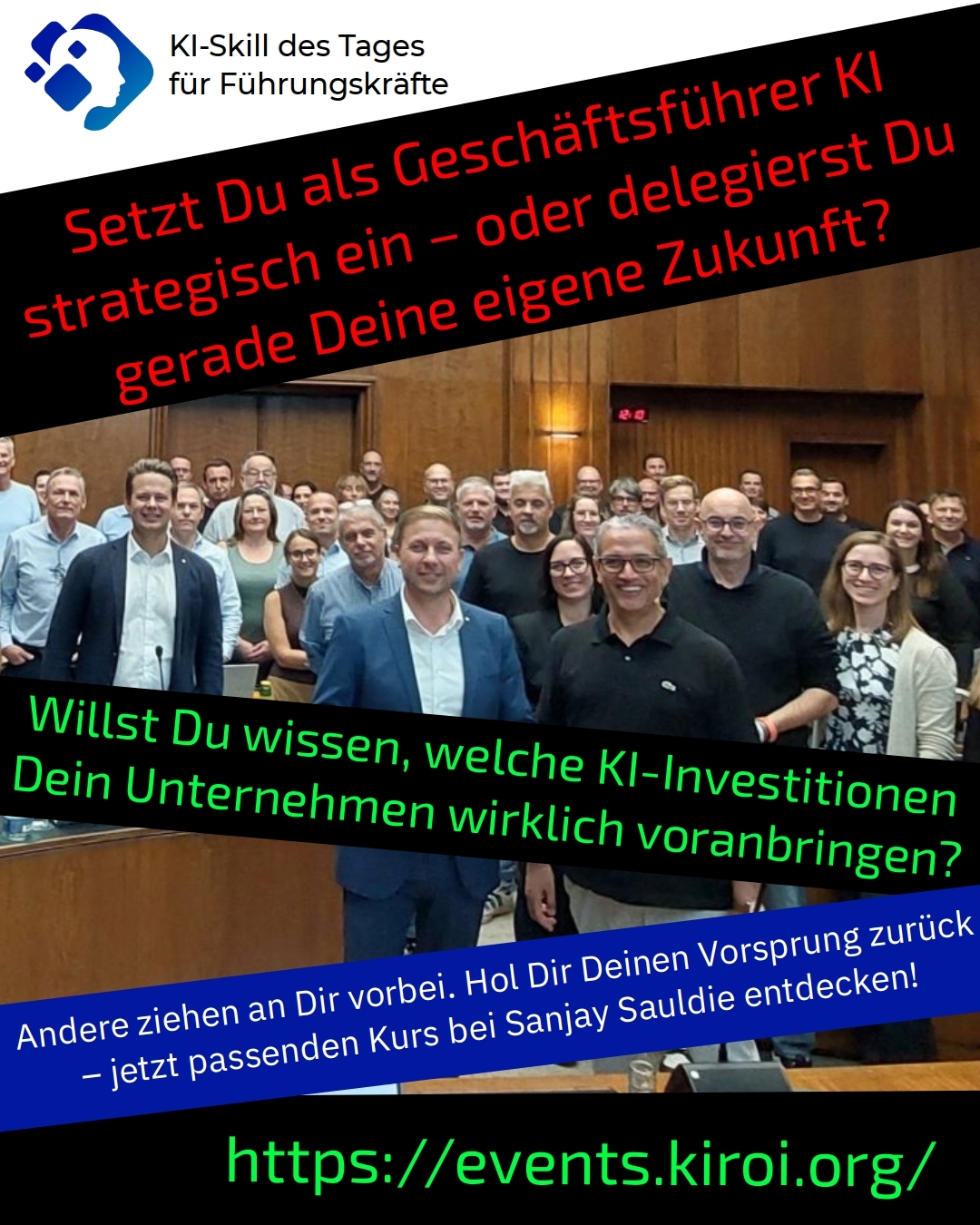
Take your existing skills to the professional level – just as over 8,000 people from over 500 companies have done with Sanjay Sauldie! Under https://events.kiroi.org/ You find ways to systematically develop your strategic technology expertise.
See through the illusion of objectivity
A common misconception is the assumption that data-driven decisions are automatically more objective and better than human assessments. This illusion can be dangerous because it leads to neglecting critical scrutiny. Every algorithmic system is based on data that was selected, prepared, and interpreted by humans. The assumptions and biases that inform these processes also shape the results. A staffing provider that automatically pre-sorts applications may reproduce historical patterns of discrimination when the training data contains corresponding biases. An real estate company that automatically evaluates locations may overlook qualitative factors that experienced agents would intuitively recognize. Automakers that fully automate quality forecasts risk overlooking subtle production problems that experienced engineers would immediately notice.
Best practice with a AIROI customer
An international trading group focused on consumer goods had implemented an advanced demand forecasting system that was intended to automatically optimize order quantities. The results were impressive until an unforeseen cultural event in a key market abruptly changed demand and the system reacted completely incorrectly. The management recognized that it had delegated control over critical supply chain decisions to a system that could not capture local cultural nuances. Together we developed a hybrid approach in which algorithmic forecasts were systematically combined with assessments from local market experts. We established escalation protocols for situations where the system and human judgment diverged. The management invested in training so that all decision-makers understood how the forecasting models worked and where their limits lay. The result was a more robust system that combined technological efficiency with human judgment and brought leadership back into the position of a strategic manager.
Responsibility cannot be delegated
Regardless of how sophisticated the systems used are, the responsibility for business decisions remains with the management. This legal and ethical reality should motivate every decision-maker to perceive the strategic control of intelligent technologies as a personal leadership task. If an algorithm makes a wrong decision, the system is not responsible; those who implemented and monitored it are. An airline whose automated booking system generates discriminatory prices cannot hide behind the technology. A chemical company whose production control leads to environmental problems bears full responsibility. If you as a manager strategically employ AI, you are consciously assuming this responsibility and ensuring that you can also bear it.
Charting the path to strategic sovereignty
Building strategic technology competence is a process that requires time, commitment, and a willingness to continuously learn. Many executives report that they were initially overwhelmed by the complexity, but later realized that it was less about technical detail and more about strategic thinking. Leaders in the textile industry do not need to understand how neural networks work mathematically. However, they must understand what these systems can do for trend forecasting and production planning. Food companies do not need an IT degree, but a clear understanding of how algorithmic supply chain optimization influences their strategic options. Construction companies benefit from the ability to critically evaluate digital planning tools and integrate them meaningfully into existing processes.
The investment in your own competence development pays off multiple times. You regain sovereignty in strategic discussions. You recognize opportunities and risks earlier. And you position yourself as a leader who actively shapes digital change, rather than being driven by it.
My AIROI Analysis
The question of whether you, as a CEO, strategically employ AI or delegate your future touches the core of what leadership means in a digitized economy. My experience from mentoring numerous companies shows that the most successful leaders are those who find a clear balance between the use of technological possibilities and the preservation of human decision-making capabilities. They understand that intelligent systems are powerful tools, but only tools. The strategic vision, ethical responsibility, and entrepreneurial judgment remain genuinely human tasks. The greatest danger lies not in the technology itself, but in the gradual abdication of leadership to algorithmic recommendations. Anyone who stops questioning, anyone who no longer wants to understand the functioning of their systems, anyone who confuses delegation with control risks not only strategic misjudgments but ultimately their own relevance as leaders. The AIROI approach offers a structured framework for finding and maintaining this balance. It supports leaders in building and maintaining technological competence without getting lost in the details. It accompanies the development of governance structures that ensure transparency and control. And it provides impetus for a corporate culture that combines technological innovation with human wisdom. The future belongs to those leaders who master this integration. They do not delegate their future – they actively shape it with all available means, but always with a clear strategic compass.
Further links from the text above:
[1] AIROI Events – Strategic Competence Development for Executives
For more information and if you have any questions, please contact Contact us or read more blog posts on the topic Artificial intelligence here.





 Deutsch
 English (UK)