
Have you ever wondered why some companies achieve little progress despite investing millions in technology, while others achieve impressive transformations with modest resources? The answer lies rarely in the quality of the software or the performance of the algorithms, but rather in a phenomenon that many executives systematically underestimate: the power of human habits. If your AI strategy If habits are failing instead of technology, you are in good company, because this challenge affects organizations of all sizes and industries. However, the exciting news is that exactly here lies a huge potential that can be unleashed with the right approaches.
The misunderstanding of technological panaceas
In numerous organizations, the persistent belief prevails that the introduction of new digital tools automatically leads to changed work practices. This assumption initially sounds plausible and logically understandable. After all, an intelligent system that takes on routine tasks should immediately relieve the employees of their workload. However, reality paints a different picture. Clients often report that new systems exist in parallel with old processes. The workforce continues to maintain its familiar work routines. The innovative technology becomes a digital dust collector.
A financial services provider invested substantial sums in an automated document analysis system that could review and categorize contracts within seconds. After six months, internal analysis showed that only twelve percent of the employees regularly used the tool. The remaining employees continued to rely on their manual review methodology. An insurance company implemented intelligent claims assessment, but the experts still reviewed each automated assessment manually. The promised efficiency gain was offset by double workload. At a private bank, customer profiles were created algorithmically, but advisors systematically ignored the recommendations.
These examples highlight a fundamental problem in the way average companies approach digital transformation. They treat technology implementation as a one-time project with a defined beginning and end. After the go-live date, they move on to the next project. The actual work, namely the embedding of new behaviors in organizational daily life, is neglected or completely skipped over.
Why new tools do not automatically change the way we work
The human brain is programmed for efficiency and prefers familiar patterns. Neuroscientific findings show that automated actions consume fewer cognitive resources than new behaviors [1]. This mechanism explains why employees instinctively revert to familiar work routines. The introduction of a new system initially requires increased mental effort. Only after repeated execution do new actions become automated routines.
In asset management, we observe this phenomenon particularly clearly. Experienced portfolio managers have developed their own analytical methods over decades. An algorithmic recommendation system not only calls their working methods into question, but also their expertise and identity. Similarly, the situation is similar for credit analysts, whose expertise is suddenly to be supplemented by machine-based evaluation models. The emotional component of this change is systematically underestimated. Compliance employees who have perfected manual verification processes for years often perceive automated controls as a threat to their professional expertise.
If yours AI strategy When efforts to change fail due to a lack of commitment to habits rather than technology, the root cause often lies in this psychological dimension. The leadership level focuses on technical implementation and neglects the human side of change. Although training courses provide instruction on how to operate new systems, they do not address the underlying behavioral patterns. This creates a gap between technical availability and actual use.
The hidden costs of unused technology
The financial implications of this discrepancy are significant and are often not fully captured. License costs for unused software permanently strain the budget. Maintenance costs for parallel systems double the administrative overhead. Training costs are wasted when the learned knowledge is not applied. Yet the greatest loss lies in the lost efficiency gains and competitive advantages that a consistent use would have enabled [2].
An asset management company calculated that partial use of its analytics platform resulted in several hundred thousand euros in potential savings annually. A regional bank found that the average processing time for loan applications had not decreased despite new technology. Employees used the system solely for documentation purposes, not for decision support. A reinsurer noted that although its risk modeling was technically state-of-the-art, underwriters hardly incorporated the results into their assessments.
The AIROI solution: Small rituals as the foundation of cultural change
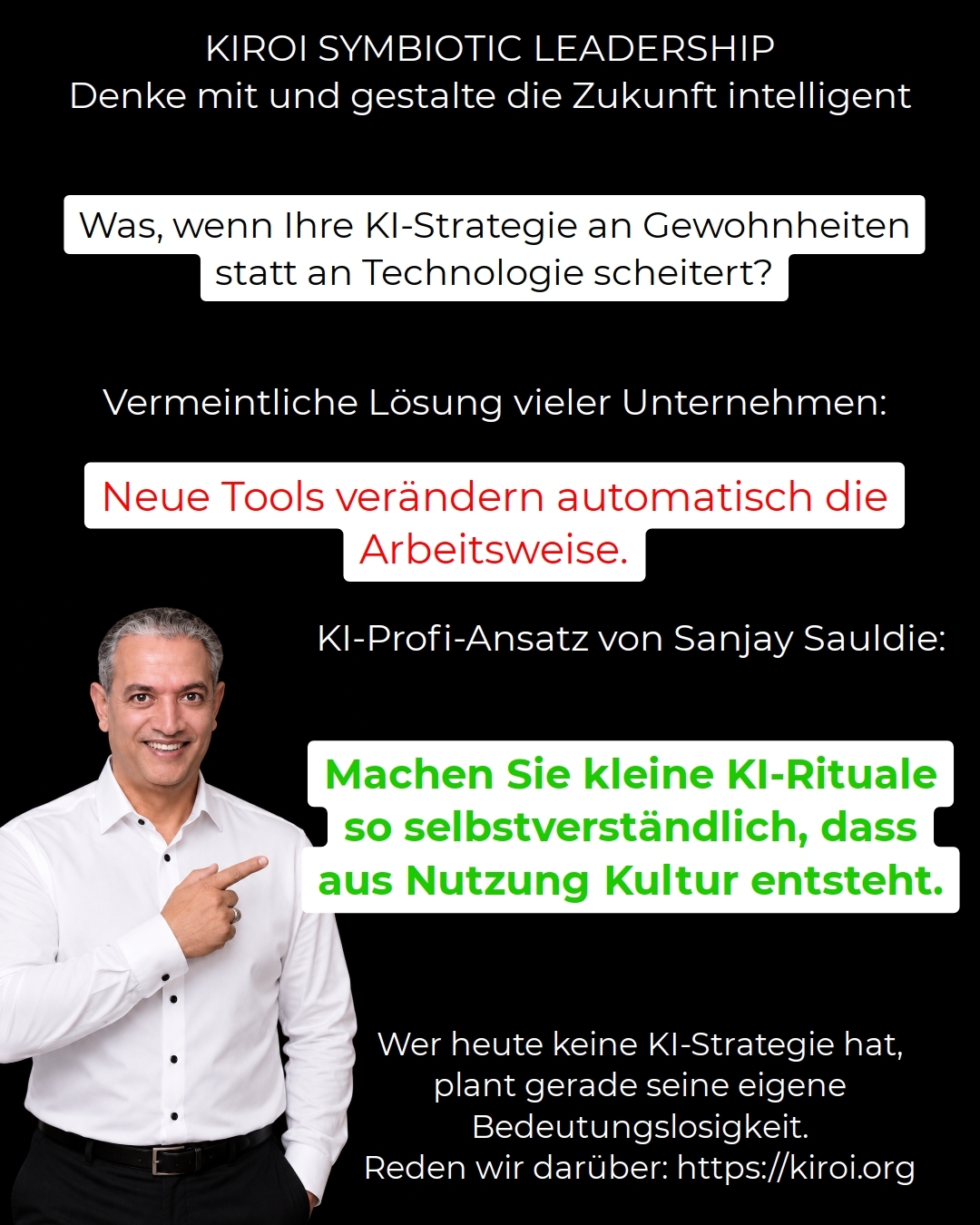
The AIROI approach, as developed within the framework of transruptive coaching, follows a fundamentally different philosophy. Instead of relying on large-scale transformation projects, this methodology focuses on establishing small, repeatable actions that gradually become self-evident. The central principle is: Make small AI rituals so natural that they become part of everyday life. This perspective shifts the focus from technical implementation to behavioral change.
A ritual differs from a mere instruction by its regular repetition and emotional anchoring. In the context of intelligent systems, this means that its use is integrated into existing work rhythms. A simple example would be the rule to take a look at the algorithmically generated insights before every customer meeting. This action takes a few minutes, but, if carried out consistently, creates a new habit. What is important is that the ritual provides immediate added value.
Best practice with a AIROI customer
A medium-sized financial institution with a focus on corporate finance faced the challenge of integrating a newly introduced credit scoring system into the daily work of its credit analysts. The initial adoption rate was disappointing at fifteen percent, although the system provided more accurate assessments than the previous manual methodology. As part of the AIROI support, the team first analyzed the points in the work process where integration would be most natural. Together with the analysts, the team developed an early morning five-minute ritual in which each employee recorded the three most important insights of the system for their upcoming cases. This short intervention was initially supported by memories and later reinforced by positive reinforcement. After three months, the evaluation showed a usage rate of eighty-seven percent, and the analysts reported increased confidence in their decisions. The decisive success factor was the connection with an existing morning ritual, namely the organizing of daily priorities. Embedding it in familiar structures significantly reduced the perceived effort and made the new intervention more quickly become natural.
The power of small steps in the AI strategy
Behavioral research confirms the effectiveness of incremental changes over radical changes [3]. Small steps bypass the natural resistance to change and enable quick success experiences. These positive experiences in turn reinforce the motivation to continue using them. This creates a self-reinforcing cycle that leads to long-term cultural acceptance.
At one fund management company, the principle was applied by having portfolio managers initially integrate only a single algorithmic indicator into their weekly analysis. This modest start significantly reduced the initial hurdle. After a few weeks, many managers spontaneously expanded their repertoire of used functions. A building society introduced a weekly team meeting where an employee shared his best experiences with the new system. This practice created social pressure and at the same time a forum for mutual learning. A factoring company established a Friday afternoon review in which automated risk assessments were compared with actual developments.
These examples illustrate how the AIROI principle is implemented in practice. The rituals are deliberately designed to be low-key and connected to immediate benefits. They do not require a fundamental change in working practices; they simply integrate organically into existing structures. This very characteristic makes them so effective.
From individual behavior to organizational culture
If yours AI strategy When efforts to change habits fail, it is not enough to simply encourage individual behavioral changes. The real challenge lies in institutionalizing these changes at the organizational level. Culture is created through shared practices, common beliefs, and collective experiences. The AIROI methodology systematically addresses all three dimensions.
Shared practices are established through team-wide rituals. For example, a leasing company introduced a monthly innovation day where departments presented their creative use cases. This event created transparency and inspired replication. Common beliefs develop through positive experiences and their communication. Collective experiences arise through shared experimentation and learning. A payment service provider established pilot groups whose findings were structured into the overall organization.
Best practice with a AIROI customer
A specialized commercial real estate financing bank had launched various digital initiatives over the years, but they never had a lasting impact. The employees were tired of change and skeptical of new projects, which made the initial situation particularly challenging. As part of the transruptive coaching process, an initial inventory of existing work routines was conducted to identify points of connection. Instead of launching another large transformation project, three minimal rituals were defined that were to be established over the next three months. The first ritual was a weekly five-minute check of automated market reports at the beginning of the team meeting. The second ritual consisted of a monthly exchange about time-saving use cases in an informal lunchtime format. The third ritual was a quarterly reflection on changed work practices within the leadership circle. These three simple practices were consistently adhered to and demonstrated by the management. After a year, the employees reported a noticeably changed attitude towards technological support, and usage rates continued to increase sustainably.
The role of leaders in cultural embedding
Leaders play a central role in the cultural adoption of new behaviors. Their own practice of the desired practices sends a strong signal to the organization. When the sales manager of a private bank demonstratively checks the algorithmic recommendations before every customer interaction, this legitimizes the same behavior among his employees. Conversely, leadership behavior that ignores the new systems undermines any transformation initiative.
The AIROI coaching supports leaders in reflecting on and adapting their own role in this process. This also includes developing new leadership rituals that embody the desired culture. For example, a CFO of a medium-sized insurance company began systematically citing insights from automated analyses in his board reports. A department manager at a savings bank integrated the question of user experiences into her regular employee discussions. These seemingly small changes in leadership behavior have a significant leverage effect.
Practical steps for implementing AIROI rituals
Implementing the AIROI approach initially requires a careful analysis of existing work routines and habits [4]. At what moments of the workday are employees most receptive to new impulses? What existing practices could serve as anchors for new rituals? What obstacles make it difficult to utilize current systems?
In the second step, suitable rituals are identified and designed. A successful ritual has several characteristics: it is easy to perform and takes a maximum of five to ten minutes. It provides an immediately tangible benefit for the person performing it. It can be integrated into existing routines. It can be easily observed and imitated by others. For example, in a mortgage broker, the ritual was introduced: calling up an automated interest rate expectation analysis before each customer consultation, which gave the advisors additional confidence in conversations.
In the third step, a gentle introduction takes place with appropriate support. This includes reminder mechanisms, feedback loops, and opportunities for sharing experiences. One collection agency used automated calendar entries as a reminder aid. Another capital management company set up a chat channel for informal exchange about usage experiences. These support structures are gradually phased out as the integration increases.
My AIROI Analysis
The experiences from numerous accompanying projects clearly show that technological excellence alone does not lead to transformation. If your AI strategy When habits fail instead of technology, the solution lies not in even more sophisticated systems but in a fundamental change in perspective. The AIROI methodology offers a structured framework that puts the human dimension of change at the center. By consistently establishing small rituals, new behaviors gradually become commonplace and, in the long term, shape a transformed organizational culture.
What is particularly noteworthy is the finding that this approach does not require additional investments in technology but rather unlocks the value of already made investments. The rituals activate existing potential and create sustainable usage habits. Clients often report that only through this cultural anchoring was the originally expected return on investment realized. The support provided by transruptive coaching helps organizations identify the rituals that are appropriate for their specific situation and successfully implement them.
The key insight is this: Successful digital transformation is not a question of the best technology, but of the smartest behavioral design. Those who understand this and act accordingly will reap the benefits of their investments, while others continue to chase the next technological promise. The future belongs to organizations that have understood that true change comes from within, through small steps, consistently pursued until they become the new normal.
Further links from the text above:
[1] Harvard Business Review – The Neuroscience of Change
[2] McKinsey – Unlocking Success in Digital Transformations
[3] ScienceDirect – The Power of Small Steps in Behavioral Change
[4] Gartner – Digital Transformation Insights
Are you a leader and would you like to learn how you can genuinely introduce AI into your company in a valuable and sustainable way, away from the hype? Take part Contact us or read more blog posts on the topic Artificial intelligence here.







 Deutsch
 English (UK)