
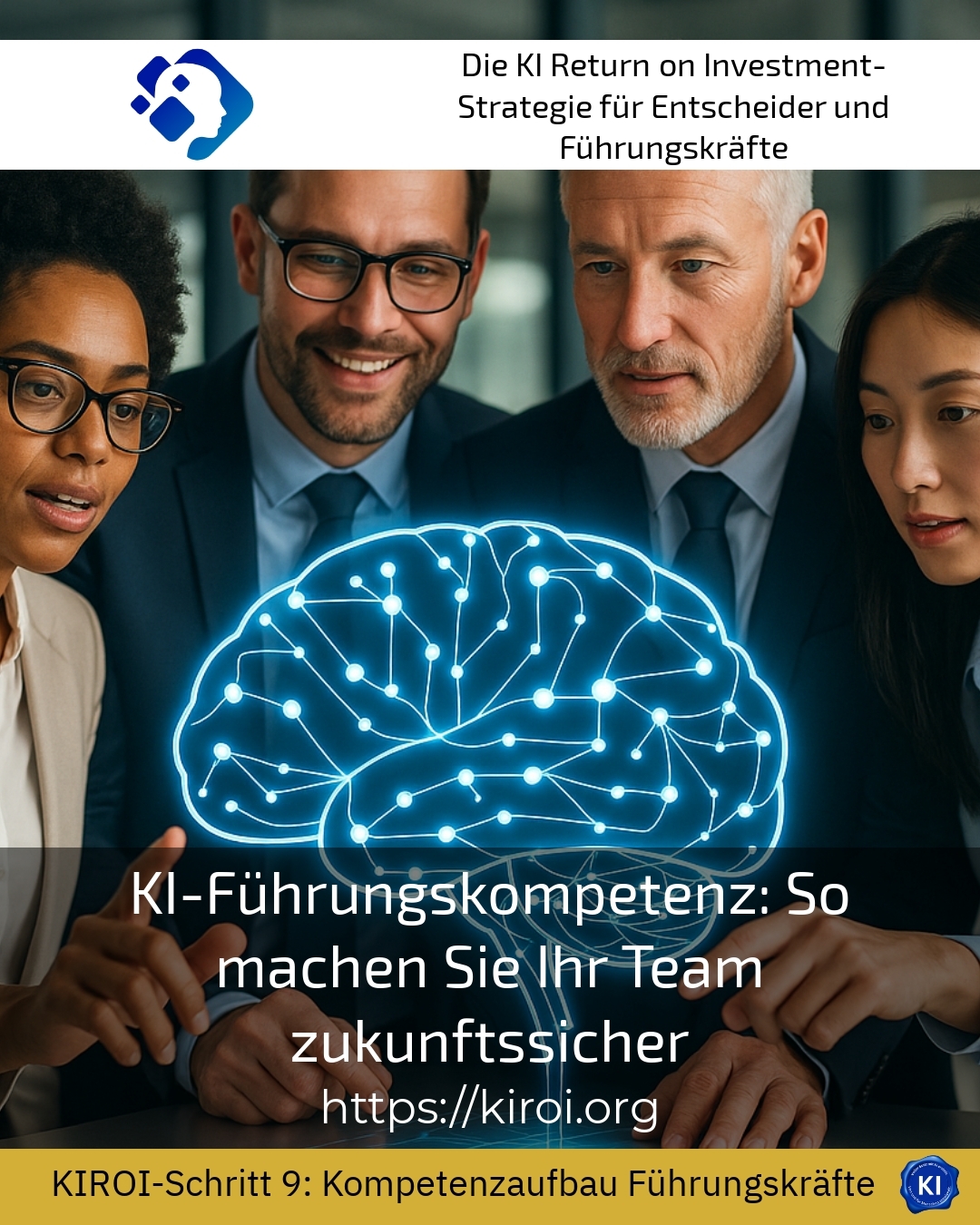
Imagine your team navigating a world that changes daily and presents new demands with confidence. It is precisely this ability that today determines the success or failure of organisations. AI leadership skills This is developing into the crucial factor for sustainable corporate success. Leaders face the challenge of preparing their employees for a future that no one can fully predict. But how can this transformation be achieved in practice? What concrete steps lead to a future-proof team? And why do so many transformation projects fail due to the human element? These questions occupy decision-makers across all industries. The following impulses show paths that have proven successful in supporting numerous organisations.
The new role of the leader in digital transformation
Leadership today means far more than the classic delegation of tasks and the monitoring of results. Modern leaders see themselves as enablers and pioneers for their teams. They create spaces where employees are allowed to experiment and learn from mistakes. This attitude often requires a fundamental rethink for experienced managers.
In the automotive industry, for instance, we're observing traditional hierarchies breaking down. Engineers are suddenly working closely with software developers and data analysts. The leader's role here is to bridge different specialist cultures and develop a shared vision. Similar developments are apparent in the financial sector, where banks are training their staff to handle algorithmic systems. New team configurations are also emerging in the healthcare sector, combining medical expertise with technological know-how.
The pharmaceutical industry faces similar challenges in integrating data-driven research methods. Leaders must build bridges between traditional lab teams and digital specialists. Retail, in turn, is fundamentally transforming its sales organisations with new analytical tools. These examples illustrate that AI leadership skills is gaining importance across all sectors.
Trust as the foundation for change
Without a solid foundation of trust, even the best transformation strategies fail in their execution. Employees who fear change will not open up to new ways of working. That's why every successful transformation begins with honest and transparent communication. Leaders should talk openly about uncertainties while offering guidance.
In the insurance industry, executives frequently report initial resistance from their teams. The worry of being replaced by automated systems initially blocks any willingness to change. It's only when leaders credibly communicate that technology is intended as support that doors open. Mechanical engineering shows similar patterns in the introduction of networked production systems. Factory workers fear the loss of their manual skills and their expert knowledge. Appreciative communication crucially supports the change here.
Best practice with a AIROI customer
A medium-sized manufacturing company faced the challenge of preparing its experienced workforce for new digital processes. The management recognised early on that purely technical training would not be sufficient to achieve genuine acceptance. As part of the transruption coaching support, we jointly developed a multi-stage concept that focused on the emotional needs of the employees. Initially, managers held open discussion rounds where concerns and worries were heard without judgment. These conversations revealed surprising insights into the team's actual fears. Many employees feared losing their recognition as experts less than they feared job losses. Based on these findings, we adapted the communication strategy and emphasised the enhancement of human skills through technological support. The managers learned to identify and actively share success stories from within the company. After six months, an internal survey showed significantly increased acceptance rates for the change projects. The key was not perfect technology, but authentic leadership communication.
Strengthening AI leadership competence through continuous development
The pace of technological change demands a permanent willingness to learn from leaders. Those who stop learning today will lose their ability to lead effectively tomorrow. This realisation is increasingly taking hold in boardrooms. At the same time, there is often a lack of time for structured further training in day-to-day leadership.
The logistics sector offers interesting approaches for integrated learning in everyday work. Managers regularly spend time observing in various company departments and experience new technologies firsthand. In the energy sector, tandem models are becoming established, where experienced managers learn from younger digital experts. The media sector is experimenting with rotating leadership roles in project teams. These diverse approaches show that learning does not necessarily have to take place in a seminar room.
Telecommunications companies are increasingly focusing on peer-learning formats among managers at different hierarchical levels. The grocery retail sector is integrating learning impulses directly into weekly management meetings. The chemical industry is also developing innovative formats for technology-oriented leadership development. All these examples illustrate how AI leadership skills can be systematically structured.
Develop future competence profiles
Many organisations are currently working on defining new competency profiles for their leaders. The focus is less on technical detail knowledge and more on meta-competencies for dealing with complexity. The ability to recognise interrelationships and think systemically is becoming increasingly important. Equally important is the competency to orchestrate heterogeneous teams and integrate different perspectives.
In the aviation industry, we are observing a reorientation of leadership selection based on these criteria. Technical brilliance alone no longer qualifies individuals for leadership roles in complex project environments. The construction sector is increasingly defining bridge competence between traditional craftsmanship and digital planning as a key qualification. The textile industry is seeking leaders who can combine sustainable production with data-driven process optimisation.
Actively shape team dynamics in transition
The introduction of new technologies often fundamentally and unexpectedly changes established team dynamics. Hierarchies shift when younger team members possess sought-after specialist knowledge. At the same time, the experience of long-serving employees remains indispensable for the company. Leaders must value these different forms of knowledge and combine them productively.
The steel industry offers impressive examples of such intergenerational dialoguing in practice. Experienced steelworkers share their implicit process knowledge with data analysts, who identify new optimisation potential. Shipbuilding deliberately creates spaces for interaction between traditional engineers and simulation specialists. In the furniture industry, mixed teams are formed comprising craft-trained specialists and designers with digital expertise.
Best practice with a AIROI customer
A long-established organisation within the service sector commissioned us to support a comprehensive team transformation. The existing departmental structure was to be replaced by agile units capable of reacting more quickly to customer needs. The management team faced the challenge of bringing together long-serving employees and new specialists into functioning teams. In transruption coaching, we initially worked on the individual attitudes of the leaders towards change. Many of them had to reflect on their own reservations about the new working methods before they could credibly lead their teams. Together, we developed formats for knowledge transfer between experienced and new team members. A weekly exchange format, where employees presented their respective competencies, proved particularly effective. This mutual recognition reduced inhibitions and created a shared identity. The managers learned to moderate such exchanges and to allow productive conflicts. After one year, team members reported significantly increased job satisfaction and innovative strength. The organisation recorded measurable improvements in its speed of reaction to market changes.
Psychological safety as a driver of innovation
Teams that feel secure dare to do more and develop more innovative solutions for complex challenges [1]. This research finding is regularly confirmed in the practical support of transformation projects. Leaders significantly shape whether psychological safety emerges in the team through their behaviour. An open approach to their own mistakes signals to the team that errors are part of the learning process.
In the advertising industry, agencies are experimenting with failure-friendly retrospectives after project completion. Software development has already established formats for constructive feedback with agile methods. Tourism is increasingly transferring such approaches to its service organisations. This cross-industry movement shows that psychological safety is not a luxury issue, but offers tangible competitive advantages.
Strategic Perspective: Future-proofing through holistic AI leadership competence
The future viability of organisations depends crucially on the quality of their leadership. Technological investments alone do not create a sustainable advantage if the human component is neglected. Leaders who take their own development seriously become role models for learning organisations. This role model function cannot be delegated or replaced by policies.
Water management impressively demonstrates how long-term infrastructure planning can be combined with agile team leadership [2]. Rail transport is transforming its leadership culture in parallel with the technological modernisation of its fleet. The waste management sector is also developing new leadership approaches for the circular economy. These examples show that securing the future requires a holistic understanding of leadership.
The real estate sector is integrating sustainability requirements and digital building control into its leadership concepts. The cultural sector is experimenting with participatory leadership models in an era of digital audience expansion. Sports organisations are combining data-driven performance analysis with people-centric athlete support. All these developments show that genuine AI leadership skills goes far beyond technical understanding.
Sustainable anchoring of transformation success
Many change initiatives fail not due to a lack of initial momentum, but due to a lack of staying power. Initial successes often materialise faster than expected, creating a euphoric sense of momentum. However, this is frequently followed by a phase of disillusionment as everyday realities test the new practices. Leaders must anticipate these phases and guide their teams through periods of difficulty.
The beverages industry has gained experience with such transformation processes during the introduction of connected production lines. The furniture retail sector had to make several attempts before the omnichannel strategy became rooted in everyday management. The printing industry also went through painful learning curves on its way to becoming a digital media service provider [3].
My AIROI Analysis
Having supported numerous organisations over the past few years has given me deep insights into the success factors of future-proof leadership. The most important realisation is that technological competence without human maturity is futile. Leaders who want to achieve real impact must first work on their own attitude. Many underestimate this inner work because it appears less tangible than technical qualification.
At the same time, I am observing a growing willingness in leadership teams to engage in profound reflection processes. The realisation that traditional leadership patterns are reaching their limits is becoming increasingly prevalent. Organisations that invest early in the development of their leaders will achieve long-term competitive advantages.
The AIROI methodology offers a structured framework that enables both individual and organisational development. Clients particularly value the connection of strategic direction with practical implementation support. Success is demonstrated not in spectacular individual results, but in the sustainable change of leadership behaviour.
For the coming years, I predict a further acceleration of change in almost all industries. Organisations will increasingly seek guidance that combines technological understanding with leadership expertise. The greatest challenge will be to balance the pace and depth of transformation. Leaders who master this balance will successfully guide their organisations into the future.
Further links from the text above:
[1] Google re:Work – Guide: Understand team effectiveness
[2] McKinsey – How HR can help build the organisation of the future
[3] Harvard Business Review – Digital Transformation Isn't About Technology
For more information and if you have any questions, please contact Contact us or read more blog posts on the topic Artificial intelligence here.








 Deutsch
  English (UK)