
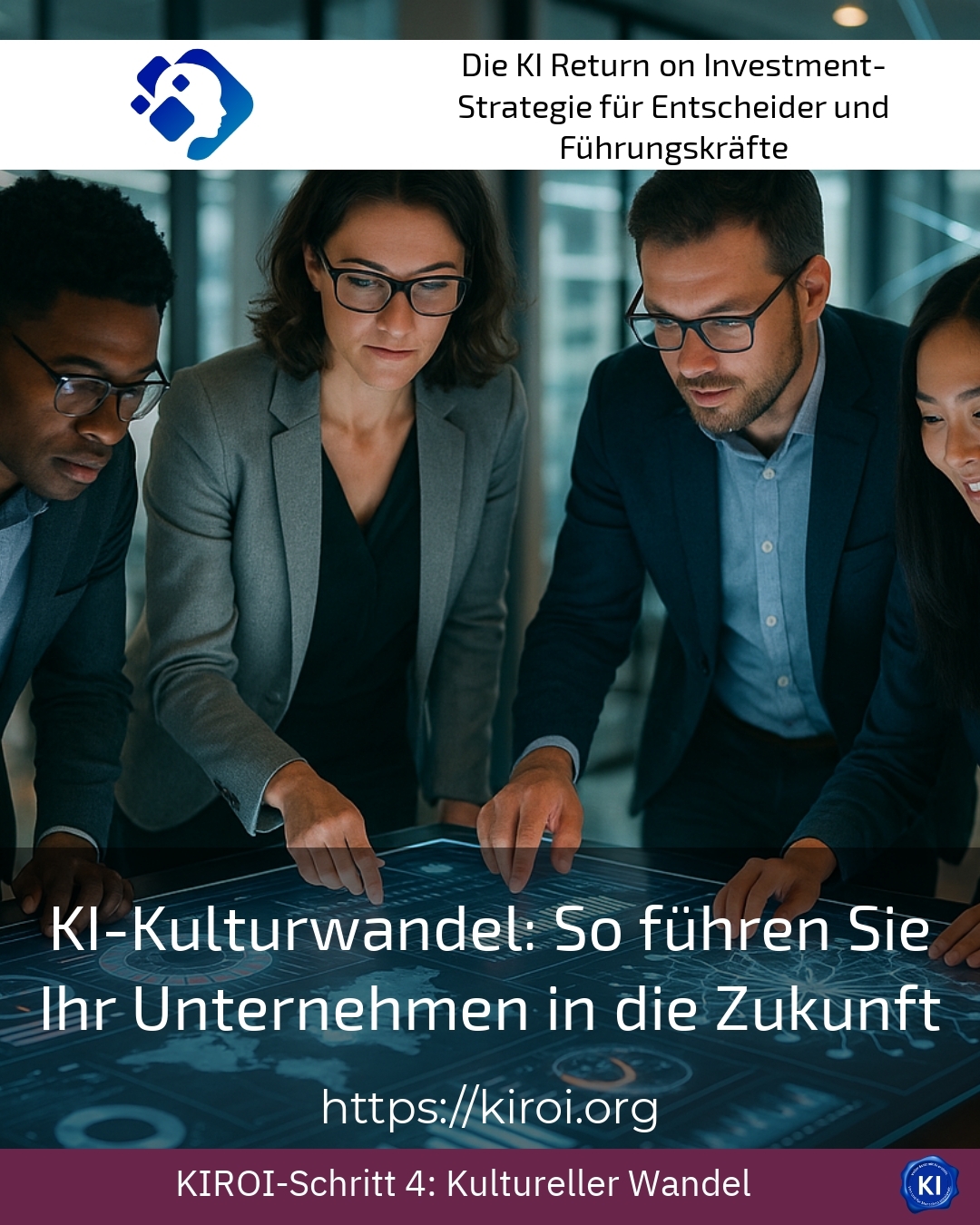
Imagine your employees embracing new technologies with enthusiasm rather than scepticism. This shift is possible. The AI cultural change decides today which companies will still be relevant tomorrow. However, many managers underestimate the human dimension of this transformation. They invest millions in technology while forgetting the people. Yet, this is precisely where the key to success lies. In this post, you will learn how to transform your company sustainably.
Why the AI culture shift requires more than just technology
The introduction of intelligent systems rarely fails due to the technology. It fails due to the people. Clients often report massive resistance within their teams. Employees fear for their jobs. Managers do not fully understand the new possibilities. And the company culture remains stuck in old patterns. That is why a holistic approach is needed.
A medium-sized manufacturing company wanted to automate its quality control. The technology worked flawlessly. However, the production staff unconsciously sabotaged the system. They didn't trust the algorithms. The situation only changed when management invested in training and open dialogue. The staff understood the benefits for their daily work.
A logistics company implemented intelligent route planning. Initially, the drivers consistently ignored the suggestions, preferring to rely on their experience. The company subsequently organised workshops. There, the drivers were able to voice their concerns. Together, all stakeholders developed suggestions for improvement. This led to genuine acceptance.
A trading company introduced automated stock forecasts. The buyers felt overlooked. They had built up years of expertise. Suddenly, a system was supposed to make their decisions. Management recognised the mistake. It positioned the technology as support, not a replacement. The buyers became experts in optimising the system.
Best practice with a AIROI customer
A long-established family business in the manufacturing sector faced a tremendous challenge. Management wanted to introduce intelligent systems across all areas of the company. However, the workforce reacted to these plans with great scepticism. Many employees had worked for the company for decades and feared for their positions. Transruption coaching supported the company intensively over several months. Initially, we conducted in-depth discussions with all hierarchical levels. During these, we identified the employees' biggest concerns and fears. Subsequently, together with the management team, we developed a transparent communication strategy. This strategy consistently placed people at the centre of all changes. We organised regular information events for the entire workforce. There, all employees could openly ask their questions and receive honest answers. Additionally, we established an internal ambassador programme with particularly dedicated employees. These ambassadors received intensive training and disseminated their knowledge to their departments. After six months, the atmosphere in the company had fundamentally changed. Employees now saw the new technologies as an opportunity rather than a threat. Productivity increased measurably, and staff turnover decreased significantly.
The five pillars of a successful AI cultural change
Sustainable transformation is based on several fundamental pillars. These pillars support each other. If one is missing, the entire endeavour becomes unstable. Therefore, leaders should consider all aspects simultaneously.
Transparent Communication as the Foundation
Openness builds trust. Employees need to understand why changes are necessary. They need honest answers to their questions. And they deserve regular updates on the progress of the transformation.
An insurance company informed its employees weekly about new developments. Management personally answered all questions in town hall meetings. This openness considerably reduced rumours and speculation. Employees felt taken seriously.
A bank set up an anonymous feedback platform. Employees could express their concerns there without fear. Management responded publicly to every piece of feedback. This practice sustainably strengthened trust in the leadership team.
An energy supplier produced short explanatory videos for its workforce. These videos explained complex technical interrelationships understandably. Employees could access the content at any time. This significantly improved their understanding of the changes.
Continuous professional development for all levels
Knowledge reduces anxiety. Those who understand how new systems work can make better use of them. That is why further training is a central success factor. It should involve all hierarchical levels.
A mechanical engineering company developed a comprehensive training programme. Every employee received at least two days of training per quarter. The content ranged from basic principles to advanced applications. This led to the development of genuine expertise throughout the company.
A pharmaceutical company implemented peer-learning groups. Experienced employees trained their colleagues. This approach fostered knowledge sharing and strengthened team cohesion. The learning curve accelerated considerably as a result.
A telecommunications provider cooperated with a university. Employees were able to obtain part-time certificates. The company covered the costs in full. This investment paid off through increased employee retention.
Leaders as role models in change
Change begins at the top. Leaders must embody transformation. Only then can they convince their teams. Their attitude influences the entire organisation.
The CEO of a car parts supplier demonstratively used new analytical tools in meetings. He publicly showed how he himself was learning. This authenticity inspired many employees. They realised that learning is not a weakness.
The managing director of a media company documented her learning journey in an internal blog. She openly shared both her successes and setbacks. This transparency created a culture of psychological safety.
A sales manager at a consumer goods manufacturer experimented publicly with new tools. He actively sought feedback and suggestions for improvement from his team. This openness fostered a collaborative atmosphere throughout the sales department.
Best practice with a AIROI customer
An international service provider with several thousand employees sought support in transforming its corporate culture. Previous attempts had failed because middle management had not come on board. This leadership level felt particularly threatened by the changes. Many managers feared that their control functions could become obsolete. Transruptions Coaching developed a special programme for this target group. In intensive workshops, we worked on the personal fears and hopes of the managers. We presented concrete new role models that would emerge in the changed organisation. The managers recognised that their leadership skills would still be needed. They understood that only the nature of their work would change. In addition, we established regular coaching sessions for particularly challenged managers. This individual support gave them security in uncertain times. After one year, most managers had developed into active drivers of the transformation. They passed on their enthusiasm to their teams, thereby significantly accelerating the entire process.
Typical challenges and effective solutions
Every transformation brings challenges. These challenges are normal and surmountable. The key is how you deal with them. Experienced guidance can provide valuable impetus.
Many companies struggle with silo thinking. Departments work in isolation from each other. This significantly hinders the integration of new systems. One chemical company solved this problem through cross-functional project teams. Employees from various areas worked together on solutions.
Another common topic is the fear of job loss. This concern is understandable and justified. One retail company addressed it with a clear job guarantee. No one would be made redundant due to automation. Instead, the company invested in retraining.
Technical overload also occurs frequently. Not all employees are tech-savvy. A construction company therefore opted for low-threshold introductory offers. Simple applications created initial successes. These successes motivated further learning steps.
The AI cultural shift as a continuous process
Transformation is not a one-off project. It is a perpetual journey. Companies must constantly evolve. Stagnation means falling behind in a changing world.
A financial services provider established a permanent innovation unit [1]. This unit continuously identifies new opportunities. It tests promising approaches in small pilot projects. Successful pilots are then rolled out across the entire organisation.
A healthcare company introduced regular retrospectives [2]. In these, teams collectively reflect on their experiences. They identify areas for improvement and implement them. This iterative approach fosters continuous learning.
A technology company regularly measures the progress of its transformation. Special key figures show the current status. This transparency enables targeted interventions when needed.
The Role of External Support in Transformation
External perspectives enrich any change process. They bring in fresh ideas and tried-and-tested methods. Furthermore, they can act as neutral intermediaries. This considerably simplifies difficult conversations.
Transruption coaching clearly positions itself as support for digital transformation projects. It's not about ready-made solutions. Instead, companies develop their own paths with professional assistance. This support provides impetus and direction.
A property company used external support for its cultural change. The consultants neutrally moderated critical workshops. They spoke uncomfortable truths that internal staff were unable to voice. This significantly accelerated the learning process.
An industrial company engaged external expertise during the development of its transformation strategy [3]. The external expertise helped to avoid common mistakes. The company benefited from the experiences of other organisations.
A retail group commissioned coaches for its leadership development. The individual support assisted managers in challenging situations. They learned new leadership skills for the changing world of work.
My AIROI Analysis
The transformation of companies through intelligent technologies is inevitable. However, the success of this transformation depends crucially on cultural change. Technology alone does not solve problems. It amplifies existing structures and behaviours. Therefore, companies must first work on their culture. The AI cultural change requires time, patience, and consistent commitment from leadership. It demands transparent communication, continuous training, and authentic role-modelling.
The examples presented demonstrate that successful transformation is possible. However, they also show that the path to achieving it is rarely straightforward. Setbacks are a part of the process and are integral to the learning curve. What's crucial is the willingness to learn from mistakes and adjust the course.
Companies that invest in their culture today will be successful tomorrow. They will be able to attract and retain the best talent. They will be able to react faster to market changes. And they will be able to better leverage the opportunities of new technologies than their competitors. Investing in people is the best investment in the future. Because ultimately, it is always people who make companies successful.
Further links from the text above:
[1] Harvard Business Review – Innovation Management
[2] McKinsey – People & Organisational Performance Insights
[3] Gartner – Information Technology Research
For more information and if you have any questions, please contact Contact us or read more blog posts on the topic Artificial intelligence here.








 Deutsch
  English (UK)