
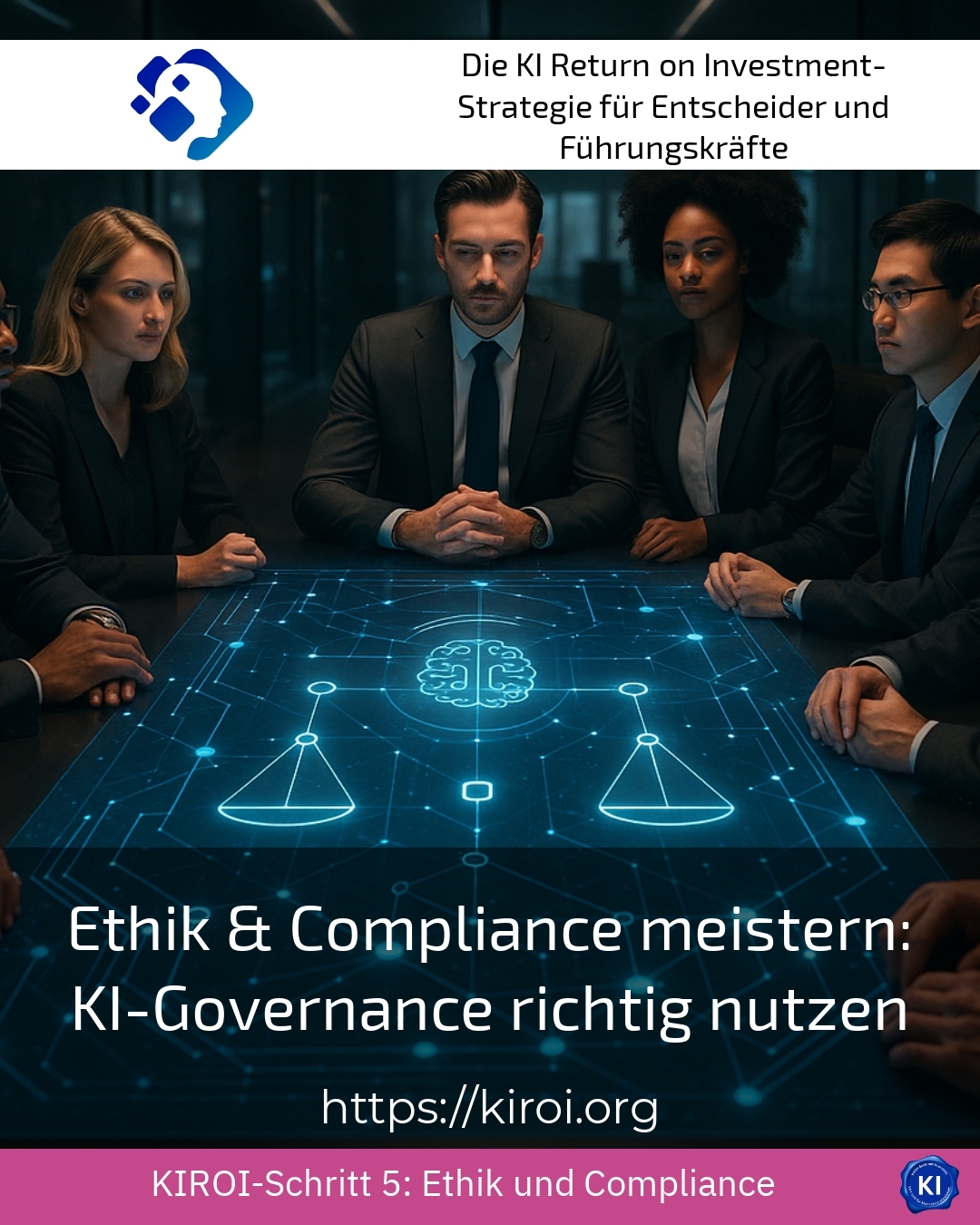
Imagine your organisation is facing a challenge that could determine success or failure. The integration of intelligent systems is currently fundamentally changing every business process. In doing so, the topic of Using AI governance effectively to the crucial success factor for sustainable corporate management. Many executives report uncertainties due to a lack of clear guidelines and constantly increasing regulatory requirements. At the same time, enormous opportunities are opening up for organisations that act early and create structured frameworks. This article will guide you on the path to responsible implementation that builds trust and supports economic success.
The fundamental importance of responsible technology governance
In an era where algorithmic decision-making systems are increasingly intervening in business processes, the question of how to properly govern these technologies is becoming a central concern for both boards of directors and supervisory boards. It is becoming apparent that organisations with well-thought-out governance structures can often achieve a significant competitive advantage. The complexity of this task arises not least from the fact that technical innovations are progressing at a rapid pace, while regulatory frameworks often lag behind, forcing companies to operate in a tension between the pressure to innovate and compliance requirements.
Clients frequently report facing the challenge of reconciling ethical principles with business objectives, and consequently require support in developing practical guidelines. In the financial sector, for example, credit institutions use algorithmic systems for credit scoring, whereby the comprehensibility of decisions for customers and regulatory authorities must be guaranteed. Insurance companies use comparable technologies for risk assessment, but face the task of identifying and excluding discriminatory patterns in training data. Investment firms that use automated trading systems must also ensure that these operate in compliance with market rules and do not pursue manipulative strategies.
Why traditional compliance approaches are reaching their limits
Traditional compliance structures were designed for a world where decisions could be made and documented by humans, which is why these approaches are often insufficient when monitoring autonomous systems. The challenge is that self-learning algorithms continuously adapt their behaviour, thereby creating decision-making processes that are difficult even for developers to understand. For example, banks face the task of maximising detection rates and minimising false positive alerts in automated money laundering prevention, without compromising transparency towards regulatory authorities.
Fund managers who rely on algorithmic portfolio management must be able to demonstrate that their systems comply with fiduciary duties to investors. Pension funds deploying artificial intelligence for long-term asset planning are confronted with the question of how to ensure the robustness of their forecasting models over decades. These examples illustrate that purely rule-based compliance is no longer sufficient and that a more comprehensive governance approach, integrating ethical principles, technical standards, and organisational processes, is therefore required.
Best practice with a KIROI customer
A medium-sized financial services company approached us because they encountered significant resistance from their compliance department when implementing an automated customer advisory system. The initial situation was characterised by uncertainty, as there were neither clear internal guidelines nor established industry standards for the use of such systems, and management feared regulatory consequences for an inadequately prepared rollout. As part of our support, we worked with the company to develop a multi-stage governance framework that addressed both the technical requirements for transparency and explainability, as well as organisational aspects like responsibilities and escalation processes. Particularly important was the involvement of all relevant stakeholders, from developers and the legal department to customer service representatives, who could contribute valuable insights into potential risks from a customer perspective. The result was a documented process model that not only met regulatory requirements but also served as a template for future technology projects, helping the company to increase its pace of innovation without compromising due diligence. Following the project's completion, the compliance department reported feeling truly empowered to competently support technological innovations for the first time, rather than instinctively blocking them.
Leveraging the strategic dimensions of AI governance correctly
Developing an effective governance strategy requires a deep understanding of the various dimensions that need to be considered when steering intelligent systems, ranging from technical aspects such as data quality and model validation to organisational issues of responsibility allocation and decision-making authority. In consulting practice, it repeatedly becomes apparent that successful implementations do not depend solely on technical expertise, but significantly on the ability to integrate different perspectives and establish a common ethical framework.
For example, asset managers face the task of comprehensibly documenting their investment strategies, especially as they are increasingly influenced by algorithmic recommendations, while simultaneously maintaining client trust. Payment service providers that use machine learning for fraud detection must ensure that their systems do not systematically disadvantage certain customer groups, while simultaneously maximising the detection rate for actual fraud attempts. Leasing companies that conduct automated contract reviews also face the challenge of balancing increased efficiency with individual customer care.
Practical approaches for organisational embedding
One of the most important insights from our support work is that governance structures are only effective when they are deeply embedded in the organisational culture and not perceived as an external set of rules to be circumvented. This requires a participatory approach to policy development, where employees from various departments are actively involved and can contribute their practical experience. For example, credit unions that wish to support their member advisory services through intelligent assistance systems benefit from involving advisors early in the development process and leveraging their expertise in designing human-machine interaction.
Securities trading firms developing algorithmic trading strategies often report that establishing an interdisciplinary governance committee bringing together traders, risk managers, and IT specialists leads to better outcomes than a purely hierarchical oversight structure. Similarly, factoring companies using automated risk models for receivables valuation can continuously improve their systems' quality through regular feedback loops between operational units and the model development team.
Ethical principles as guardrails
The formulation of ethical fundamental principles forms the foundation of any sustainable governance strategy, whereby these principles must be concrete enough to guide action in practice, and at the same time flexible enough to be transferable to different application contexts [1]. Transparency, fairness, accountability, and data protection are central values here, which have a special significance in the financial industry due to the particular trust relationship with customers. For example, building societies (Bausparkassen) that use scoring models for lending must ensure that their decision criteria are free from discrimination and can be explained to applicants upon request.
Private equity firms utilising artificial intelligence to identify promising acquisition targets face the ethical question of the extent to which they are obliged to disclose the role of algorithmic analyses in their decision-making processes. Similarly, debt collection companies employing automated communication systems for debtor contact must consider how to achieve efficiency gains without violating the dignity of the individuals concerned. These examples illustrate that ethical principles must not remain abstract but need to be operationalised into concrete guidelines for action.
Best practice with a KIROI customer
An internationally active asset management firm approached us because they wanted to develop a comprehensive ethical framework for the use of intelligent systems in investment advice, which would comply with the regulatory requirements of various jurisdictions and reflect their own high standards of customer care. The particular challenge lay in the fact that the company already had several algorithmic systems in use, which had evolved historically and whose development had not been guided by uniform principles, thus requiring subsequent harmonisation. We supported the company in conducting a comprehensive ethics audit, during which all existing systems were systematically checked for compliance with defined fundamental principles, employing both technical analyses and interviews with users and affected customer groups. Based on this assessment, we jointly developed a catalogue of principles with the management team, which serves as a binding framework for all future development projects and contains clear criteria for the ethical evaluation of new applications. A key success factor was the establishment of an Ethics Board, which meets regularly and performs both advisory and decision-making functions on complex issues. The asset management firm reports that this structured approach has not only strengthened customer trust but has also led to increased sensitivity to ethical issues internally, which has a positive impact on the entire corporate culture.
Continuous monitoring and adjustment of governance structures
Another key insight from our consultancy work is that Using AI governance effectively does not represent a one-off project, but requires a continuous process of monitoring, evaluation, and adaptation [2]. This is particularly true for self-learning systems, whose behaviour changes over time and therefore require regular review to ensure they continue to operate in line with defined principles. For example, publicly traded financial service providers must continuously monitor their algorithmic trading systems to detect unintended market effects early on and make appropriate adjustments.
Credit card companies using machine learning for fraud prevention face the challenge of regularly recalibrating their models for new fraud schemes without negatively impacting the customer experience through overly restrictive security measures. Similarly, mortgage lenders utilising automated property valuation models must continuously validate their systems to ensure they adequately reflect market changes and do not develop systematic biases.
The role of external support in transformation processes
The complexity of the challenges involved in the responsible integration of intelligent systems leads many organisations to seek external guidance to benefit from experiences in other contexts and identify blind spots in their own perspective. Transruption coaching positions itself as a guide for projects that address both the technical and organisational and cultural dimensions of transformation and aim to support holistic development. The impulses introduced through external perspectives often help to open up stagnant discussions and develop new approaches to solutions.
Financial holdings that manage multiple subsidiaries with different business models, for instance, benefit from external support that assists in developing a group-wide governance framework while taking into account the specific requirements of individual entities [3]. Asset managers who are increasingly digitalising their investment processes report that collaborating with specialised consultants has helped them identify potential risks early on and address them proactively. Neobanks, which are digitally oriented from the ground up, can also benefit from external input to ensure that their rapid scaling does not come at the expense of the ethical integrity of their systems.
How Using AI governance effectively creates competitive advantages
Organisations that invest early in robust governance structures are not only positioning themselves for regulatory compliance but can also leverage this as a competitive differentiator, as customers and business partners increasingly value demonstrable ethical standards. Sustainability-focused investment funds employing algorithmic screening tools for ESG assessments can enhance their credibility with ethically minded investors through transparent governance practices. Family offices specialising in discretionary asset management report that the ability to clearly explain how their technical systems operate solidifies trust with their sophisticated clients.
Robo-advisor platforms, which offer automated investment advice to retail clients, face the particular challenge of communicating complex algorithmic decisions in a way that can be understood by users with less technical expertise, requiring thoughtful governance and clear communication standards. These examples illustrate that ethical governance should be understood not as a cost factor, but as an investment in sustainable business success.
My KIROI Analysis
Following intensive consideration of the diverse aspects of responsible control of intelligent systems, a clear picture emerges: organisations that act proactively and develop structured governance frameworks will be better positioned in the long term than those that wait reactively for regulatory requirements. The integration of ethical principles, technical standards and organisational processes requires a holistic approach that brings together different perspectives and is continually developed. It is particularly noteworthy that successful implementations are always supported by strong backing from corporate management, who see governance not as a hindrance, but as an enabler for sustainable innovation.
The financial industry faces particular challenges, as it is traditionally heavily regulated and simultaneously exposed to enormous pressure for innovation, requiring a particularly careful balance. However, the experience gained from our advisory work shows that this challenge is manageable if companies are willing to invest in interdisciplinary teams and foster a culture of open discussion on ethical issues. The future belongs to those organisations that understand that technological excellence and ethical integrity are not opposites, but can mutually reinforce each other if they are considered together from the outset. In this sense, the current transformation phase offers a unique opportunity to establish governance structures that not only meet today's requirements but are also flexible enough to keep pace with future developments.
Further links from the text above:
[1] European Parliament on AI Regulation and Ethical Guidelines
[2] BaFin – Supervision of Banks and Financial Service Providers
[3] OECD Principles on Artificial Intelligence
For more information and if you have any questions, please contact Contact us or read more blog posts on the topic Artificial intelligence here.











 Deutsch
  English (UK)