
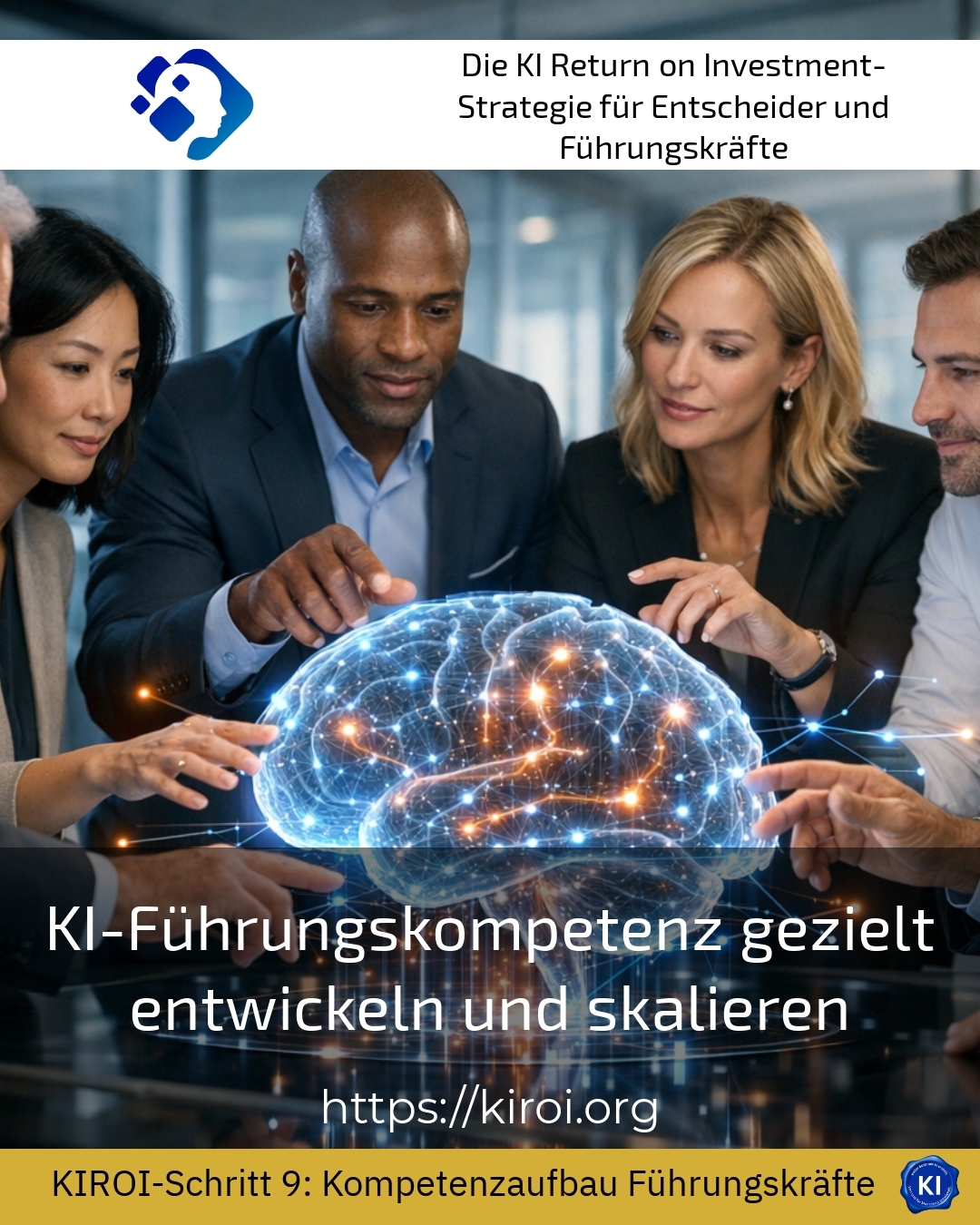
How do companies succeed in systematically preparing their executives for the challenges posed by intelligent technologies and in doing so anchor sustainable changes across the entire organization? This question currently concerns many decision-makers in a wide range of industries. The targeted development of AI leadership skills It is becoming increasingly the decisive competitive factor. At the same time, we observe that traditional forms of further education are often insufficient to meet the complex requirements of digital transformation. Leadership figures must today not only understand the technological fundamentals but also develop strategic visions and be able to accompany their teams through phases of intense change. Transruptive coaching offers valuable support in projects related to these multifaceted transformation processes.
The strategic importance of modern leadership skills in the technological age
The requirements for executives have fundamentally changed in recent years. While previously primarily expertise in specific fields and classic management skills were sought, today holistic competencies are taking center stage, combining technological understanding with human-centered leadership. In the manufacturing industry, for example, we are seeing production managers suddenly having to deal with autonomous systems. They need a basic understanding of machine learning. At the same time, they must lead their employees through these changes. The financial sector faces similar challenges. There, institutions are increasingly relying on automated decision-making processes in lending. The responsible executives must understand how these systems work. Only then can they assess ethical implications and meet regulatory requirements.
Another striking example comes from the healthcare sector. Clinic management is increasingly integrating diagnostic assistance systems into their departments. The challenge lies in properly integrating medical staff. At the same time, they must inform patients transparently about the use of these technologies. In retail, many companies are experimenting with personalized recommendation systems. Store managers face the task of meaningfully integrating these tools with personal customer service. Clients often report that they feel overwhelmed by the speed of these developments. This is precisely where systematic competence development comes into play.
AI leadership competence as the key to successful transformation
The development of AI leadership skills It requires a structured approach. This goes far beyond just one-off training sessions. It is rather a continuous learning process. This process must be integrated into daily management practices. In the logistics industry, it is clear how important this aspect is. There, intelligent systems optimize supply chains in real time. Management personnel must be able to interpret these optimizations. They must also be able to respond appropriately to unexpected results. The tourism industry faces similar challenges. Hotel managers are increasingly relying on dynamic pricing through algorithmic systems. Understanding the underlying mechanisms becomes a core competency.
Best practice with a AIROI customer
A medium-sized machine manufacturing company approached us with a clear challenge, because the management had made significant investments in predictive maintenance systems, but the acceptance among middle-level executives remained shockingly low. The production managers viewed the new technologies more as a threat to their expertise than as a support for their daily work. In the context of the transruptive coaching, we developed together a multi-stage program that initially aimed at understanding and then at practical application. The executives learned to critically question the predictions of the systems and to match them with their own experience. Particularly important was the realization that their professional expertise was not replaced but rather complemented. After six months, the participants reported a completely changed relationship to the technologies used. They had learned to see the systems as valuable tools. At the same time, they were able to lead their teams through the change process with significantly more conviction. The downtime decreased measurably, and employee satisfaction also increased.
Scalable concepts for sustainable competence development
The real challenge lies not only in the individual development of individual leaders. Rather, it is about, AI leadership skills To embed it in organizations on a broader basis. This requires thoughtful scaling strategies that take into account both the corporate culture and the available resources. In the insurance industry, we are seeing interesting approaches. Companies are establishing internal competence centers there. These centers act as multipliers for the entire organization. The energy sector is pursuing similar strategies. Network operators are training their executives in handling intelligent grid control systems. These insights are then systematically rolled out across the organization.
The education sector also provides insightful examples. School principals need to understand how adaptive learning systems work. Only then can they make their use pedagogicaly meaningful. At the same time, they must support teachers in integrating these tools. The media industry faces the task of appropriately qualifying its editorial staff. Increasingly, systems for automated content creation are being used there. However, the journalistic responsibility remains with the people. Finding this balance requires specific leadership qualities.
Practical ways to develop leadership skills in AI across various industries
The concrete implementation of development programs must take into account industry-specific peculiarities. In the pharmaceutical industry, for example, regulatory requirements play a central role. Executives must understand how validation processes work for algorithmic decision support. They must be able to communicate these requirements to their teams. The automotive industry is undergoing a fundamental transformation. There, executives must orchestrate the transition from mechanical to software-based product development. This requires a profound rethinking of the entire leadership culture.
Interesting developments are also evident in the field of professional services. Consulting firms are increasingly relying on analytical tools to support decision-making. Partners must be able to interpret these findings. They must also know the limitations of these tools and be able to communicate them. The construction industry is experimenting with generative design support. Architects and project managers must learn to work creatively with these systems. In doing so, they must not abandon their own creative vision.
Best practice with a AIROI customer
A retail company with several hundred branches faced the challenge of ensuring comprehensive training for its management across all locations without disrupting ongoing operations. The central question was how to ensure consistent competence development across all locations. Together, we developed a modular program that combined face-to-face phases with digitally supported self-learning modules. Regional managers took a key role as learning companions for their branch managers. The approach was particularly successful in using concrete use cases from their own company as learning material. Participants worked, for example, with real data from their own branches. They were able to immediately see how the concepts taught could improve their daily work. Upon completion of the program, the company had a critical mass of qualified management personnel. These individuals could act as internal ambassadors for the further transformation. The systematic transfer of knowledge was thus firmly anchored in the organization, and initial skepticism gave way to constructive curiosity about new possibilities.
Overcoming challenges in implementation
The introduction of systematic development programs for AI leadership skills In practice, it encounters various obstacles. Clients often report time constraints in their daily work. The perception that further training involves additional stress is widespread. In the banking sector, we observe typical conflict areas. There, regulatory training competes with strategic development initiatives for scarce time budgets. The telecommunications industry faces similar challenges. Rapid technological change requires continuous adaptation. Executives often feel torn between operational requirements and learning needs.
Another aspect concerns overcoming reservations about new technologies. In agriculture, for example, we sometimes encounter some skepticism. Companies there are increasingly relying on precision management systems. Acceptance among experienced managers is growing slowly. The food industry faces the task of optimizing quality assurance through intelligent systems. Production managers must learn to trust these systems appropriately. At the same time, they must not give up their critical judgment ability.
Success factors for effective development programs
Experience shows that certain factors significantly influence the success of competency development programs. First and foremost, visible support from the top management level is indispensable. Without this commitment, even the best initiatives become ineffective. In the chemical industry, we see positive examples. There, board members personally engage in transformation programs. This signals the strategic importance of these topics. The transportation industry shows similar success patterns. Forwarding companies whose management actively participates in learning formats achieve significantly better results.
A second crucial factor lies in the practical relevance of the content being delivered. Abstract theoretical concepts have little resonance. The real estate industry provides illustrative examples in this regard. Successful programs rely on concrete real-life use cases from the workplace. Executives work with real data and scenarios. The connection between learning content and daily practice is immediately tangible. The textile industry follows similar approaches when introducing optimized production planning systems. Department heads learn directly from the tools they will later use.
My AIROI Analysis
The systematic development and scaling of leadership competencies in the context of intelligent technologies presents companies with multifaceted challenges that go far beyond traditional training approaches and require a fundamental rethinking of human resources development. My analysis clearly shows that successful organizations must combine three key elements: first, a clear commitment from the top leadership level to the strategic importance of this competence development; second, practical learning formats that are directly linked to everyday work; and third, systematic mechanisms for scaling the acquired knowledge across the entire organization. The examples from various industries illustrate that there is no one-size-fits-all solution, but rather context-specific approaches are required.
At the same time, it becomes apparent that companies cannot manage this transformation in isolation and often benefit from external support. Transruptive coaching provides valuable insights by helping leaders reflect on their own role in the change process and develop new patterns of action. Investing in leadership skills pays off in the long run because well-prepared leaders can lead their teams more effectively through transformation phases. The coming years will show which organizations successfully meet this challenge and which will fall behind, which is why now is the right time to systematically work on developing these crucial competencies [1][2][3].
Further links from the text above:
[1] AIROI-Methodology for AI transformation projects
[2] Transruption – The approach for digital transformation
[3] Contact for individual advice on leadership development
For more information and if you have any questions, please contact Contact us or read more blog posts on the topic Artificial intelligence here.







 Deutsch
 English (UK)