
Will you soon be replaced by a machine when you check credit applications or release transfers daily?
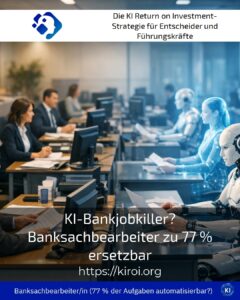
This question currently concerns hundreds of thousands of employees in one of the most traditional economic sectors of our country. The wave of automation is sweeping into traditional office tasks that only a few years ago would have been considered impossible. According to the Job Future Report of the Institute for Employment Research [1], the substitutability of activities in this sector is frighteningly high at 77 percent. The term AI bank job killer Therefore, this number is not circulating in professional circles and social media without reason. But what does this number mean specifically for people who visit their workplace every morning in a branch or an administrative center? The answer to this question is more complex than the bare statistics suggest. At the same time, this development opens up completely new perspectives and opportunities. Those who act now can actively contribute to the change.
The automation wave is affecting traditional fields of activity
Digitalization has been fundamentally changing the way financial institutions operate for years. Today, intelligent systems are taking on tasks that were previously carried out exclusively by humans. Account opening is now completely digital and without human intervention. Credit checks are also running automatically in many institutions. Algorithms analyze income documents and compare them with historical data. Processing recurring orders no longer requires manual intervention. Even more complex processes such as credit decision-making are increasingly being supported by machines.
A concrete example illustrates this development particularly clearly. Previously, the authentication process for new customers was carried out exclusively at the counter. Today, customers can easily identify themselves via video telephony from home. Intelligent software checks identity documents for authenticity. It compares biometric features in seconds with the transmitted images. The error rate is even lower than that of human inspectors. This development exemplifies why biometric authentication is a superior method of identification. AI bank job killer It is not fiction.
Another example can be found in the field of document processing. Every day, financial institutions receive thousands of documents by mail and email. Previously, employees manually sorted and processed these entries one by one. Today, optical character recognition systems automatically recognize the content. They assign the documents to the correct processes and forward them on. This has reduced the processing times by more than half.
Best practice with a AIROI customer A medium-sized financial institution from southern Germany faced the challenge of significantly reducing processing times for real estate financing. Customer wait times sometimes exceeded two weeks before approval. During a transruptive coaching session, we first analyzed all process steps together with the management team. It became apparent that a large portion of the time was spent on repetitive verification procedures. The employees spent hours reconciling land registry extracts with application documents. Together, we developed a strategy for the stepwise introduction of intelligent assistance systems. The solution automatically checked all incoming documents in full for errors immediately thereafter. Missing documents were immediately requested digitally from the applicants. The human experts now focused on complex individual case decisions. After six months, the processing time had been reduced to an average of four days. At the same time, employee satisfaction had increased because monotonous tasks were eliminated. Not a single job was eliminated, but the job profiles had fundamentally changed.
Why the AI bank job killer needs to be considered differently
The figure of 77 percent substitutability sounds alarming and threatening at first. However, it deserves a differentiated consideration and classification. The platform Job-Futuromat [1] analyzes individual core activities of occupational profiles. It examines whether these activities could already be technically automated today. Technical feasibility does not automatically mean immediate implementation. Economic factors also play an equally important role in implementation. Social acceptance and regulatory frameworks also influence the process. The transformation therefore takes place gradually and not overnight.
Let’s look at a third example from the day-to-day operations of a financial institution. Customer support by phone is one of the most labor-intensive areas of all. Chatbots and voice assistants can already reliably answer standard inquiries today. They also provide information about account balances, opening hours, and the nearest branch. However, with more complex requests, they quickly reach their limits. A customer in a difficult life situation needs empathetic advice. This human component cannot be easily replaced by technology. This is where the concept of AI bank job killer It is too short.
Asset management provides a fourth revealing example of this differentiation. Today, robo-advisors create investment portfolios fully automatically based on scientific criteria. They rebalance portfolios on a regular basis and tax-optimally without human intervention. Yet wealthy private clients often prefer personal contact. They value the exchange about their individual goals and concerns. The emotional support during volatile market phases remains a profoundly human task.
which activities are particularly affected
The analysis of the Job Future Matrix [1] reveals clear patterns in the most at-risk activities. Particularly vulnerable are standardized processes with little variability. The collection of customer data into IT systems is clearly among these. Likewise, the verification of completeness of incoming applications of various types. Monitoring of payment entries and collection procedures can also be easily automated. Routine compliance checks also fall into this category.
A fifth example illustrates this development in the area of processing tasks. The processing of paper invoices used to be completely manual. Employees reviewed each individual case and decided individually on the course of action. Today, intelligent systems perform this task in seconds. They automatically categorize the reasons and initiate appropriate follow-up processes. Human review is limited to exceptional cases only.
In the area of account management, a similar picture emerges. The processing of address changes is now largely automated. Customers update their data themselves via digital channels conveniently from wherever they are. Also, prepayments are recorded electronically and processed immediately. The subsequent processing of booking errors is increasingly carried out automatically without human intervention.
Opportunities and new perspectives through change
Technological change not only destroys jobs, but also creates new ones. However, accompanying this transformation requires proactive action from all involved parties. Many employees report uncertainty and fears about the future in conversations. At the same time, completely new career paths open up for proactive employees. The demand for specialists in human-machine interaction is continuously growing. Experts in the ethical evaluation of algorithmic decisions are also urgently needed.
A sixth example illustrates these positive developments clearly. The customer advisory service for sustainable investment has been booming for several years. Expertise and empathy are equally in demand and indispensable here. Customers want to understand how their money impacts the environment and society. They seek dialogue about complex relationships and individual value preferences. This highly advisory-intensive activity cannot be meaningfully automated.
The same applies to the support of entrepreneurs and founders of new businesses. Start-ups require tailored financing solutions and strategic advice. Assessing business models requires experience and knowledge of people alike. Evaluating founder personalities remains a human competence. This creates new, challenging fields of activity with future prospects.
Best practice with a AIROI customer A regional bank with several locations recognized early on the need for a strategic realignment. The management initially feared massive resistance from the workforce against changes. In transruptive coaching, we therefore developed a participatory approach to transformation. Employees from all departments were actively involved in shaping the future. Together, they identified activities that could be meaningfully automated. At the same time, they defined new roles that would optimally utilize their strengths. An ex-officer was further trained to become an internal process optimizer. A client advisor specialized in assisting with inheritance matters. The bank also established an internal think tank for digital innovation. The internal employee survey after one year showed a significantly increased level of satisfaction. Fluctuation fell to the lowest level since the company’s founding. Open communication about changes had created trust and reduced fears.
Taking the AI bank job killer as an opportunity
Despite all the challenges, the transformation of the financial sector offers significant opportunities. Those who invest early in their own further education position themselves advantageously. The ability to collaborate with intelligent systems becomes a key competence. Social and emotional intelligence is also gaining massive importance. Leaders need new competencies for managing hybrid teams. Providing guidance for this development through external coaching provides valuable impulses.
A seventh example illustrates the practical implementation of these considerations. Fraud prevention benefits enormously from the collaboration between humans and machines. Algorithms reliably and quickly detect suspicious transaction patterns in real time. However, the final evaluation and decision-making are still made by a human expert. This division of labor optimally and efficiently combines the strengths of both parties.
This model of collaboration is also proving effective in complaint management. Intelligent systems categorize incoming complaints according to urgency and subject matter. They suggest appropriate solutions and prepare relevant information. The human employee then focuses on empathic communication. He finds individual solutions and strengthens the customer relationship through personal contact.
Action recommendations for affected individuals and decision-makers
The findings from numerous consulting projects lead to clear recommendations. For individuals, lifelong learning is not an option but a necessity. Regular engagement with technological developments protects against unpleasant surprises. Maintaining networks and soft skills also pays off in the long run. Openness to new fields of activity significantly expands personal scope for action.
For executives and human resources managers, other priorities emerge. Transparent communication about upcoming changes reduces fears. The early involvement of the workforce in transformation processes creates acceptance. Investments in further training ensure the preservation of knowledge within the company itself. The socially compatible design of change sustainably strengthens the employer brand.
An eighth example impressively highlights the importance of proactive action. A financial institution established an internal qualification program for digital skills. Employees were able to participate in training sessions on new technologies during working hours. Particularly dedicated colleagues were trained to become internal multipliers and trainers. The measure not only fostered expertise but also team cohesion.
My AIROI Analysis
The intensive study of the phenomenon of AI bank job killer It reveals a nuanced picture. The technological substitutability of 77 percent of activities is both a reality and a challenge. At the same time, it would be wrong to interpret this figure as a scenario of collapse for an entire occupational group. The transformation is taking place gradually and offers opportunities for adaptation for all involved parties. What is crucial is the willingness to actively participate in the change rather than passively waiting for it to happen.
From my consulting practice, I know that many employees come to us with concerns. They wonder if their skills will still be needed tomorrow. They are seeking guidance in a time of rapid change and upheaval. Transruptive coaching offers valuable support in identifying their personal strengths and weaknesses. Together, we develop individual strategies for professional development.
For organizations, the opportunity lies in redesigning work processes and role models. The combination of human strengths with machine efficiency creates real added value. Empathy, creativity, and complex problem solving remain human domains. The future belongs to companies that successfully achieve and maintain this balance. Supporting such transformation projects is a core area of our work at AIROI.
In conclusion, I would like to emphasize that technological progress is always a matter of societal design. We decide together how to use these tools and what values guide them. A humane working world of the future is possible if we consciously shape it.
Further links from the text above:
[1] Job-Futuromat of the Institute for Employment Research
For more information and if you have any questions, please contact Contact us or read more blog posts on the topic Artificial intelligence here.








 Deutsch
 English (UK)