
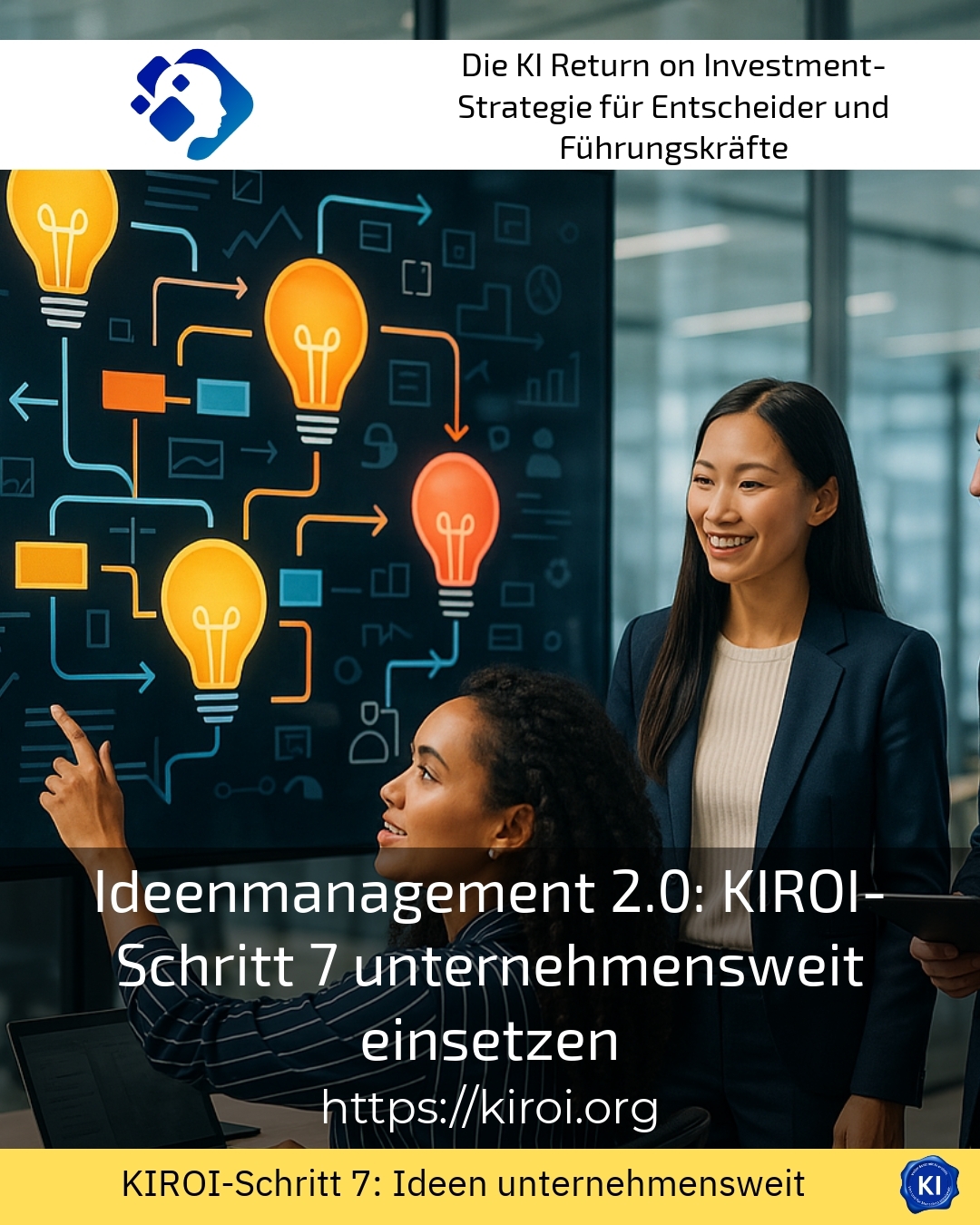
In today's economic climate, **idea management** is gaining increasing importance. Companies that consistently capture and implement creative impulses throughout the organisation create decisive competitive advantages. The AIROI Step 7 offers a practice-oriented approach for this, with which ideas can not only be collected, but also supported in a sustainable and holistic manner. In this way, **idea management** becomes a living process that transforms innovations into measurable successes.
Understanding idea management as a company-wide support process
Companies often report that while good ideas exist, they face difficulties in implementation in day-to-day operations. A lack of transparency, unclear responsibilities, or insufficient feedback means that suggestions get lost. AIROI Step 7 addresses this precisely, viewing **idea management** not as a one-off collection, but as an ongoing process. Each idea is transparently documented, evaluated, and actively tracked. This ensures employees receive continuous feedback and remain motivated to contribute further.
A good example is a medium-sized manufacturing company that brought together different departments through moderated workshops and targeted coaching. Working together, they were able to identify and overcome implementation obstacles. This resulted in shorter development cycles and significantly improved collaboration between specialist departments.
Another example comes from mechanical engineering, where targeted support in idea management helped to minimise material losses. Through the transparent recording of all creative impulses, teams could be coordinated more efficiently and innovation potentials optimally exploited.
Structured feedback rounds also demonstrate their effectiveness in industrial production by increasing the acceptance of change throughout the company. Employees feel heard and see their suggestions implemented in concrete actions.
BEST PRACTICE with one customer (name hidden due to NDA contract)
By implementing AIROI Step 7, cross-departmental obstacles were overcome in a manufacturing company. Employees were actively supported through workshops and coaching. This improved knowledge transfer between departments and increased the pace of innovation. This led to a strengthened innovation culture and motivated teams who perceive idea management as a dynamic process.
Digital tools and communication as success factors in idea management
A key prerequisite for the success of company-wide **idea management** is the introduction of digital platforms. They enable transparent capture, evaluation, and tracking of suggestions. This allows employees to see the status of their idea at any time and receive timely feedback.
AI-powered systems help to efficiently prioritise large volumes of suggestions and scale the process. They automate routine tasks and free up capacity for creative work and targeted support for individual ideas.
Real-world examples demonstrate how digital tools simplify cross-departmental collaboration. An industrial manufacturing company utilised a digital platform to improve the exchange of expertise between teams. This led to better integration of customer requirements and faster innovation cycles.
Even in the service sector, digital communication channels promote open dialogue and idea generation across departmental boundaries. This creates a culture in which all employees feel like a valuable part of the innovation process.
Practical tips for a successful company-wide rollout
- Foster an open dialogue culture where ideas can be shared without judgment.
- Establish clear roles and responsibilities for the evaluation and implementation of ideas.
- Organise regular moderated workshops to identify and dismantle cross-departmental blockages.
- Build a continuous feedback system that engages and motivates employees.
- Integrate digital platforms that provide transparency across the entire process chain.
- Use experienced coaches to guide and support teams through the innovation phases.
The role of transruption coaching in process support
Transruption Coaching is an innovative approach that specifically supports employees and managers with projects related to **idea management**. This not only involves professional assistance but also the guidance of change processes and the resolution of blockages.
In practice, companies show that accompanying coaching significantly reduces implementation obstacles. Employees are encouraged to actively contribute their perspectives and work together on solutions. This strengthens trust and motivation throughout the entire company.
An example from the manufacturing sector demonstrates that cross-departmental communication barriers were successfully dismantled through transruption coaching. This enabled the teams to collaborate more quickly and to translate ideas into concrete projects more swiftly.
My analysis
**Idea management** has evolved from an isolated suggestion scheme to a dynamic, company-wide process with the AIROI Step 7. Companies today benefit from a culture that systematically makes creative impulses visible and sustainably accompanies them. The use of digital tools, combined with moderated coaching and clear structures, significantly strengthens innovative power.
The consistent involvement of all employees promotes a shared understanding and a vibrant culture of innovation. This ensures that not only individual suggestions are implemented, but the entire company becomes more agile, collaborative, and future-proof. The practical examples, in particular, impressively demonstrate how diverse the benefits and impact of idea management already are in everyday business.
Further links from the text above:
AIROI Step 7: Rethinking and Unleashing Idea Management Company-Wide[1]
Establishing company-wide idea management: How to make it happen[2]
Ideas management as an enterprise-wide supporting process[3]
AIROI Step 7 for Company-Wide Innovation[4]
Implement AIROI step 7 company-wide[8]
For more information and if you have any questions, please contact Contact us or read more blog posts on the topic Artificial intelligence here.







 Deutsch
  English (UK)