
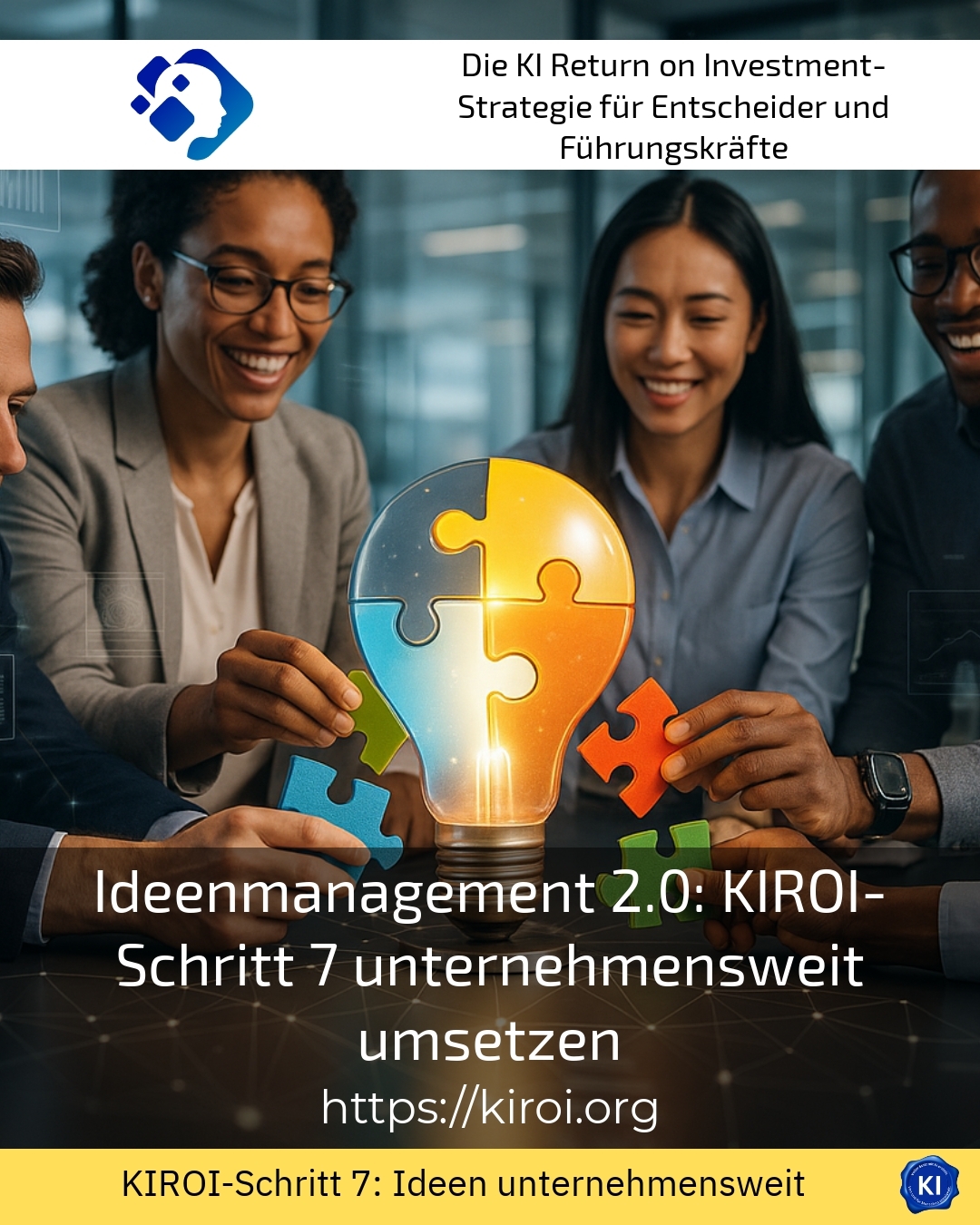
**Idea management** is becoming increasingly important in today's business world, as companies not only want to develop innovative products but also need to continuously improve their internal processes. The AIROI Step 7 is a crucial building block in this context for implementing **idea management** in a structured and sustainable way across the entire company. It supports all phases of idea development – from capture and evaluation to final implementation – and ensures that creative impulses do not go to waste but actually have an impact. In this article, you will learn how to practically implement Step 7, what best practice examples exist, and what measures you can take to set your company on a course for innovation.
Ideas management as an enterprise-wide supporting process
It is often not enough to simply collect ideas. Companies frequently report that a lack of transparency and feedback is blocking their implementation. AIROI Step 7 therefore understands **idea management** as a continuous accompanying process and integrates a systematic feedback system. This actively involves employees and provides them with clear feedback on the status of their suggestions. This transparency strengthens acceptance and motivates further participation.
In the automotive industry, for example, teams organise facilitated workshops to specifically address efficiency improvements in manufacturing. This ensures a rapid transfer of small and large improvements into daily production. It works similarly in the financial sector, where agile teams continuously optimise customer processes based on submitted ideas. In retail, too, digital platforms demonstrate how suggestions can be channelled and implemented across different branches, strengthening customer loyalty.
BEST PRACTICE with one customer (name hidden due to NDA contract)
In a medium-sized manufacturing company, the AIROI Step 7 was used to accelerate the implementation of improvement suggestions. Moderated workshops helped to identify and overcome cross-departmental obstacles. The result was a noticeable increase in innovation culture, accompanied by faster development cycles and greater employee motivation.
Practical implementation steps for business success
For **idea management** to work company-wide, clear structures and processes are needed. A first step involves regularly held, moderated workshops where employees from different departments are brought together in a targeted way. During these workshops, obstacles to implementation are identified and initial solutions are developed. This promotes dialogue and strengthens collaboration.
Another important measure is the introduction of digital platforms that capture, evaluate, and transparently document the progress of all ideas. This ensures transparency and increases the participation of all employees, as they can track the status of their suggestions at any time.
Furthermore, it is advisable to involve experienced coaches or innovation experts. They guide the teams through the individual phases, provide impetus, and support in overcoming barriers. This systematically strengthens innovative strength.
Examples from various industries
In mechanical engineering, for example, structured feedback loops have significantly shortened product development times. Close collaboration between engineering and sales helped to integrate customer needs even better into the development process. Software companies benefit from iterative retrospectives, which help to implement customer requests more quickly while simultaneously improving team communication. In retail, networked idea platforms strengthen internal communication across store boundaries, thus promoting practical improvements to customer service.
Ideas Management: A Driver for Sustainable Business Growth
Successful **idea management** directly impacts a company's success. It not only supports the development of new products but also fosters a culture where all employees actively contribute to further development. This change leads to greater motivation, strengthens collaboration, and enhances overall innovative capacity.
By specifically implementing AIROI Step 7, companies establish a vibrant innovation process that relies on open exchange, appreciation, and systematic support. This prevents the so-called „idea death“ and instead creates sustainable momentum for progress.
My analysis
AIROI Step 7 is an effective tool for embedding **idea management** not as an isolated task, but as an integral part of corporate culture. The combination of moderated dialogues, digital tools, and continuous support makes this approach a practical model. Companies from various industries report that this step has enabled them to realise innovations more quickly and effectively, while simultaneously integrating employees into the change process. An actively lived innovation culture is essential today to remain competitive in the long term, and AIROI Step 7 effectively supports this.
Further links from the text above:
[1] Ideas Management 2.0: AIROI Step 7 for Your Business
[2] Rethinking idea management: AIROI Step 7 for your business
[5] Unleashing Idea Management: AIROI-Step 7 Across the Enterprise
[6] Scale company-wide with idea management AIROI step 7 – SAULDIE
[7] AIROI step 7: Rethink idea management across the organisation
For more information and if you have any questions, please contact Contact us or read more blog posts on the topic Artificial intelligence here.











 Deutsch
  English (UK)