
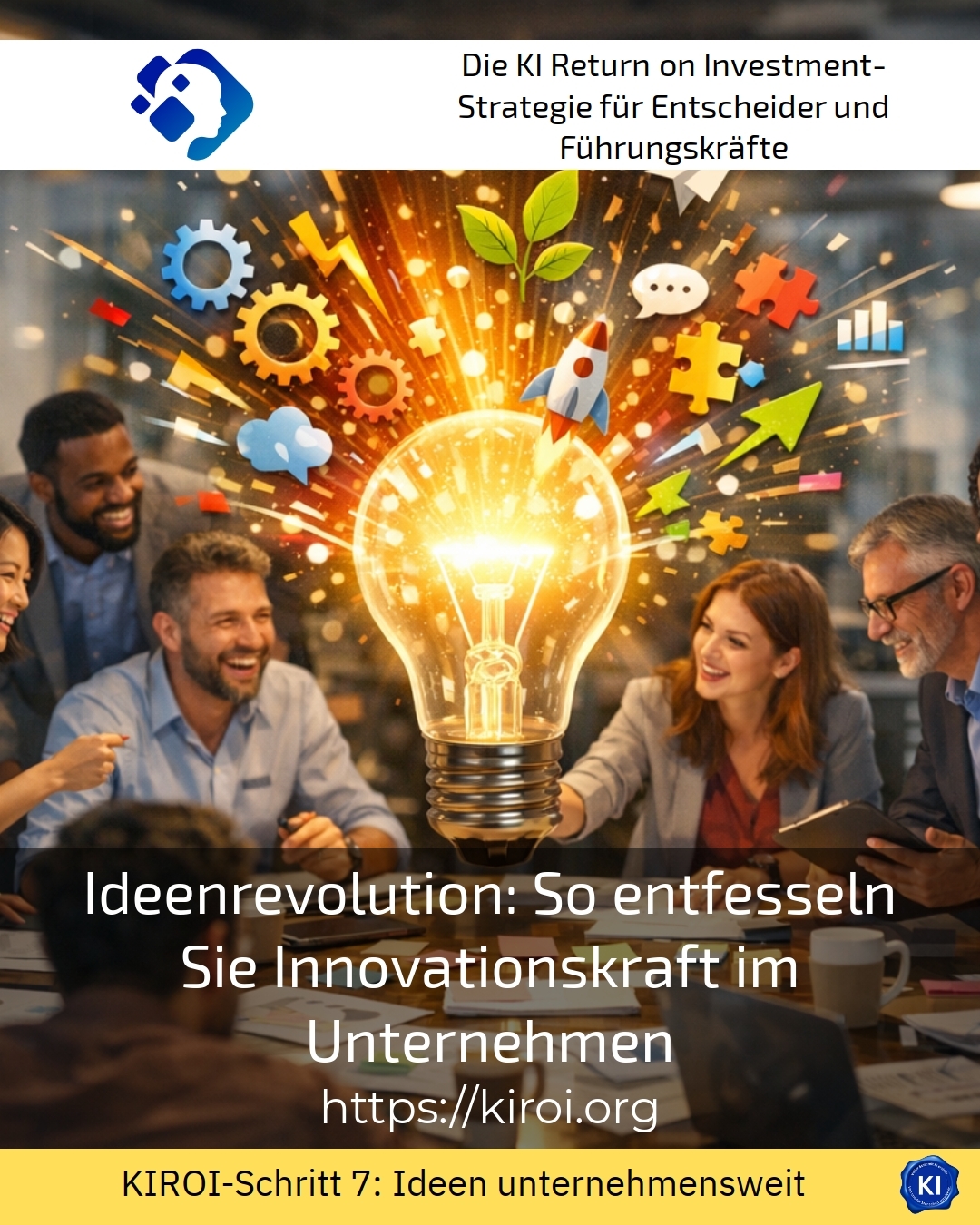
Why do nine out of ten companies fail to develop breakthrough ideas despite having highly skilled teams and considerable resources? The answer often lies not in a lack of creativity, but in entrenched structures that stifle any budding innovation. Ideas Revolution: How to Unleash Innovation Power in the Company They are already stifled in their infancy. Anyone who wants to shape markets today must understand that transformative changes are not random outcomes. They arise through systematic guidance and the conscious design of framework conditions. In this article, you will learn what concrete steps organizations can take to unleash creative potential and create sustainable competitive advantages.
Recognize the hidden blocks to creative development
Many executives report similar challenges in their daily work. They observe how promising approaches get lost in endless approval loops. At the same time, they experience that employees keep their best ideas to themselves. The reasons for this are manifold and range from fear of criticism to a lack of time for experimental work. A mid-sized manufacturing company found that over eighty percent of the improvement suggestions came from only ten percent of the workforce. This insight led to a fundamental realignment of the internal communication culture.
Similar patterns are evident in the financial sector, where strict compliance requirements often serve as an argument against unconventional approaches. Yet, many executives often overlook the fact that regulatory requirements and creative thinking do not have to be mutually exclusive. For example, an insurance company developed entirely new customer service concepts by purposefully assembling interdisciplinary teams. These teams combined legal expertise with design thinking methods and achieved remarkable results.
In healthcare, we encounter similar situations when clinics try to make their processes more patient-oriented. Clients often report that established hierarchies make even small changes significantly more difficult. Transruptive coaching helps in such cases by breaking out of entrenched patterns of thinking and developing new perspectives.
Best practice with a AIROI customerA traditional machine engineering company with over two thousand employees faced the challenge of fundamentally accelerating its product development. The previous approach required an average of eighteen months from initial idea to market launch. In the context of intensive collaboration, we first analyzed all decision-making paths and identified numerous unnecessary approval loops. Subsequently, we established so-called innovation cells that were largely autonomous and reported directly to the management. These cells received their own budgets and the freedom to engage external partners without prior coordination with the purchasing department. Within six months, three marketable prototypes were created, one of which was subsequently developed into a successful serial product. The crucial success factor was building trust while defining clear guidelines at the same time. The employees reported unanimously that for the first time they truly felt empowered to make their own decisions and to take risks.
Ideas revolution: This is how you unleash innovation through cultural change
Sustainable change always begins with the corporate culture. This invisible force ultimately determines whether new ideas can thrive or wither away. Leaders often underestimate how strongly their own behavior influences the willingness to engage in creative collaboration. A technology company in the renewable energy sector introduced weekly error analyses in which only failed projects were discussed. This practice normalized failure and encouraged employees to venture into more ambitious projects.
In retail, we are currently witnessing massive changes due to changing customer expectations. One retail company responded to this by granting store managers complete autonomy in product design. The result surprised even the most skeptical critics of this approach significantly. Local adaptability increased significantly, and at the same time, completely new product categories emerged from direct customer contact. Examples like these vividly demonstrate how decentralized decision-making structures can unleash creative impulses.
The logistics industry is also facing enormous transformation challenges that require creative solutions. A freight company developed a digital feedback system together with its drivers that enabled route optimizations in real time. The drivers were transformed from passive executors into active contributors to the operational processes. Transruptions coaching accompanied this process and helped them constructively address resistance [1].
Creating psychological safety as a foundation
Without psychological security, every effort to change culture remains ineffective. People share their best ideas only when they do not have to fear negative consequences. A pharmaceutical company installed anonymous idea channels to overcome this hurdle. Surprisingly, even experienced executives took advantage of this opportunity to introduce unconventional proposals. The quality of the submitted ideas improved significantly within a few months.
In the banking sector, some institutions are experimenting with so-called counter-opinion rounds. In this practice, a person is deliberately tasked with critically questioning every proposal. This practice relieves skeptics of the role of the spoiler and normalizes constructive criticism. One private bank reported that this method significantly improved decision quality. At the same time, employees felt encouraged to bring forward even incomplete ideas.
Design structural frameworks for creative development
Culture alone is not enough when structural barriers hinder the flow of creativity. Organizations need intentionally designed spaces and times for experimental work. A automotive supplier established so-called future labs where employees could have twenty percent of their working time free. This investment paid off within a year through patentable inventions. The resulting innovations covered both products and manufacturing processes alike.
In the field of renewable energy, a wind farm operator shows how structural changes can foster creativity. The company largely removed traditional departmental boundaries and instead organized employees into project clusters. These clusters formed flexibly depending on the task at hand and dissolved again after the project was completed. The idea revolution: This is how the innovation force unleashed itself, manifested here in a threefold increase in patent applications.
In the education sector as well, such approaches are gaining increasing importance. A private university introduced innovation semesters in which students and faculty worked together on real business problems. The results exceeded all expectations and led to several spin-offs [2].
Best practice with a AIROI customerAn energy provider with a regional focus sought ways to more actively involve its employees in transformation processes. Previous efforts had failed due to the skeptical attitude of the workforce, which perceived changes as a threat. Together, we developed a multi-stage program that began at the individual level and gradually transitioned to collective formats. First, we conducted individual interviews with key personnel to understand and take their concerns seriously. Subsequently, we organized moderated workshops where these individuals could contribute their perspectives. The crucial element was the consistent implementation of at least one proposal from each workshop. This commitment generated trust and motivated further participation in change processes. After eighteen months, the company culture had changed in a measurable way, as evidenced by both employee surveys and business metrics. Turnover decreased by forty percent, while customer satisfaction rose to record levels.
Technology as a Facilitator of Creative Collaboration
Digital tools can significantly accelerate creative processes when used correctly. A media company implemented a platform for asynchronous idea development that connected geographically distributed teams. This technology enabled the continued development and refinement of ideas across time zones. Within a few weeks, concepts that would have taken months in traditional meetings were created. The quality of the results also benefited from the diversity of perspectives involved.
In the field of food production, a manufacturer uses digital twins to virtually test product innovations. This technology not only reduces development costs but also enables bolder experiments. Employees can try out ideas without tying up material resources or blocking production lines. The company reported a fourfold increase in the number of concepts tested per quarter.
Promising developments are also emerging in the construction industry, which support creative work. An architectural firm is using virtual reality to involve customers early in the design process. This method generates valuable feedback and at the same time inspires unconventional design ideas [3].
Re-thinking leadership for sustainable innovation power
Traditional leadership models often prove to be a barrier to creative development. The role of the leader transforms from a decision-maker to an enabler and moderator. A software company experimented with rotating leadership roles, in which team members took on leadership tasks in turn. This practice expanded perspectives and significantly enhanced understanding of different challenges. At the same time, new leadership talents emerged that had not previously been visible.
In the hospitality industry, a hotel chain demonstrates how empowered leadership unleashes creativity. Each branch was given the freedom to respond independently to local peculiarities and develop individual offerings. The headquarters limited itself to defining quality standards and providing resources. The result was an explosion of local innovations, some of which were adopted across the entire group.
Transruptions coaching accompanies leaders through this fundamental change in roles and provides important impulses. Clients often report initial uncertainty, which quickly gives way to enthusiasm about new possibilities. The idea revolution: How to unleash innovation is particularly successful where leadership is understood as a service function [4].
My AIROI Analysis
The systematic examination of numerous transformation projects reveals clear patterns of successful change processes. Organizations that sustainably harness their creative potential always combine cultural, structural, and technological measures. They begin by creating psychological safety and build upon it by creating supportive frameworks. The human factor remains at the center of all efforts and investments.
Those companies that understand change as a continuous process rather than a one-time project are particularly successful. They establish mechanisms for ongoing reflection and adaptation of their approaches. They avoid overcommitment through too many simultaneous initiatives and set clear priorities. The involvement of external support is often valuable in uncovering blind spots.
From the AIROI perspective, it is evident that technological tools can only reach their full potential in supportive cultural contexts. The best collaboration platform remains ineffective if employees have to fear criticism. Conversely, motivated teams can achieve remarkable results with simple means as well. The key lies in the balanced design of all relevant dimensions.
For decision-makers, this means adopting patience while simultaneously acting consistently. Cultural changes take time and often only show their effect after months or years. However, those who persevere and authentically live out what they preach will achieve lasting success. The examples described in various industries vividly demonstrate that transformation is possible and what fruits it brings.
Further links from the text above:
[1] Harvard Business Review – Innovation Insights
[2] McKinsey – Innovation Strategy
[3] Forbes Innovation
[4] MIT Sloan – Research on Innovation
For more information and if you have any questions, please contact Contact us or read more blog posts on the topic Artificial intelligence here.







 Deutsch
 English (UK)