
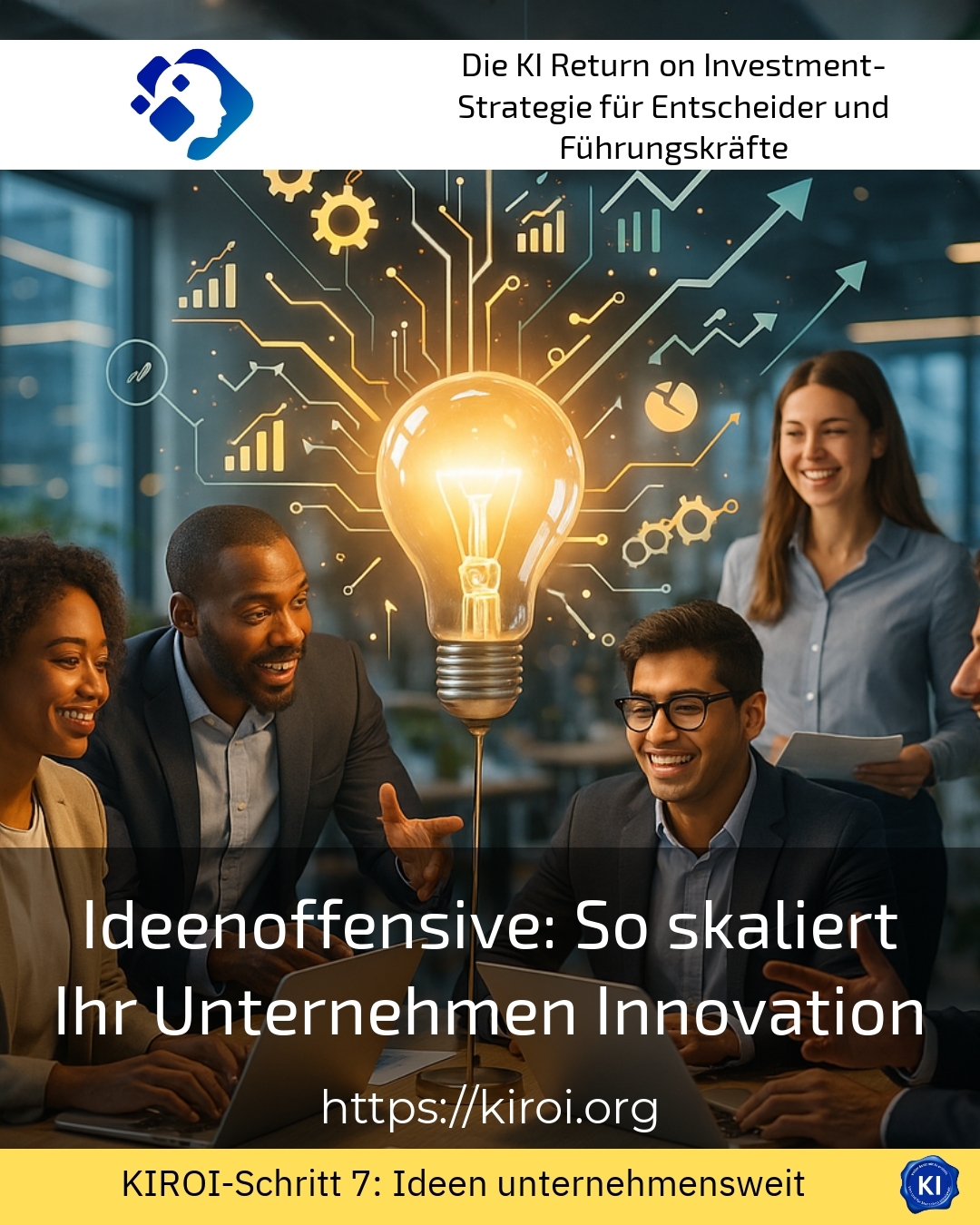
Imagine your company could generate, evaluate and bring dozens of innovative concepts to market daily. Innovation Offensive: How to Scale Your Business's Innovation describes precisely this transformation, which is no longer a far-off prospect. Many leaders wonder how they can systematically multiply their teams' creative output. This is not about random successes or brilliant individuals. Instead, a structured process that combines creativity with systematic methods is at the core. This is precisely where this article comes in, offering concrete approaches for sustainable growth.
Why traditional development processes are reaching their limits
Traditional structures often hinder the free flow of creative impulses within organisations. Departmental boundaries act like invisible walls that make exchange difficult. At the same time, many companies lack a clear methodology for evaluating new concepts. A medium-sized mechanical engineering firm recently reported on precisely this problem. Its engineers had brilliant ideas, but these foundered in endless coordination rounds. Sales, in turn, recognised customer needs but could not effectively communicate them. This resulted in isolated solutions rather than holistic products.
A logistics provider faced similar challenges in digitalising its warehouse processes. The IT department developed software that nobody wanted to use. At the same time, warehouse workers created their own workarounds that were not documented anywhere. These parallel worlds not only cost resources but also valuable market opportunities. This demonstrates why a Innovation Offensive: How to Scale Your Business's Innovation This needs to be approached systematically. Without clear structures, even the greatest creative potential will fizzle out.
A third example comes from the retail sector. A fashion chain wanted to expand its product range based on customer feedback. However, different branches collected feedback in different ways. Head office received conflicting information and consequently made hesitant decisions. The competition reacted more quickly and gained crucial market share. This situation highlights the need for standardised processes.
Best practice with a AIROI customer
An internationally operating pharmaceutical company approached us with a specific concern. The research department continuously generated promising approaches for new active ingredients. However, implementation regularly failed due to internal hurdles and protracted approval processes. Together, we developed a multi-stage evaluation system that linked scientific criteria with economic factors. Within six months, the average evaluation time was reduced by more than forty percent. At the same time, the number of candidates approved for clinical trials increased significantly. Employees reported increased motivation because their contributions were now visibly recognised. Transruption coaching accompanied the cultural change within the organisation. Managers learned to view mistakes as learning opportunities rather than career risks. This changed attitude enabled more open communication between hierarchical levels.
The Idea Offensive: How Your Business Scales Innovation Through Cultural Change
Technical solutions alone are not enough to unleash creative potential. The decisive factor lies in the company culture and the values that are lived. Employees must feel that their contributions are valued and taken seriously. A car supplier introduced regular innovation workshops that involved staff from different departments. Production workers discussed manufacturing processes with designers. These unusual combinations led to surprising breakthroughs.
A telecommunications provider implemented a digital suggestion system that created transparency. Everyone could see which ideas had been submitted and how they were being evaluated. Comments and further development by colleagues were explicitly encouraged. This led to complex solution approaches originating from simple initial thoughts. Within a year, the platform recorded several thousand active users. Many of the improvements implemented originally came from employees without management positions.
An insurance group went a step further and set up its own innovation unit. This unit deliberately operated outside the established structures. A start-up mentality met with corporate resources, creating productive tension. The unit developed several digital products for younger target groups in a very short space of time. Some of these products are now being used in the core business.
Concrete methods for systematic creativity
Design Thinking, Lean Startup and agile methodologies offer proven frameworks for structured creativity [1]. These approaches emphasise rapid experimentation and continuous learning from feedback. A utility company used Design Thinking workshops to develop new services. Participants extensively adopted the perspective of various customer groups. This empathy work resulted in offerings that addressed genuine needs.
A construction company experimented with hackathons where interdisciplinary teams developed prototypes within two days. These events created a productive time pressure that prevented perfectionism. Instead, functional demonstrators emerged, which could be tested immediately. The best concepts subsequently received resources for further development.
A food manufacturer focused on continuous improvement through small, everyday experiments. Production teams were empowered to independently test and document process changes. Successful adjustments were standardised and rolled out company-wide [2]. This bottom-up strategy effectively mobilised the workforce's experiential knowledge.
Technological enablers for scalable creative processes
Digital tools can significantly accelerate and enhance the creative process. Collaboration platforms enable real-time, location-independent teamwork. Artificial intelligence assists with the analysis of large data sets and pattern recognition. A chemical company is using algorithmic systems to suggest promising molecular combinations. This allows scientists to concentrate on the most promising candidates.
A media conglomerate is using machine learning models to predict audience engagement. Content strategies are now based on data analysis rather than gut feeling. At the same time, there remains scope for creative experimentation and surprising formats. The technology does not replace human creativity, but rather specifically enhances it.
A financial services provider implemented a platform for distributed brainstorming across multiple time zones. Employees from Asia, Europe, and America collaboratively developed new product concepts. The asynchronous communication allowed for more thorough consideration than rushed in-person meetings. This technological infrastructure became the foundation of a global creative culture [3].
Best practice with a AIROI customer
A medium-sized mechanical engineering company approached us with the challenge of fundamentally modernising its product development process. The previous approach was linear and time-consuming, leading to long market launch times. As part of the transruption coaching, we first analysed the existing processes and identified critical bottlenecks. We then jointly developed a parallel working model, allowing different development phases to take place concurrently. Digital simulation tools significantly reduced the need for physical prototypes. Communication between design, production, and sales was intensified through daily short meetings. Within one year, the company was able to shorten its average development time by a third. At the same time, customer satisfaction increased because feedback was incorporated into product improvements more quickly. Employees reported increased job satisfaction due to closer collaboration. The company gained several new major customers through its enhanced responsiveness to market demands.
The role of external impulses in the idea offensive
Internal perspectives alone often lead to tunnel vision and entrenched ways of thinking. External partners can provide valuable suggestions and uncover blind spots. A consumer goods manufacturer regularly collaborates with universities and research institutes. Students bring fresh perspectives, while the company offers practical expertise. This symbiosis creates results that neither side could achieve alone.
A software company actively scouts within the startup scenes of relevant industries. Promising young companies are invited to form partnerships or be acquired. This allows the corporation to integrate disruptive technologies into its portfolio early on. The startups benefit from market access and scaling resources.
A trading company organises annual customer advisory boards, which evaluate new product line ideas. End consumers provide direct feedback on prototypes and concept sketches. This immediate feedback prevents costly product developments that miss the mark in the market. The customers feel involved and develop stronger brand loyalty.
Measurability and continuous optimisation of creative processes
What isn't measured can't be systematically improved. Creativity may initially seem difficult to quantify, but suitable metrics certainly do exist. One technology group measures the number of patent applications submitted per department. At the same time, it records the proportion of implemented suggestion schemes. These metrics enable targeted interventions for weaknesses [4].
A consultancy firm tracks the time from the initial concept idea to market launch. Bottlenecks in the process are made visible and can be addressed. Regular retrospectives analyse completed projects for learning potential. These findings are incorporated into improved process standards.
A healthcare provider uses employee surveys to capture its perceived innovation culture. The results serve as a basis for targeted leadership development. Increasing satisfaction levels correlate with increased creative output by teams. These connections highlight the importance of soft factors.
My AIROI Analysis
The support of numerous organisations during creative transformation processes has provided important insights. Successful companies view creative development not as a one-off effort, but as a continuous practice. They create structures that offer both freedom and direction. Leaders play a crucial role in this as role models and enablers.
The Innovation Offensive: How to Scale Your Business's Innovation requires a holistic approach. Technology alone is no more sufficient than pure cultural work or isolated method training. Only the interplay of all elements unfolds a sustainable effect. Transruption coaching specifically supports organisations in this complex integration effort.
Clients often report initial scepticism towards structured creative processes. However, the concern that spontaneity might be stifled is regularly proven unfounded. On the contrary, clear frameworks actually create a safe space for bold experimentation. Staff members know how their contributions will be evaluated and which resources are available.
The coming years will show which organisations can most effectively mobilise their creative potential. Competition for the best concepts will intensify further. Companies that invest in their creative infrastructure now will secure decisive advantages. The goal should not be to produce individual flashes of inspiration. Rather, it is about generating a steady stream of valuable impulses and converting them into market success. This ability will become the key differentiator in increasingly dynamic markets.
Further links from the text above:
[1] Harvard Business Review – Innovation
[2] McKinsey – Insights on Innovation
[3] MIT Sloan – Research and Innovation
[4] Gartner – Innovation Strategy
For more information and if you have any questions, please contact Contact us or read more blog posts on the topic Artificial intelligence here.











 Deutsch
  English (UK)