
„`html
Ideas management: Innovation through participation and structure
Ideas management is at the heart of many successful companies because it systematically harnesses the creative potential of all employees and translates it into concrete improvements. Especially in the age of digitalisation and constant change, a structured approach to ideas is indispensable. Companies that take ideas management seriously not only foster innovation but also strengthen the identification and motivation of their teams – and this has a positive impact on company success[1][3].
Clients repeatedly approach us with the question of how they can better harness the creative knowledge within their departments. Often, it remains at the level of individual suggestions that are not pursued further. This is where the transruption coaching approach comes in: it specifically guides teams and leaders in introducing and sustainably implementing ideas management – from the initial concept right through to successful realisation.
Ideenmanagement with KIROI Step 6: From Theory to Practice
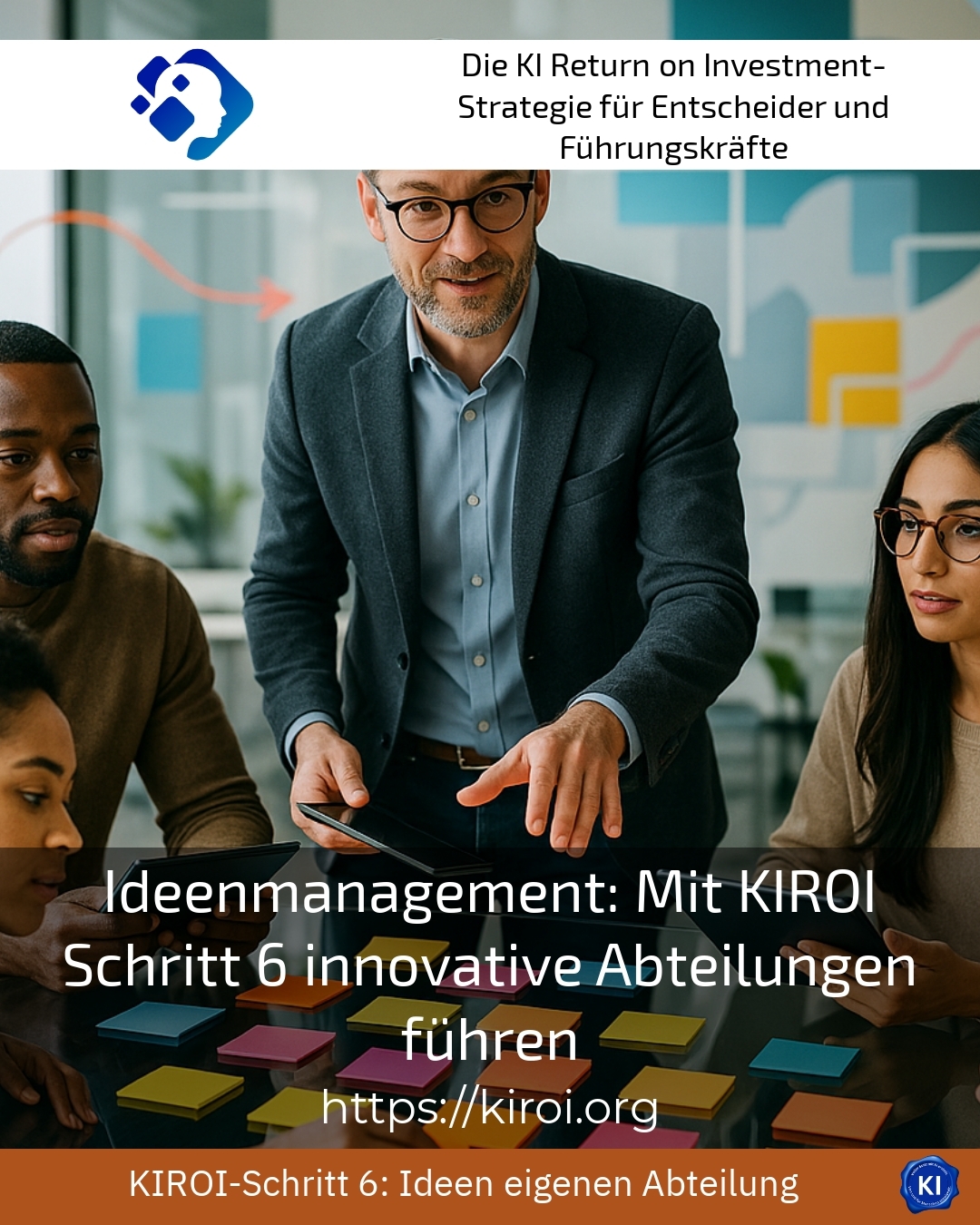
By focusing on concrete idea development within departments, KIROI Step 6 creates a solid foundation for sustainable improvements. Employees are encouraged to actively contribute their experiences and challenges, so that practice-oriented solutions emerge that noticeably simplify everyday work[2].
An example from production: In a facilitated workshop, a team identified ways to reduce material waste. The consistent implementation of these ideas not only saved costs but also stabilised product quality. In the HR department, the development of intelligent shift plans led to less stress and greater motivation. And in sales, optimised visit intervals ensured more efficient routes and stronger customer loyalty – all results of a well-established idea management system[2].
Success is achieved through the combination of creative impulses and structured support. In ideation sessions and workshops, teams bring in different perspectives, jointly prioritise suggestions, and define concrete action steps. Targeted facilitation and coaching ensure that no valuable idea is lost and that all participants are involved in the process.
BEST PRACTICE with one customer (name hidden due to NDA contract) In a medium-sized manufacturing company, the implementation of KIROI Step 6 led to improved collaboration between production and quality management. Through targeted idea-generation sessions, bottlenecks were identified, and the scrap rate was significantly reduced. This process strengthened collegial communication and led to measurable efficiency gains because all levels were actively involved and the benefit to the company was transparent[2].
Ideas management as an integral part of corporate culture
Ideas management thrives on an open culture of mistakes and learning. It is not about dictating perfect solutions from above, but rather about tapping into everyone's knowledge base. In sales, this led to a new, digital platform for customer communication, based on suggestions from the team. In logistics, an analysis of transport routes resulted in savings in time and costs. And in the IT department, junior and experienced colleagues collaborated to develop tools that made projects more efficient [2][4].
Experience shows that a clearly structured idea management process increases motivation and creates a vibrant innovation culture. Feedback and recognition for submitting ideas are just as important as transparency about the further course of action – from documentation and evaluation to implementation and visible successes[1][9].
Practical tips for successful idea management in your organisation
Many teams wonder how they can make the best use of idea management. This often involves choosing suitable formats, internal communication, or involving all hierarchical levels. The following tips will help to unlock potential and reduce barriers:
- Creating simple, digital platforms to gather ideas quickly and easily – analogue suggestion boxes still have their place, but they are being supplemented by modern tools.
- Establish regularly moderated workshops and creative formats that bring together employees from different levels and functions.
- Document and evaluate every idea submitted, and communicate the status transparently – this keeps motivation high and ensures nobody feels overlooked.
- Celebrate successes and give recognition, even if an idea cannot be implemented.
- Determine those responsible for idea development and implementation to ensure no suggestions get shelved.
An example from the manufacturing industry: the introduction of targeted exchange formats led to employees sharing ideas more actively and increased transparency regarding decisions. In the service sector, teams report that clear structures and regular feedback strengthen their identification with the company. In the IT industry, a well-thought-out idea management system helps to connect the knowledge of experienced and younger employees and to anchor innovations sustainably[4].
Digital tools and artificial intelligence in idea management
Digitalisation opens up new opportunities for idea management. Modern platforms allow ideas to be collected, discussed, and evaluated quickly. Artificial intelligence can support the recognition of trends, the analysis of potential, and the acceleration of the implementation process.
In the logistics sector, software has been introduced to capture and evaluate suggestions, involving all employees. In production, digital dashboards support transparency regarding the status of ideas and the successes achieved. And in marketing, AI-powered tools help to identify the most promising ideas for campaigns from a large number of suggestions.
However, the use of such technologies does not replace personal accompaniment and moderation. Idea management remains a social process that thrives on trust, openness, and active listening – and this is precisely where transruption coaching comes in.
Making idea management measurable
Successful idea management is not an end in itself, but should bring about concrete improvements. Therefore, it is worthwhile to regularly review the process and the results. Key figures such as the number of suggestions submitted, the implementation rate, or the benefits achieved provide information about its effectiveness.
In the manufacturing industry, targeted idea management has significantly reduced scrap rates. In customer service, suggestions for improvement have led to shorter processing times and increased customer satisfaction. And in the IT department, projects have been implemented more efficiently through the use of new tools – all measurable successes that underscore the value of idea management[2][4].
BEST PRACTICE with one customer (name hidden due to NDA contract) A mid-sized manufacturing company introduced a benchmarking system that made the number and quality of suggestions transparent. The teams regularly received feedback on the progress of their ideas, which noticeably increased engagement. At the end of the year, alongside a multitude of implemented improvements, there were also better metrics for productivity and employee satisfaction – a clear sign of the effectiveness of idea management.
My analysis
Ideas management is far more than the traditional company suggestion scheme or a short-term innovation boost. It is a core competence of future-proof companies that systematically want to foster and utilise the creative potential of their employees. Processes, methods, and digital tools create the structure – but it is the culture of listening, exchange, and recognition that makes ideas management sustainably successful.
Companies that understand idea management as a continuous, ongoing process not only achieve measurable improvements but also enhance the motivation, identification with the company, and innovative strength of their teams. An open approach to new ideas and transparency about the implementation process increase acceptance and lead to sustainable, tangible results.
Ideenmanagement is therefore not a short-term measure, but a strategic lever for long-term competitiveness and innovation.
Further links from the text above:
- What is Idea Management? Definition, Process and Examples [1]
- Ideas Management: KIROI Step 6 Unleashes Departmental Innovation [2]
- What is idea management? Definition, importance & practice [3]
For more information and if you have any questions, please contact Contact us or read more blog posts on the topic Artificial intelligence here.
„`











 Deutsch
  English (UK)