
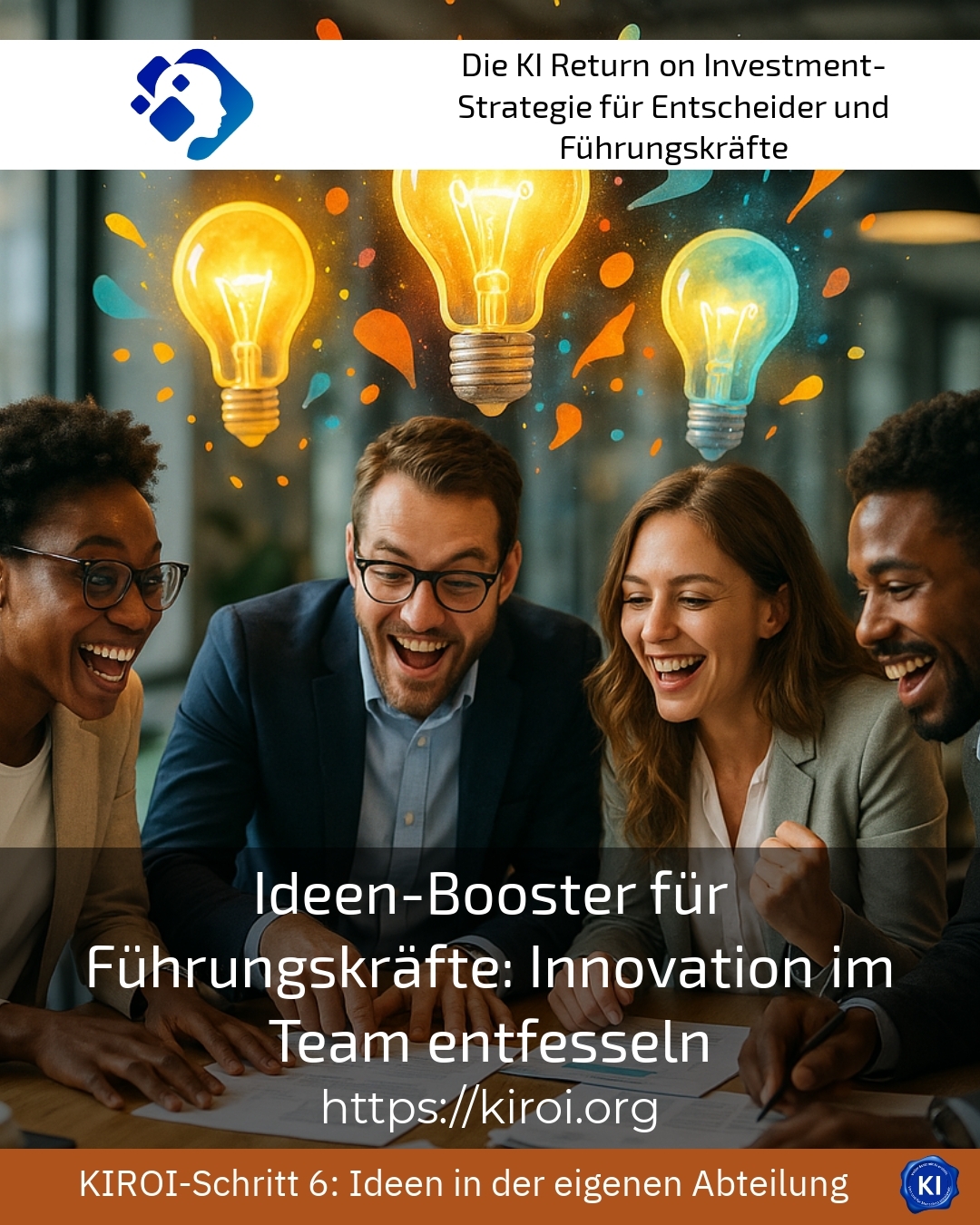
Have you ever wondered why some teams seem to effortlessly produce groundbreaking ideas, while others remain stuck in creative stagnation despite all their efforts? The answer often lies not in a lack of talent or missing resources, but rather in the way leaders unlock and cultivate the creative potential of their employees. As Idea booster for leaders acting as a systematic approach that goes far beyond sporadic brainstorming sessions and instead establishes a sustainable culture of innovation that inspires every single individual in the team to achieve peak creative performance.
Discovering the hidden power of collective creativity
Enormous innovation potential lies dormant in numerous companies and is never realised. Employees carry brilliant ideas within them, yet for various reasons they do not voice them. Some fear rejection or criticism from superiors and colleagues. Others simply do not believe that their suggestions will be heard. As a manager, you can systematically break down these barriers. The first step consists in establishing psychological safety within the team. This means that every team member can speak openly without having to fear negative consequences.
For example, a technology company implemented so-called „fail forward sessions“, in which employees presented their failed projects and shared the insights gained from them. This practice fundamentally changed the corporate culture. Suddenly, people dared to contribute even unpolished ideas. A medium-sized engineering firm introduced anonymous suggestion boxes that were accessible both digitally and physically. The response far exceeded all expectations. A consultancy firm established weekly „inspiration hours“ in which teams analysed case studies from outside their industry and applied their principles to their own challenges.
Idea booster for leaders: Creating spaces for creative thinking
The physical and temporal design of the work environment significantly influences creativity. Leaders frequently report that their best ideas do not come to them in the office. Instead, they happen during a walk, in the shower or in relaxed moments. This observation contains an important lesson for team management. Our brain needs free space to create new connections and generate innovative solutions.
A pharmaceutical company set up so-called „think tanks“ – specially designed rooms without telephones or computers. Teams met there regularly for creative sessions. A financial services provider introduced „walking meetings“ as the standard format for one-to-one discussions. It was proven that the physical activity encouraged the flow of ideas and fostered openness in discussions. A software developer introduced „20% time“ – modelled on well-known technology firms – and enabled staff to pursue their own projects.
Best practice with a AIROI customer
A medium-sized manufacturing company approached our transruptions coaching team with a specific challenge that many leaders will recognise. The pace of innovation had slowed down significantly, despite employing highly qualified engineers and technicians. As part of our support, we first analysed the existing communication structures and identified several blockades in the flow of ideas. Together, we developed a multi-stage concept that encompassed both cultural and structural changes. The leaders learned to listen actively and not to evaluate ideas prematurely. We implemented a digital idea management system that ensured transparency and traceability. After six months, team members reported a noticeably more open climate. The number of submitted improvement suggestions tripled within a year. It was particularly pleasing that several of these ideas actually fed into product development and led to measurable cost savings that made the company more competitive.
Establish methods for systematic idea generation
Creativity can certainly be fostered in a structured way without stifling its spontaneity. The Idea booster for leaders includes various proven techniques that teams can apply [1]. These methods provide a framework within which creative thinking can unfold. Design Thinking, for example, offers an iterative process that consistently puts the user at the centre. The SCAMPER method encourages questioning and modifying existing products or processes systematically.
A consumer goods company integrated design thinking workshops into its product development. The cross-functional teams achieved significantly more customer-centric results than before. A logistics company used Edward de Bono's „Six Thinking Hats“ method [2]. As a result, team members viewed problems from various perspectives and avoided one-sided approaches to solutions. A retail company implemented regular „reverse brainstorming sessions“, in which teams consciously looked for ways to make processes worse in order to subsequently do the exact opposite.
Leveraging diversity as a driver for innovation
Homogeneous teams tend to develop similar solutions and miss blind spots. Diversity, on the other hand, brings together different perspectives, experiences and ways of thinking. Initially, this can lead to friction. In the long term, however, it results in more robust and innovative solutions that appeal to different target groups [3].
An automotive supplier deliberately hired employees from outside the industry. A former restaurateur brought completely new perspectives on customer service. A medical technology company integrated patients and nursing staff directly into its development teams. These co-creation approaches led to more practical products. An insurance company formed cross-generational innovation teams in which experienced employees and career starters worked together on future topics.
The role of the leader as an innovation catalyst
Leaders shape the innovation culture significantly through their own behaviour. If they themselves do not show curiosity, their team members will not do so either. That is why the Idea booster for leaders Always engage in self-reflection. How open are you yourself to new ideas? How do you react to suggestions that contradict your own beliefs? You should ask yourself these questions regularly.
The CEO of an energy supplier spends one day a month in various departments. He listens, asks questions and gathers ideas directly from the shop floor. A female managing director from the construction industry has an open-plan office with no doors. Every employee can come in at any time and submit suggestions. The head of an IT service provider personally writes handwritten thank-you cards to employees whose ideas have been implemented.
Transruptions Coaching guides leaders in questioning their own thought patterns and developing new approaches to leadership. The insights generated in the process have an immediate effect on the entire team dynamic. Clients frequently report that noticeable changes in team culture become apparent after just a few sessions.
Best practice with a AIROI customer
A healthcare leader came to transruptions coaching with a specific concern that many in similar positions will recognise. The team appeared demotivated and hardly contributed any ideas of their own. During the coaching process, it became clear that the leader's unconscious behaviours were stifling creative impulses in the bud. For example, they frequently interrupted employees before they could fully articulate their thoughts. Together, we developed strategies for more active listening and more appreciative communication. The leader began to consciously pause during meetings and ask open questions. They introduced a ritual where every team member was allowed to share a new idea or observation at the end of a meeting. The transformation did not happen overnight, but developed gradually over several months. Today, the leader describes their team as „brimming with ideas“ and proudly points to several innovations that originated directly from the workforce.
A culture of error as the foundation for bold ideas
Innovation requires experimentation, and experiments sometimes fail. Without a healthy culture of error, employees will not take risks. Instead, they will play it safe and tread well-worn paths. For leaders, this means not punishing mistakes, but understanding them as learning opportunities [4].
A fintech startup celebrates the „best mistake“ every month with a little ceremony. The employee whose mistake provided the most valuable lesson receives a symbolic award. A traditional family-run retail business introduced „experimentation budgets“. Teams can use these funds for pilot projects without having to go through extensive approval processes. A chemical company documents failed experiments just as carefully as successful ones in order to preserve knowledge for future projects.
Technology as an enabler in the innovation process
Digital tools can significantly accelerate and democratise the flow of ideas. Collaboration platforms make it possible to gather, evaluate and further develop ideas – regardless of location or hierarchical level. Artificial intelligence can assist in recognising patterns and revealing connections that humans might otherwise have missed.
An international corporation uses an internal platform where employees can submit ideas and evaluate other ideas. The best proposals receive resources for implementation. A media company uses AI-powered tools to identify trends early and derive innovation impulses from them. A manufacturing company implemented virtual reality environments in which teams can work together on prototypes even though they are located in different places.
The Idea booster for leaders combines human creativity with technological support. Throughout this, humans remain at the heart of it all. Technology serves as a tool, not as a replacement for genuine interpersonal collaboration and dialogue.
My AIROI Analysis
Following careful consideration of the various dimensions of promoting innovation in teams, it becomes clear that sustainable change must always begin with the leader themselves. The ability to unlock creative potential is not an innate trait, but a learnable skill that can be continuously developed. From my experience with numerous companies across a wide range of industries, certain success factors emerge that are valid across all sectors.
First of all, the creation of psychological safety is fundamentally important. Without it, people will keep their best ideas to themselves. Furthermore, it turns out that structured methods and free creative thinking are not mutually exclusive, but rather complement each other. A good framework provides orientation without being restrictive. Diversity repeatedly proves to be an underestimated factor for innovation. Teams that bring together different perspectives develop more robust solutions.
The role of the leader is shifting from decision-maker to enabler. It is less about having the best ideas yourself and much more about creating conditions in which others can excel. Transruption coaching supports leaders in making this transformation and inspiring their teams to achieve peak performance. The results speak for themselves: more engaged employees, more innovative products, and a corporate culture that attracts and retains talent.
Further links from the text above:
[1] IDEO U – Design Thinking Resources
[2] De Bono Group – Six Thinking Hats
[3] Harvard Business Review – Diversity and Inclusion
[4] Psychology Today – Understanding Failure
For more information and if you have any questions, please contact Contact us or read more blog posts on the topic Artificial intelligence here.










 Deutsch
  English (UK)