
Why do so many teams, despite enormous potential, remain far behind their capabilities, even though they have qualified employees and sufficient resources?
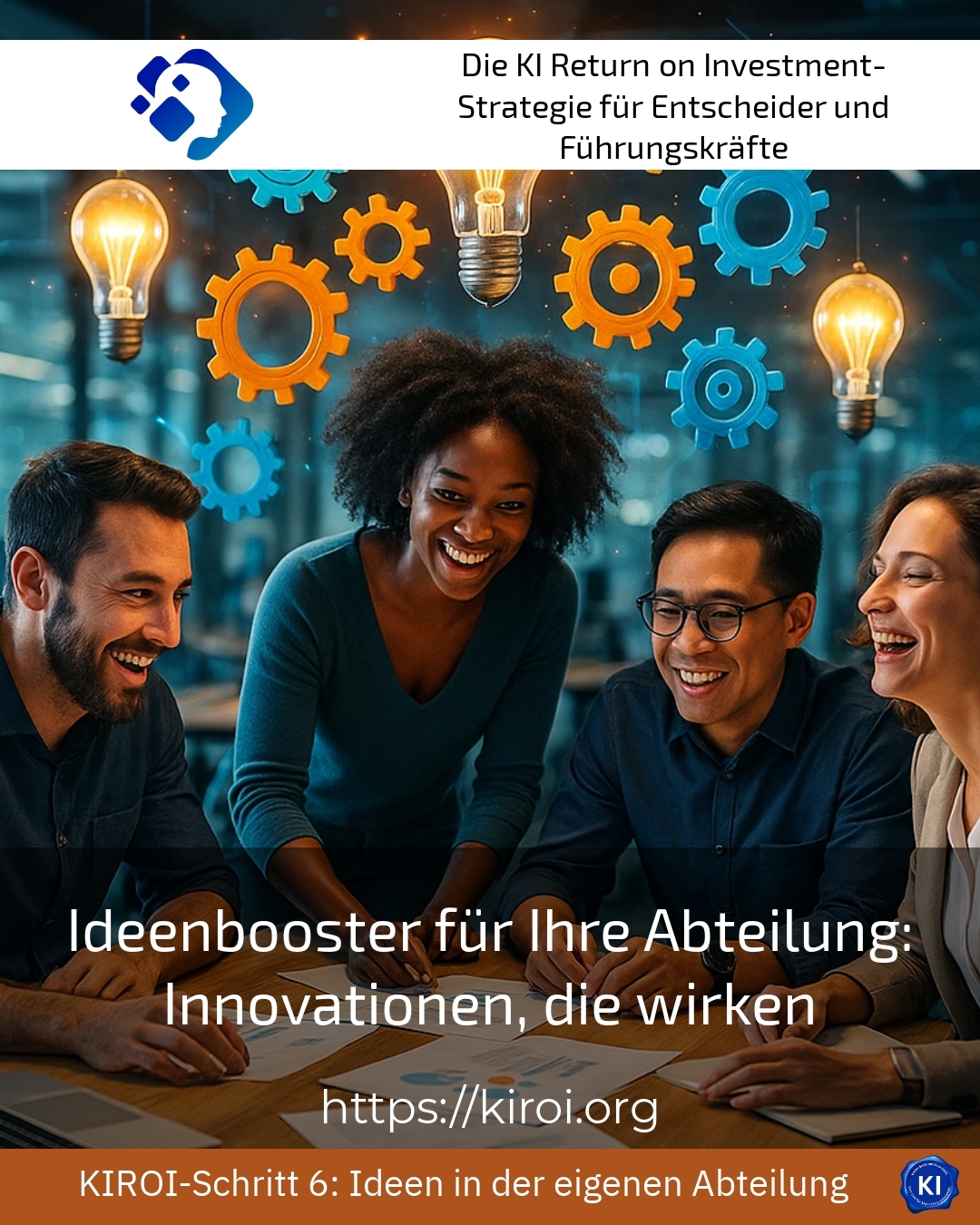
This question concerns executives in almost all industries, and the answer often lies in a lack of systematic creativity promotion, which is a real challenge for companies. Idea booster for your department: Innovations that work It can work. In a time when changes are advancing rapidly and markets are continuously transforming, companies need more than just reactive adjustments – they need proactive impulses that have a lasting impact. This is where a well-thought-out concept comes into play, helping teams fully unleash their creative potential and translate it into measurable results. The following sections show you concrete ways to drive this transformation in your field.
Recognize and dissolve the hidden blockages
Before new concepts can bear fruit, existing obstacles that disrupt the creative flow must be identified. Often, leaders report an atmosphere in which new suggestions are welcomed but rarely consistently implemented. This discrepancy between aspiration and reality leads to frustration and a gradual withdrawal of committed employees, who prefer to keep their energy to themselves rather than invest it in seemingly hopeless initiatives.
For example, a medium-sized manufacturing company in the mechanical engineering sector realized that its weekly meetings had become mere status meetings. The introduction of dedicated creative phases with structured methods fundamentally changed the dynamics. Similarly, a logistics service provider, which suddenly gained access to ideas that had previously been withheld out of fear of criticism due to the implementation of anonymous suggestion channels, experienced a similar change. A financial institution, on the other hand, broke through its blockages by establishing hierarchical-free innovation circles in which apprentices had as much weight as experienced department managers.
Best practice with a AIROI customer
An international trading company approached us because despite highly motivated employees, the rate of innovation had stagnated for several years. Analysis showed that an overly complex approval process acted as an invisible barrier. Every new idea had to go through five approval stages, which meant that even promising concepts often remained in the queue for months. As part of the transruptive coaching, we supported the company in radically simplifying this process. We introduced a two-stage quick process for projects under a specific budget framework. Additionally, we established monthly pitch sessions where employees could present their concepts directly to the decision-making committee. The results exceeded all expectations. Within six months, the number of submitted proposals tripled. What was even more important, however, was that the implementation rate rose from twelve percent to a remarkable forty-four percent. The employees reported a completely changed atmosphere in which commitment was once again seen as meaningful.
Your idea booster for your department: Innovations that work – methods with substance
Choosing the right methods is crucial to determining whether creative impulses will dissipate or have a lasting impact. This does not involve applying as many techniques as possible, but rather selecting those approaches that are specifically suited to the specific situation and culture of a department. A proven approach is to first identify the existing strengths and use them as the foundation for further development [1].
The Design Thinking methodology has proven to be an effective tool in numerous contexts. A healthcare provider used this approach to fundamentally improve the patient experience. A software company transformed its development process and reduced the time to market by almost half. A educational institution, in turn, developed entirely new learning formats using this methodology that met the changing needs of its participants.
In addition to design thinking, techniques such as brainwriting, the 6-3-5 method, or morphological analyses also support systematic idea generation. These approaches are particularly effective when they are not seen as one-time events but as continuous practice [2]. Regularity creates routine, and routine lowers the threshold for creative thinking.
Use digital tools as amplifiers
The digital transformation opens up entirely new possibilities for collaborative idea development. Platforms for virtual brainstorming enable teams distributed geographically to be brought together and their collective intelligence to be pooled. For example, an automotive supplier introduced a digital innovation platform where employees from all locations could submit their ideas and evaluate them with each other. An energy provider used similar tools to connect ideas from different business areas. Finally, a media company developed a continuous feedback system using digital tools that early on indicated which concepts had particular potential.
The importance of leadership role in the idea booster for your department: Innovations that work
Leaders significantly shape the development or absence of an innovation culture through their behavior. Their role as role models cannot be delegated and is more immediate than any formal directive. When leaders themselves are open to new approaches and communicate their own failures transparently, they create a space of psychological safety that is essential for creative risk-taking [3].
One construction company experienced a remarkable change when management began to specifically ask for unconventional solutions in meetings. One pharmaceutical company established so-called failure Fridays, where failed projects were analyzed and the insights gained from them were shared. A telecommunications provider, in turn, introduced mentoring programs in which experienced executives accompanied younger employees in developing and implementing their ideas.
Best practice with a AIROI customer
An insurance company sought support because despite extensive training programs, the expected innovation dynamics did not materialize. The deeper analysis conducted as part of our support revealed that the middle management level acted as an unconscious bottleneck. These executives were under enormous operational pressure and therefore prioritized day-to-day business over longer-term development projects. Together, we developed a concept that explicitly gave these executives time for innovation work. We defined measurable goals for creative initiatives and integrated them into the performance evaluation. Additionally, we established a buddy system in which two executives supported each other in achieving their innovation goals. The change was noticeable. The affected executives began actively encouraging their teams and creating spaces for experimental work. After nine months, the number of piloted projects had quadrupled.
Strategically deploy resources
Creativity requires space – both in terms of time, space, and finances. The provision of dedicated resources signals that innovation efforts are taken seriously. For example, a consumer goods manufacturer made available fixed time budgets for experimental projects for its departments. An IT service provider set up physical creative spaces that differed significantly from the usual office environment. A chemical company, in turn, established an internal innovation fund from which promising concepts could be funded without bureaucracy.
From idea to impact – building the implementation bridge
The best idea remains ineffective if it is not translated into practice. This transition from conception to implementation represents the biggest challenge for many organizations. Structured processes can help build this bridge and significantly increase the likelihood of implementation.
One retail company established so-called rapid prototyping weeks in which selected ideas were converted into testable versions within the shortest time possible. An industrial company introduced stage-gate processes that defined clear milestones and decision points. A service company, in turn, relied on agile methods such as Scrum to iteratively develop and continuously improve new concepts [4].
The key often lies in starting small and learning quickly. Pilot projects allow for testing hypotheses and gathering insights before making larger investments. This approach reduces risks while simultaneously creating the evidence base required for scaling.
My AIROI Analysis
Observations from numerous accompanying projects reveal a clear pattern. Organizations that develop sustainable innovation dynamics differ from others not primarily by the quality of their ideas, but by their ability to create and maintain a supportive environment. This environment is characterized by several factors. It provides psychological safety, allowing employees to express even imperfect ideas. It provides the necessary resources without tying them to overly complex approval processes. It has leaders who lead by example through their own behavior, setting the standard for what others should expect.
Particularly noteworthy is the realization that the factor time is often underestimated. Creative processes cannot be accelerated indefinitely. They require incubation phases during which ideas can mature. Organizations that understand this and create corresponding spaces for freedom achieve better results in the long run than those that rely on constant output pressure. Transruptive coaching supports companies precisely in this balance between dynamism and patience, between action and reflection. The accompaniment of such transformation projects has repeatedly shown that the Idea booster for your department: Innovations that work then it is most effective when it is understood as a continuous journey – not as a one-time event.
Further links from the text above:
[1] Harvard Business Review – Innovation Management
[2] IDEO U – Design Thinking Resources
[3] Google re:Work – Psychological Safety in Teams
[4] Scrum.org – Agile Implementation Guides
For more information and if you have any questions, please contact Contact us or read more blog posts on the topic Artificial intelligence here.











 Deutsch
 English (UK)