
Why do more than 70 percent of all innovation initiatives in companies fail, even though employees develop brilliant ideas every day?
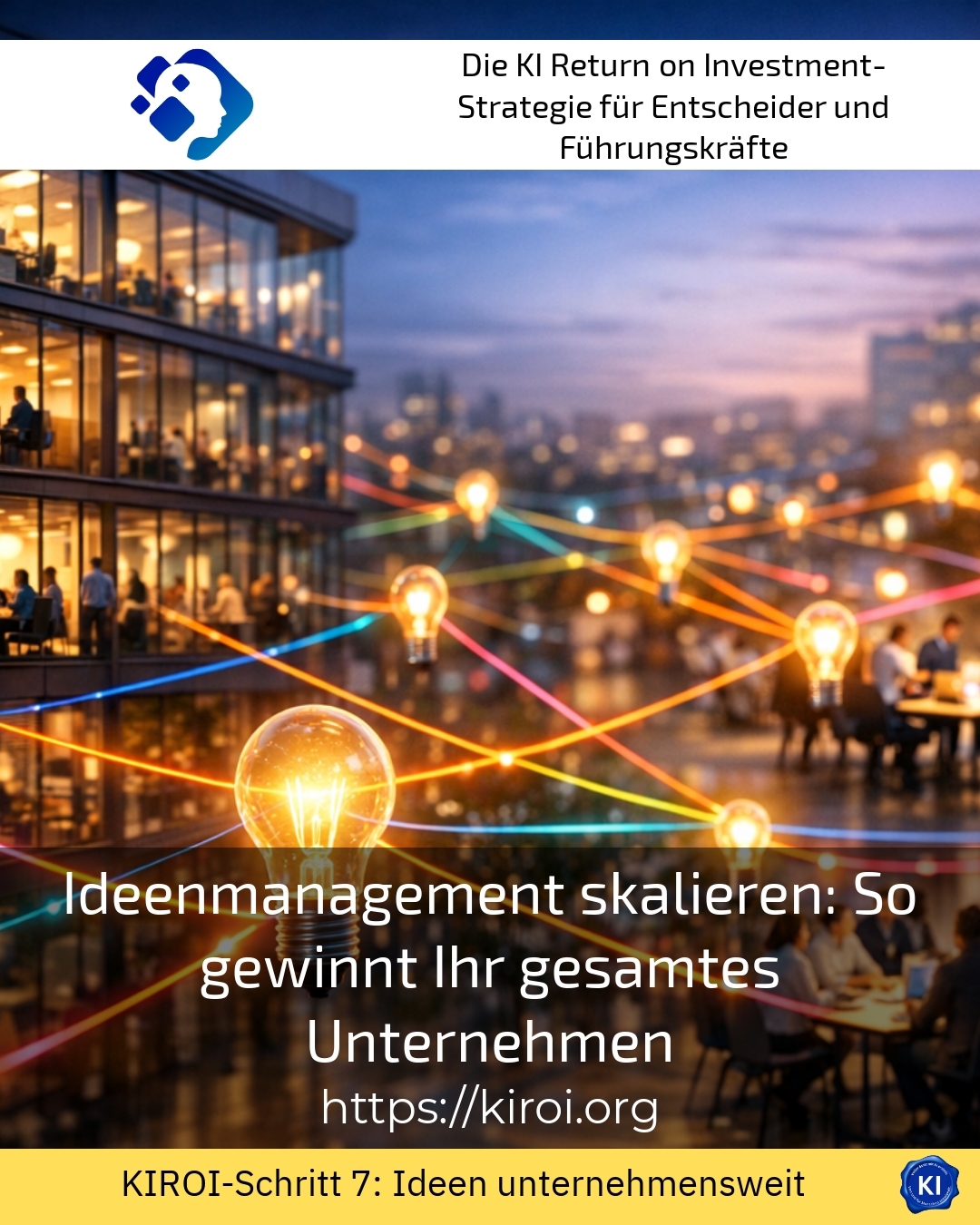
This question concerns executives and board members worldwide. The answer often lies in a systematic problem: Many organizations collect suggestions and ideas for improvement, but they fail to consistently extend these processes to the entire company. Scaling ideas management This represents one of the biggest challenges, because it requires not only technical infrastructure but also a profound cultural change. Companies that successfully master this step often report significant improvements in their competitiveness and employee satisfaction. In this article, you will learn how to proceed systematically and what impulses transruptive coaching can provide in such transformation projects.
The fundamental importance of structured innovation processes
Innovations rarely arise in a vacuum. They grow where people can freely express their thoughts. At the same time, they need structured channels for further development. Many organizations significantly underestimate this connection. They install digital platforms and expect immediate results. But that is not how more sustainable change works.
For example, a manufacturing company in the mechanical engineering sector started with a simple digital solution for ideation gathering. The first few weeks were promising. Employees submitted numerous suggestions. However, after three months, participation dramatically stagnated. The cause was quickly identified: there was a lack of transparent communication about the status of submitted ideas. People did not know what happened to their contributions.
Another example shows similar patterns. A logistics company implemented a company-wide proposal system. The management hoped to save millions in costs. Instead, it caused frustration among employees. The reason: The evaluation criteria were not transparent and the decision-making processes took months. Successful transformation therefore always requires the guidance of experienced partners.
In healthcare, similar challenges are evident. Clinics have enormous potential for improvement. Nurses and doctors develop practical solutions for recurring problems on a daily basis. Yet these insights often remain trapped in the minds of individuals. Transruptions coaching helps organizations systematically unearth exactly these hidden repositories of knowledge.
Best practice with a AIROI customer
A medium-sized company in the automotive parts industry faced the challenge of fundamentally revising its innovation processes and extending them to all locations. The previous structures only functioned satisfactorily at the main location, while the international branches were largely disconnected. As part of a transruptive coaching project, we supported the project team over several months in developing a cross-location strategy. Together, we identified cultural differences in engagement readiness and developed adapted communication strategies for each location. The management received intensive training in valuing ideas and transparent feedback to the submitters. Particularly important was the establishment of local innovation ambassadors who acted as a bridge between the teams and the central coordination. After twelve months, the company recorded a threefold increase in the number of submitted improvement proposals, while at the same time the implementation rate increased. Employee satisfaction in this area improved measurably, and management reported on a noticeably more innovation-friendly corporate culture.
Scaling idea management: Technology as a facilitator
Digital tools play a central role in expanding innovation processes. They enable cross-site collaboration and create transparency. At the same time, companies must not overvalue the technology. It is merely a tool. The real power always lies with the people.
In the financial sector, banks are increasingly relying on AI-powered platforms for idea evaluation. These systems automatically analyze submitted proposals for relevance and feasibility. They suggest connections with similar ideas and thus significantly speed up the evaluation process. The human decision remains the final step [1].
Insurance companies are experimenting with gamification elements in their innovation platforms. Employees collect points for submitted and implemented ideas. These points can be exchanged for rewards or further training opportunities. Participation thus increases measurably because the recognition is immediately tangible.
In retail, companies use mobile applications to collect ideas directly at the point of sale. Sales staff can document observations and improvement suggestions in real time. This immediate capture prevents valuable insights from being lost. The central office thus receives a continuous stream of practical knowledge from all branches.
Do not underestimate the cultural dimension
Technology alone does not create an innovation culture. People need to feel safe to share their ideas. They need the confidence that their contributions will be valued. Leaders bear a special responsibility in this regard.
In the pharmaceutical industry, this dynamic is particularly evident. Scientific staff in research departments possess deep expertise. However, hierarchical structures often hinder the free exchange of ideas. Younger team members hesitate to question established approaches. Breaking down this psychological barrier requires time and sensitive guidance.
Energy companies face similar challenges. The transition to renewable energy requires fundamental rethinking. Employees with decades of experience in conventional technologies must develop new ways of thinking. Their expertise remains indispensable. Successful change integrates existing knowledge with fresh perspectives.
In the education sector, universities are experimenting with open innovation formats. Students, faculty, and administrative staff work together to improve them. These heterogeneous groups bring different perspectives. The results often surprise with their creativity and practical applicability [2].
Measurable success through systematic idea management can be scaled up
Evidence of concrete success consistently convinces skeptical stakeholders. Key performance indicators must go beyond mere submission rates. What matters are the rate of implementation, the time span until realization, and the economic benefits. These metrics require sophisticated measurement systems.
Telecommunications companies, for example, track the return on investment of each idea implemented. They document savings, revenue increases, and process improvements in detail. This transparency motivates further submissions and justifies investments in the innovation infrastructure.
In the aviation industry, airlines measure the impact of employee ideas on customer satisfaction. Improvement proposals from the on-board staff often lead to noticeable service improvements. The link between the idea and the customer benefit is explicitly communicated. This significantly strengthens the commitment of those who submit the ideas.
Industrial companies link their innovation management with continuous improvement processes. Lean management approaches and idea management complement each other optimally. Small improvements add up to significant efficiency gains. The systematic documentation makes these successes visible and understandable [3].
Best practice with a AIROI customer
An international trading company wanted to fundamentally modernize its existing proposal system and extend it to all European branches. The challenge was to take into account different corporate cultures and legal frameworks. As part of our transruptive coaching support, we first developed a deep understanding of the local circumstances of each location. We conducted interviews with employees at all levels of the hierarchy and identified specific obstacles and success factors. Based on this, we designed a flexible framework that combined global standards with local adaptability. The implementation took place in stages over eighteen months, with each location receiving individual support. The establishment of a cross-location community of practice, in which innovation leaders regularly exchanged experiences, proved particularly valuable. The company was able to increase its conversion rate from originally twelve percent to over forty percent and documented savings in the double-digit millions within the first two years after the transformation was completed.
Leaders as key figures of transformation
Without committed leadership, any innovation initiative fails. Managers must be role models and actively solicit ideas. They should also submit their own suggestions and openly discuss their own failures. This authenticity builds trust and encourages others.
In the media industry, there are successful examples of this leadership culture. Publishing houses that successfully manage digital transformation often have leaders who actively promote experimentation. They tolerate failures as learning opportunities and publicly celebrate successes. This attitude permanently shapes the entire organization.
Construction companies face particular challenges when integrating commercial employees. Tradespeople on construction sites often do not have regular access to digital systems. Innovative companies are therefore developing hybrid approaches that combine analog and digital elements. Site managers play a central role as intermediaries in these processes.
In the hospitality industry, the attitude of the branch management determines the success of local innovation initiatives. Hotels with committed directors receive significantly more improvement suggestions than establishments with distant leadership. Personal attention and timely feedback motivate the entire team to actively participate.
Scaling idea management in practice: step by step
The successful expansion of innovation processes requires a thoughtful approach. Rapid implementations regularly fail. Instead, a gradual approach with continuous adjustment is recommended.
The first step consists of an honest assessment of the current state of affairs. Where are existing processes currently located? What strengths can be expanded upon? What weaknesses require attention? This analysis forms the foundation for all further activities.
In the second step, companies define clear goals and success criteria. What is the expanded system supposed to achieve? What metrics measure progress? Without this clarity, there is no direction for all involved.
Pilot projects in selected areas subsequently enable the gathering of practical experience. These controlled experiments demonstrate what works and what requires adaptation. The findings are then incorporated into the company-wide rollout [4].
My AIROI Analysis
The systematic expansion of innovation processes across the entire company represents one of the most challenging transformation tasks that organizations must tackle today. My experience from numerous accompanying projects clearly shows that technological solutions alone are never enough to achieve sustainable change. The decisive success factor lies, rather, in the consistent integration of digital infrastructure, cultural development, and engaged leadership.
Companies that address all three dimensions simultaneously achieve significantly better results than those that focus on individual aspects. The role of external support is often underestimated. Neutral perspectives help identify blind spots and break through stagnant patterns. Transruptive coaching provides just this support and accompanies organizations through the complex phases of transformation.
Particular emphasis should be placed on the importance of patience and perseverance. Cultural changes take time, and quick successes should not mislead people into thinking that long-term work is not necessary. Organizations that possess this long-term mindset and consistently work on their innovation capabilities are ideally positioned to meet the challenges of the future. The path may be challenging, but the results often justify the effort.
Further links from the text above:
[1] McKinsey: The Eight Essentials of Innovation
[2] Harvard Business Review: Innovation Topics
[3] BCG: Innovation Strategy and Delivery
[4] Gartner: Innovation Strategy Insights
For more information and if you have any questions, please contact Contact us or read more blog posts on the topic Artificial intelligence here.









 Deutsch
 English (UK)