
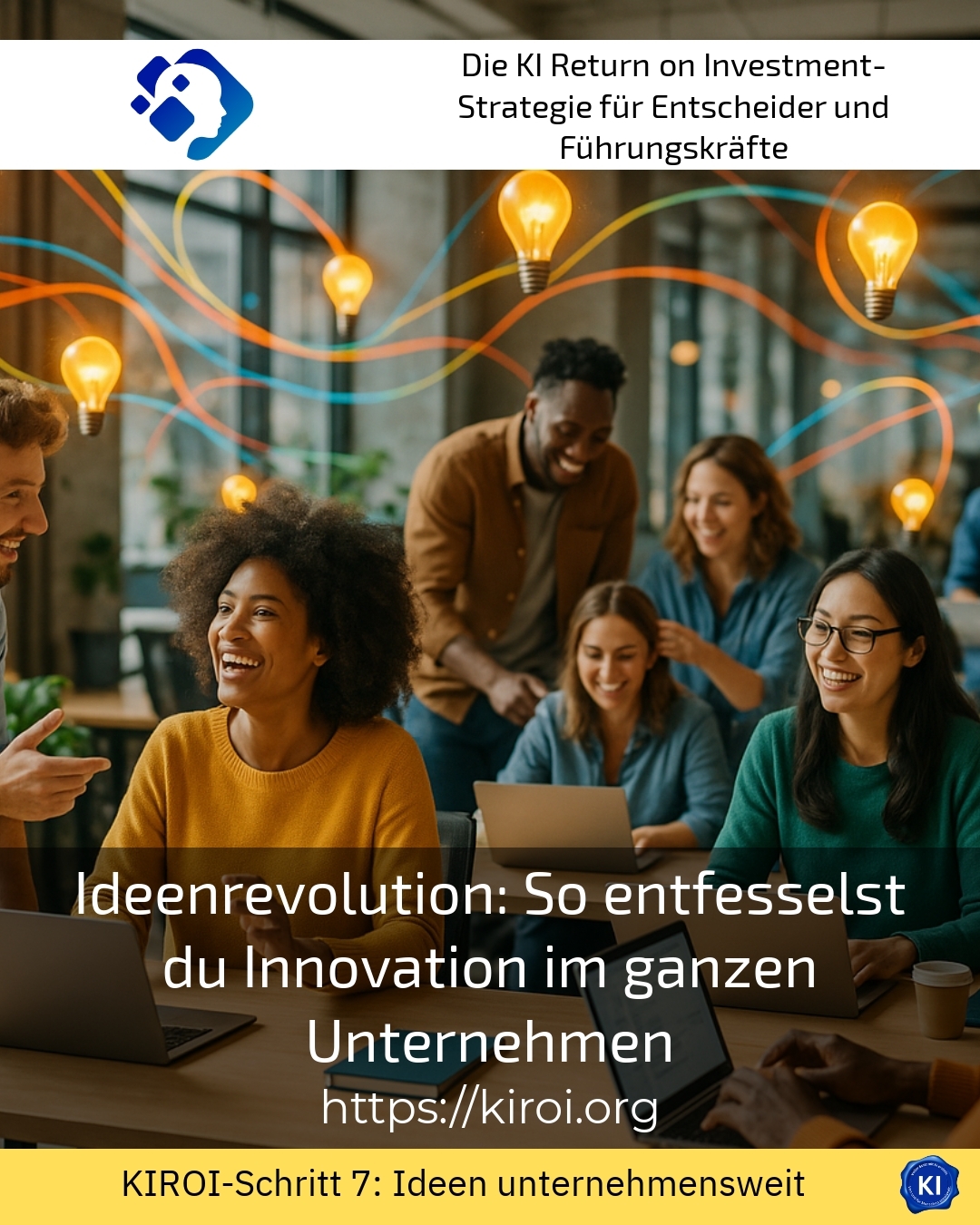
Imagine your company transforming into a place where every single employee becomes an engine of progress. The Idea revolution it doesn't begin in the executive suites or research departments, but rather unfolds wherever people collaborate and search for better solutions together. In a world that is changing at breakneck speed, it is no longer enough to rely on individual geniuses or leave innovation to chance. Instead, organisations need systematic approaches to unleash the creative potential of everyone involved and initiate sustainable change. This article shows you how to bring about exactly this transformation.
Why classical structures block creative flow
Traditional corporate hierarchies have served excellently for decades, enabling predictable processes and clear responsibilities. However, these structures often act like invisible walls today, hindering the free flow of ideas and stifling creative impulses at the outset. Employees often find that their suggestions get lost in bureaucratic loops or never reach the decision-makers. For instance, a medium-sized engineering company reported that innovative suggestions from production took an average of eight months even to be considered. A logistics provider found that only three percent of submitted ideas were ever implemented. And a financial institution recognised that the best suggestions often came from employees who worked furthest from the decision-making bodies.
This realisation leads to a fundamental question that every leader should ask themselves. How can we dismantle barriers without losing the necessary order? The answer lies not in radical upheavals, but in careful changes to company culture. Transruption coaching supports organisations in finding precisely this balance and establishing new ways of working step by step. This is less about spectacular individual measures and more about continuous improvements that reinforce one another.
The revolution of ideas begins with the right attitude
Before technical platforms or formal processes are introduced, something fundamental needs to change. Attitudes towards ideas and those who propose them form the foundation of any successful innovation culture. Leaders play a crucial role in this, as their behaviour signals what is desired and what is not. One retail company transformed its culture by having supervisors consistently ask questions rather than provide answers. An energy provider introduced weekly idea breakfasts where hierarchies were deliberately set aside. And a technology group established the principle that even the most unconventional idea is initially valued.
However, these cultural changes do not happen overnight, but require patience and consistent action over longer periods. Clients in transruption coaching often report how difficult it is to break old patterns and establish new behaviours. Support from experienced coaches can provide valuable impetus and reveal blind spots. The external perspective, which questions ingrained thought patterns and opens up alternative perspectives, often proves particularly helpful.
Best practice with a AIROI customer
A medium-sized company in the manufacturing sector approached us because its innovative strength had been stagnating for years and younger talent was leaving the company. The initial situation presented a classic picture: hierarchical structures, long decision-making processes, and a culture where mistakes were considered failures. As part of the transruption coaching, we first worked intensively with the management team on their own attitude towards change and uncertainty. In parallel, we identified the biggest obstacles to creative thinking together with employees from all departments. The results were illuminating and sometimes painful for the management level. It turned out that many excellent ideas already existed but never found their way to the top. We then established a simple system whereby every submitted idea received initial feedback within seven days. Additionally, we trained managers in giving constructive feedback and treating even seemingly absurd suggestions with appreciation. After nine months, the number of submitted ideas had quadrupled. Even more importantly, however, employee satisfaction had measurably increased, and staff turnover had significantly decreased. To this day, the company reports a vibrant culture of discussion that would have been unthinkable before.
Create space for creative thinking
Innovation needs not only the right attitude, but also physical and temporal spaces in which it can emerge [1]. Specifically, this means that companies must consciously create spaces where employees are allowed to experiment. One pharmaceutical company grants its researchers one day per month for their own projects without any requirements. A car parts supplier set up so-called innovation labs where teams from different departments work on future topics. And an insurance group established virtual creative spaces where employees from different locations can jointly develop ideas.
However, such spaces only work when they are linked to the appropriate security. Psychological security means that people dare to express unfinished thoughts without having to fear negative consequences [2]. The revolution of ideas thrives on the fact that even seemingly crazy suggestions are welcome and seriously considered. Transruption coaching supports leadership teams in establishing precisely this security and in setting an example for open thinking themselves.
Methods and tools for systematic innovation
Besides a cultural foundation, concrete methods are also needed to channel and utilise creativity. Design Thinking has proven to be an effective approach in many industries because it places people and their needs at the centre [3]. For example, a telecommunications company uses this method to develop new service concepts, consistently incorporating the customer's perspective. A retailer uses Design Thinking workshops to continuously improve the shopping experience in its branches. And a hospital applies the method to make processes more patient-friendly and reduce waiting times.
Digital platforms can further accelerate and democratise the flow of ideas by breaking down barriers between departments and hierarchical levels. Idea management systems allow suggestions to be collected, evaluated, and developed transparently. One construction company reports that through such a platform, ideas from site workers reached management directly for the first time. A media group uses gamification elements to increase participation in innovation processes. And a chemical company connects its ideas platform with artificial intelligence to bundle similar suggestions and identify synergies.
The Role of Leadership in the Idea Revolution
Without committed leaders, even the most sophisticated innovation strategy remains ineffective, because ultimately people make the difference, not just systems. Leadership in innovative organisations means less control and more enablement, fewer instructions and more questions. A software company trained its entire leadership to use coaching conversation techniques to better tap into the creative potential of its teams. An industrial conglomerate introduced the principle of servant leadership, where superiors primarily act as supporters of their employees. And a consultancy established reverse mentoring programmes, where junior employees advise their leaders on new technologies and trends.
This transformation of the leadership role presents a considerable challenge for many, as it questions cherished habits and power positions. Transruption coaching accompanies leaders through this often difficult process and helps to develop new behaviours. The aim is not to give up authority, but to use it differently and to lead through inspiration rather than control.
Best practice with a AIROI customer
A service company with several thousand employees came to us with a specific problem: the innovation department regularly produced new concepts, but these were hardly adopted or implemented by the operational units. The analysis quickly showed that this was a classic silo problem, with different areas working past each other. As part of the coaching, we developed a completely new approach that decentralised innovation responsibility and shifted it to the operational teams. The central department transformed from an idea factory into a support team that provided methods and enabled networking. We accompanied this transformation over several months, working with both the management team and key individuals from all departments. It was particularly important to take fears of loss of importance seriously and address them constructively. The results far exceeded expectations, as ideas suddenly came from areas that had never previously been considered innovative. The implementation rate increased dramatically because the operational teams could now realise their own ideas. The company reports a tangible energy and enthusiasm that has impacted all areas and led to measurable improvements in customer satisfaction and efficiency.
Error culture as fuel for breakthroughs
Every genuine innovation comes with the risk of failure because, by definition, new things are not yet tried and tested and involve uncertainties. Organisations that punish or stigmatise mistakes inevitably stifle the willingness to take bold experiments in doing so. An aviation company therefore established a consistent learning culture programme, in which mistakes are systematically analysed and the insights are shared. A technology company celebrates so-called Fail Fridays, where teams present their failed projects and discuss the learning effects. And a consumer goods manufacturer introduced error budgets, which teams are explicitly allowed to use for risky experiments.
This new attitude towards mistakes requires a fundamental change in the mindset of everyone involved, from senior management to the shop floor. The revolution of ideas can only succeed if people dare to take unconventional paths and accept setbacks as part of the process. Transruption coaching provides impetus on how this cultural change can succeed and which concrete measures have proven effective in practice.
My AIROI Analysis
The analysis of the described approaches and practical examples clearly shows that innovation is not a product of chance, but can and must be systematically promoted. The key to success is always the combination of cultural, structural, and methodological elements that interlock and reinforce each other. Organisations that rely on individual measures alone generally do not achieve sustainable results because the various factors must work together. The revolution of ideas always begins with the attitude of leadership and then continues in changed structures and processes. I find the realisation that speed in implementation is less crucial than consistency and perseverance to be particularly important. Many companies start with great enthusiasm but lose focus after a few months when initial hurdles arise.
The AIROI methodology offers a structured framework for systematically addressing the various areas of action and making progress measurable. It has been shown that an external perspective from experienced coaches can provide significant added value by breaking down ingrained patterns and opening up new perspectives. At the same time, the actual work always lies with the people within the organisation themselves, who must live and shape the change. Transruption coaching is understood as support on this path, not as a substitute for the commitment of those involved. The practical examples impressively demonstrate the potential that lies dormant within organizations when it is consistently unlocked. The path to an innovative organisation may be demanding, but the results often justify the investment in time and resources.
Further links from the text above:
[1] Harvard Business Review: Innovation
[2] McKinsey: Psychological Safety and Leadership Development
For more information and if you have any questions, please contact Contact us or read more blog posts on the topic Artificial intelligence here.









 Deutsch
  English (UK)