
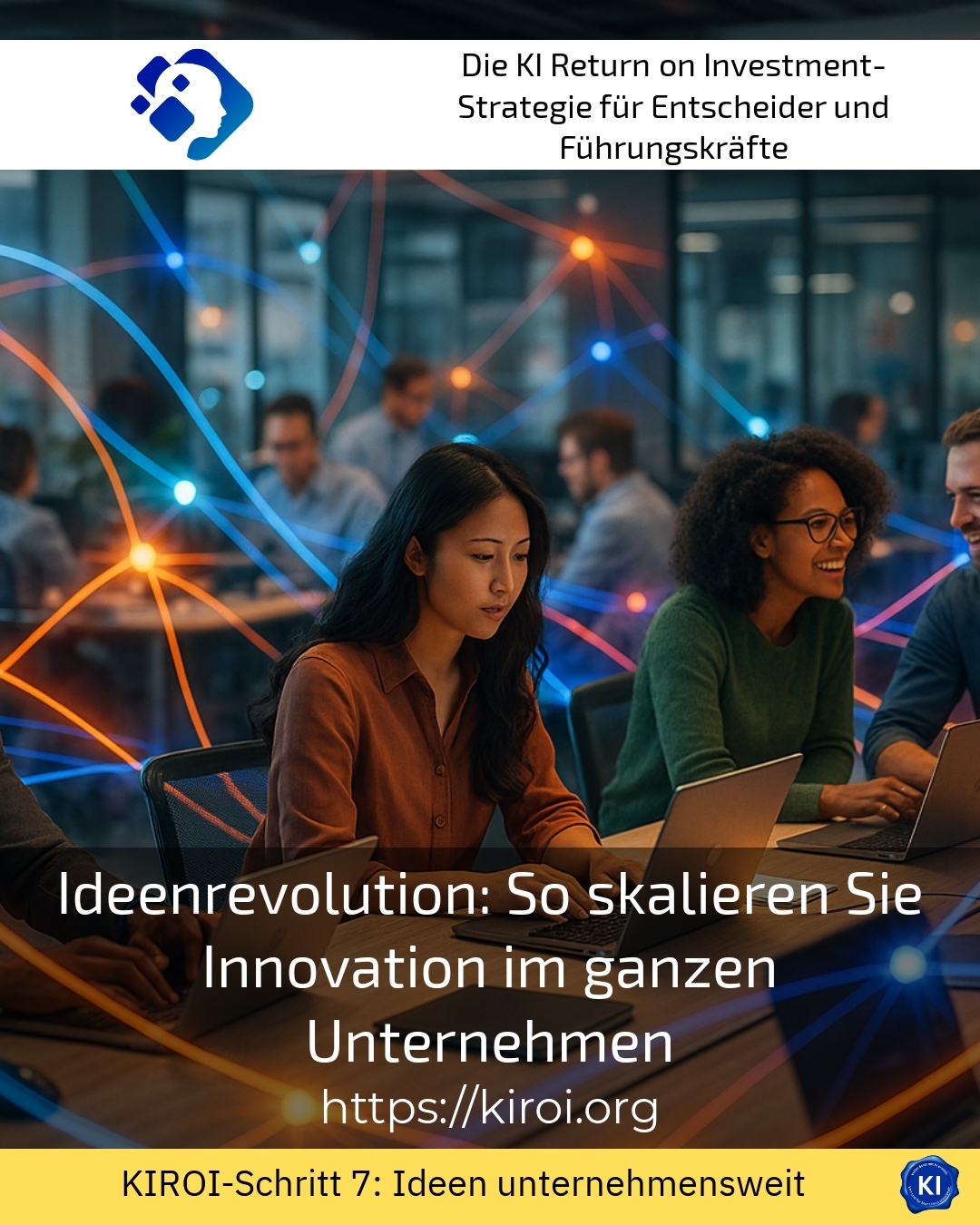
Imagine your company develops hundreds of brilliant ideas every day, but only a fraction of them ever reach the implementation stage. This is precisely where Idea revolution as they fundamentally change how organisations tap into and systematically leverage creative potential. In a rapidly changing economic world, the ability for scalable creativity determines success or stagnation. Many leaders turn to transruptions coaching with precisely this challenge, because they sense that traditional innovation methods are reaching their limits. They are looking for input to make change processes sustainable and to actively involve employees.
Why traditional approaches often reach their limits
Many companies still rely on central innovation departments or occasional workshops for idea generation. While these methods work satisfactorily on a small scale, they are difficult to transfer to larger structures. A medium-sized mechanical engineering company recently reported exactly this dilemma [1]. Although creative workshops were held regularly, most suggestions got bogged down in bureaucratic processes. As a result, employees increasingly lost the motivation to contribute their ideas.
A logistics service provider had similar experiences when trying to gain fresh impetus through annual innovation competitions. The initial response was considerable, but the actual implementation rate remained alarmingly low. Another example comes from the retail sector, where a chain of stores introduced internal suggestion boxes. After initial enthusiasm, however, these gathered dust unnoticed because no one systematically evaluated the submitted suggestions. These patterns clearly show that isolated measures are rarely sufficient.
The crucial difference lies in scalability and cultural integration. Companies need structures that establish creative thinking as a natural part of the daily working routine. This is precisely where professional support comes in, as it aids in initiating sustainable changes.
Best practice with a AIROI customer
An internationally active manufacturing company with over three thousand employees faced a significant challenge in its internal idea generation. The existing processes were highly hierarchical, meaning many valuable suggestions never reached the decision-making level. As part of the transruption coaching, we jointly developed a multi-stage concept for decentralised creativity promotion. First, we identified so-called innovation ambassadors in various departments who acted as the first point of contact for new ideas. These multipliers received special training in appreciative idea evaluation and the constructive further development of suggestions. In parallel, we established digital channels that enabled employees to collaborate across different locations. The results positively surprised even the most sceptical managers. Within six months, the number of viable suggestions more than tripled. Particularly noteworthy was the increased employee satisfaction, as people finally felt heard. This project demonstrates how structured support can initiate sustainable change.
The Ideas Revolution as a Cultural Process of Change
A real Idea revolution concerns far more than just methods or tools. It requires a profound cultural shift that involves all levels of hierarchy and challenges traditional ways of thinking. Leaders play a central role in this, as their behaviour sets the framework for openness. A financial service provider only recognised these connections after several failed digitalisation projects [2]. The technical solutions were available, but the company culture blocked their effective use.
A similar picture emerges in the healthcare sector, where highly qualified professionals often work within rigid structures. A clinic group attempted to establish interdisciplinary innovation teams. Initially, hierarchical conflicts dominated the collaboration because established role perceptions were not questioned. The situation only noticeably improved through targeted team development and the introduction of equal communication formats. In the education sector, too, those responsible frequently report comparable challenges. Teachers possess enormous practical knowledge, but institutional barriers often prevent constructive exchange.
The key lies in the deliberate creation of psychological safety. People only contribute their best ideas when they don't fear negative consequences. This insight is regularly confirmed in the guidance of transformation projects.
Creating structures for a sustainable ideas revolution
Alongside the cultural dimension, organisations also require concrete structures for systematic idea development. These structures must be neither too rigid nor too arbitrary, but must provide a productive framework. For example, a technology company introduced so-called innovation sprints, during which teams were temporarily released from their regular duties. The results then fed into a structured evaluation process, which ensured transparency and fairness.
In the manufacturing industry, other formats have proven effective, such as regular improvement rounds directly on the production line. Employees know the processes best and often identify optimisation potential that remains hidden from managers. A car parts supplier reports significant efficiency gains through this approach [3]. In the service sector, customer-focused feedback loops work particularly well. Service employees gather valuable insights through direct contact and can systematically incorporate them.
The art lies in developing suitable formats for the respective context. Standard solutions rarely work because every organisation brings its own peculiarities. Professional support helps to develop and implement individual approaches.
Technology as an Enabler of the Ideas Revolution
Digital tools can Idea revolution significantly accelerate and simplify when used cleverly. Modern collaboration platforms enable cross-location cooperation and make idea generation processes transparent. A media company implemented such a platform and recorded significantly more participation than with previous analogue approaches. The inhibition threshold for participation decreased because employees could submit their suggestions flexibly and simply.
Artificial intelligence offers additional opportunities for idea evaluation and pattern recognition. Algorithms can analyse large numbers of suggestions and identify connections that might be missed by human observers. A pharmaceutical company is using such systems to pre-select promising research approaches. In the energy sector, digital twins support the rapid simulation and evaluation of innovative concepts. These technological capabilities open up entirely new perspectives for systematic creativity processes.
However, technology never replaces human creativity and interpersonal trust. It can only act as an amplifier and supporter, while the actual innovation work remains with people.
Best practice with a AIROI customer
A retail group with over five hundred branches was looking for ways to better utilise the decentralised knowledge of its employees. The geographical distribution made in-person meetings time-consuming and expensive, meaning many good ideas remained unused. Together, we developed a hybrid concept that combined digital and analogue elements. Initially, we introduced a low-threshold app that employees could use to document their observations and suggestions. A specially trained team from various hierarchical levels regularly reviewed these submissions and provided constructive feedback. Particularly promising approaches were explored further in regional workshops, where the idea generators were personally involved. This combination of digital reach and personal recognition proved extremely effective. Employees experienced that their voices mattered and their contributions were taken seriously. Within one year, several successful pilot projects for customer loyalty emerged from this process. The group is now planning to expand the concept to other business areas and to continuously develop it further.
Rethinking Leadership for Successful Idea Revolution
The role of leaders is fundamentally changing if organisations wish to systematically unlock creative potential. Traditional command-and-control structures contradict the requirements of a vibrant innovation culture. Instead, skills such as active listening, encouragement, and constructive feedback are gaining importance. A construction company went through precisely this transformation after the previous authoritarian leadership style had driven away numerous talents.
Similar developments are apparent in the public sector, although the framework conditions there are particularly challenging. A city administration experimented with so-called innovation labs, where work was carried out across hierarchies. Initially, there was resistance because familiar lines of reporting were bypassed. However, after some successes, acceptance grew, even among sceptical managers. In the non-profit sector, organisations also report positive experiences with participative leadership models. Employees feel more connected to the mission and contribute more engagement.
leadership development becomes the central building block of every Idea revolution. Without the right expertise at the top, even the best structures remain ineffective.
Measurability and continuous improvement
Many organisations struggle to measure and evaluate the success of their innovation efforts. Classic metrics such as submitted ideas or implemented projects often fall short. An insurance company therefore developed a multidimensional key figure system that also takes qualitative aspects into account. This included, for example, the diversity of idea generators, the processing times of suggestions, and the satisfaction of those involved.
A different approach is proving successful in the hospitality industry, where guest feedback is directly incorporated into the innovation process. The feedback shows precisely which improvements are well-received and where further action is needed. A software company uses agile retrospectives to regularly question and adapt its own innovation process. This continuous reflection prevents once-established structures from becoming rigid and losing their effectiveness.
The most important takeaway is that perfectionism is counterproductive. An iterative approach, which allows for small steps and learning from mistakes, is better.
My AIROI Analysis
The systematic development of creative potential presents organisations with complex challenges that go far beyond methodological issues. My experience from numerous support projects shows that sustainable changes only arise when cultural, structural, and technological aspects are considered together. Isolated measures regularly fizzle out because they are not embedded in a coherent overall concept. Leaders, in particular, frequently underestimate the importance of psychological safety as a prerequisite for open idea exchange.
The examples presented illustrate that there is no royal road to success. Idea revolution Giving. Every organisation must find its own path, one that fits its history, values and people. Standard solutions regularly fail because of this complexity, which is why individual support is so valuable. Transruption coaching supports decision-makers in recognising blind spots and daring to take bold steps. It offers a safe space for reflection and experimentation, without imposing hasty solutions.
The coming years will show which organisations successfully master the transformation. What is certain is that those who start now and persevere will have an advantage. Investing in creative structures pays off in the long term, even if short-term successes are not always visible. Those who wish to embark on this path will find an experienced guide for this demanding journey in transruptions-coaching.
Further links from the text above:
[1] Harvard Business Review – Innovation
[2] McKinsey – The Eight Essentials of Innovation
[3] Forbes – Innovation
For more information and if you have any questions, please contact Contact us or read more blog posts on the topic Artificial intelligence here.








 Deutsch
  English (UK)