
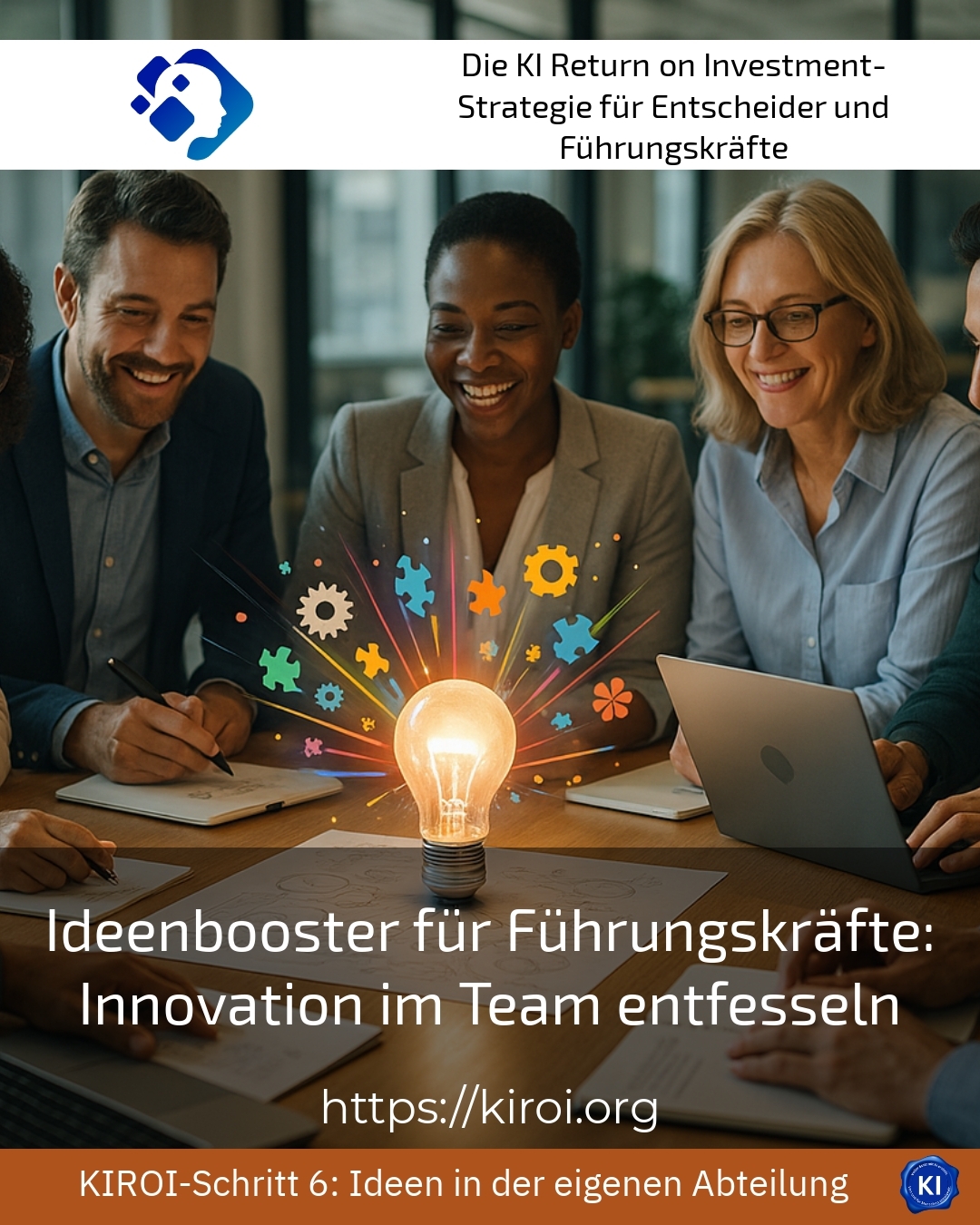
Imagine your team suddenly develops groundbreaking concepts that propel your entire organisation forward. This is precisely what many leaders experience when they are acting as Innovation Booster for Leaders: Unleashing Team Innovation work. The key doesn't lie in expensive programmes or complicated methods. Instead, it all begins with a changed attitude and targeted impulses. Clients often report that even small adjustments have a big impact. This article shows you practical ways to increase creativity and innovation.
Why traditional approaches are no longer sufficient today
The world of work is changing rapidly, presenting established leadership models with new challenges. Classic hierarchies and rigid decision-making processes often stifle creative processes. Employees wait for approvals while competitors are already bringing new solutions to market. We are observing this dynamic particularly in technology-driven companies and in the service sector. For example, a mechanical engineering company lost valuable time due to lengthy approval loops. A financial services provider struggled with outdated product development cycles that were no longer market-appropriate. Similarly, a medium-sized logistics company experienced good ideas getting lost in day-to-day business.
The causes lie deeper than merely organisational structures. Many leaders were trained in an era when control was considered a strength. Today, however, teams need freedom, trust, and psychological safety for real innovation. This shift requires a rethink at all levels of the organisation. Transruption Coaching supports leaders precisely in this important transformation towards greater openness.
As an idea booster for leaders: Unleashing innovation in teams through trust
Trust forms the bedrock of any innovative team culture in successful companies. Without trust, employees are hesitant to voice unusual suggestions or take risks. They fear negative consequences and prefer to maintain established patterns. However, it is precisely this restraint that prevents breakthroughs to truly new solutions.
A pharmaceutical company experienced this situation particularly clearly in its research department. The scientists worked in isolation and shared few insights with each other. Only when management actively led by example in embracing tolerance for error did the atmosphere noticeably change. A similar situation occurred at an automotive supplier whose engineers held back innovative approaches because they feared criticism. A retail company, in turn, found that its sales employees avoided creative customer approaches.
Best practice with a AIROI customer
A medium-sized manufacturing company approached us with an urgent concern. Management noticed that despite highly qualified specialists, hardly any suggestions for improvement were being submitted. As part of the Transruption Coaching, we first analysed the existing communication structures very thoroughly. This revealed that managers were unconsciously sending critical signals when employees presented new ideas. Together, we developed a format called "Innovation Breakfast," where discussions took place without regard to hierarchy. Managers learned to listen actively and provide appreciative feedback without immediate evaluation. Within six months, the number of submitted suggestions increased significantly, quadrupling. Even more important, however, was the qualitative change in the ideas, which were now much more profound. Employees suddenly dared to share even unfinished thoughts and develop them further with others. This openness led to a product innovation that gave the company a real competitive advantage.
Creating psychological safety as a foundation
The term psychological safety describes a climate where people dare to take risks [1]. In a study, Google identified this factor as the most important success factor for high-performing teams. Leaders can actively promote this safety through their own exemplary behaviour in everyday life.
A telecommunications company implemented weekly reflection sessions where failures were discussed openly. An energy provider introduced anonymous idea channels to break down initial barriers for shy employees. A consulting firm explicitly rewarded failed experiments if they yielded learning effects. These examples show that psychological safety must be consciously designed by leadership.
Creative methods and formats for the idea booster for executives: unleashing innovation in the team
Besides the cultural foundation, teams also need concrete tools for idea generation in their day-to-day work. Design Thinking, Brainwriting, and other methods offer structured frameworks for creative processes. However, it is crucial that these formats fit the respective company culture and appear authentic.
A software company experimented with hackathons, where cross-departmental teams worked intensely on challenges. An insurance group established innovation labs as protected spaces for unconventional thinking, away from day-to-day operations. A retailer used regular customer workshops to bring fresh perspectives directly into the company and integrate them.
The choice of the right method depends on various factors that need to be carefully considered. Team size, industry, available time, and desired outcomes all play important roles in the decision. Transruption Coaching supports leaders in identifying and successfully implementing suitable formats within their teams.
Leveraging diversity as a driver of innovation
Homogeneous teams tend to develop similar solutions and overlook blind spots in their work. Diversity, on the other hand, brings together different experiences, perspectives, and ways of thinking in a creative process. This variety acts as a natural catalyst for innovative ideas and unexpected connections between concepts.
A media company deliberately assembled cross-generational teams for project work with great success. A technology group promoted international exchange programmes to strengthen cultural diversity across all departments. A healthcare provider actively involved patients in the development of new services with impressive results. These examples illustrate the enormous potential of diverse collaboration for genuine innovation.
Best practice with a AIROI customer
A company with international operations in the consumer goods sector was looking for ways to accelerate its product development. Previous innovation cycles were taking too long and often missed customer needs, unfortunately. As part of our support, we developed a cross-functional innovation team composed of members from eight different departments. Marketing, production, sales, finance, IT, customer service, purchasing, and quality assurance worked together on one project. The leader consciously took on the role of a facilitator rather than a traditional decision-maker. They ensured clear communication, removed obstacles, and consistently protected the team from disruptive influences. The result positively surprised all involved with the quality and speed of the work. Within three months, a product concept was developed that clearly passed all internal tests with top marks. The market launch occurred six months earlier than with comparable projects in the past. The sustainable networking of the departments, which continued to exist even after the project ended, was particularly valuable.
The role of the leader in the innovation process
Leaders significantly shape the innovation culture of their teams anew each day through their behaviour. They send signals about what is desired and what is not, often unconsciously through small gestures. Their reaction to new ideas determines whether employees will dare to make further suggestions in the future.
A construction company experienced how a sceptical comment from the CEO triggered months of hesitation within the team. A chemical group, on the other hand, benefited from the divisional manager publicly acknowledging and valuing every suggestion. A hotel group trained its managers in appreciative communication with remarkable practical results.
The transformation towards innovation-promoting leadership often requires personal development and reflection over a long period. Old patterns must be recognised, questioned, and replaced with new ones in a continuous process. Transruption coaching supports these change processes individually and provides valuable impulses for the sustainable development of the leadership personality.
From Manager to Enabler
The classic management role traditionally focuses on planning, control, and decision-making within hierarchical structures. However, innovative teams require leaders who can act flexibly as enablers and supporters. These enablers create frameworks within which creativity can thrive and develop freely.
A sports equipment manufacturer fundamentally changed its leadership culture through a comprehensive coaching programme for all levels. An IT service provider established Servant Leadership as its guiding principle and experienced a significant boost in innovation thereafter. A food manufacturer granted teams more autonomy, quickly reaping the rewards of more engaged and creative employees. These examples impressively demonstrate the shift from a controlling manager to a supportive enabler.
Recognising and overcoming obstacles as an idea booster for leaders: Unleashing innovation in teams
The path to greater innovation is rarely straightforward and presents numerous challenges. Resistance, setbacks, and frustrations are part of the change process and must be overcome. What is crucial is how leaders deal with these obstacles and what attitude they adopt.
An electronics company encountered massive resistance from middle management during its culture change. A transport and logistics firm struggled with naysayers who wanted to pick apart every new idea out of fear of change. A textile manufacturer experienced initial enthusiasm that quickly turned to disillusionment due to a lack of resources.
These situations require perseverance, empathy, and strategic skill from all parties involved in the company. Resistance should not be fought, but understood and taken seriously as an important signal. Often, objections hide legitimate concerns or valuable suggestions for potential improvements in the process.
Best practice with a AIROI customer
A family firm steeped in tradition within the mechanical engineering sector faced a difficult challenge with modernisation. The younger generation of the owning family desired more innovation, while long-serving managers remained sceptical. In Transruption Coaching, we initially developed a shared understanding of the differing perspectives of both sides. The older managers contributed valuable experience and knowledge, which absolutely could not be lost. The younger generation provided fresh impetus and the courage for new approaches, which the company had been lacking until then. We established a tandem model, where experienced and young managers successfully led projects together. This configuration leveraged the strengths of both sides while significantly minimising their respective weaknesses. After initial friction, a productive dynamic developed between the different generations within the company. Today, the company successfully and harmoniously blends tradition and innovation in its corporate culture. Employee satisfaction demonstrably increased, and the innovation rate also improved significantly and sustainably.
Embedding a sustainable innovation culture
Individual innovation projects bring short-term success, but sustainable impact requires lasting cultural integration. A true innovation culture doesn't emerge overnight, but grows continuously over months and years. It must be nurtured, promoted, and continuously revitalised through conscious leadership actions.
A furniture manufacturer embedded innovation into its corporate values and consistently exemplified these to all employees. A tourism group meaningfully linked innovation goals with its remuneration system at all hierarchical levels. A medical technology company strategically and wisely established its own innovation department with a direct connection to senior management.
Anchoring requires consistency in words and deeds over a long period from everyone. One-off workshops or campaigns are not enough to bring about lasting change in the company. Transruption coaching accompanies organisations long-term on this important path of sustainable cultural transformation.
My AIROI Analysis
Over the years, supporting numerous leaders and teams has provided me with deep insights into innovation processes. It repeatedly shows that technical solutions alone are not enough for real innovation. The human factor remains decisive for the success or failure of innovation initiatives in companies. Leaders who act as genuine idea boosters successfully combine several important personal qualities.
You listen actively and take suggestions seriously, without premature judgment or disparagement. You consistently create space and protect your teams from excessive pressure from day-to-day operations. You celebrate successes and deal constructively with setbacks, without assigning blame. You invest in relationships and build trust through your authentic daily behaviour.
My AIROI analysis also shows that innovation must never be an end in itself within companies. It must always be able to create clear added value for customers, employees, or society. Leaders should therefore always ask themselves what problem innovation is concretely intended to solve.
I observe the greatest progress in leaders who are willing to continuously question themselves. They recognise that their own behaviours can often represent the biggest obstacles to team innovation. With this insight and professional guidance, sustainable transformation is usually pleasingly successful.
Further links from the text above:
[1] Google re:Work – Psychological Safety in Teams
For more information and if you have any questions, please contact Contact us or read more blog posts on the topic Artificial intelligence here.









 Deutsch
  English (UK)