
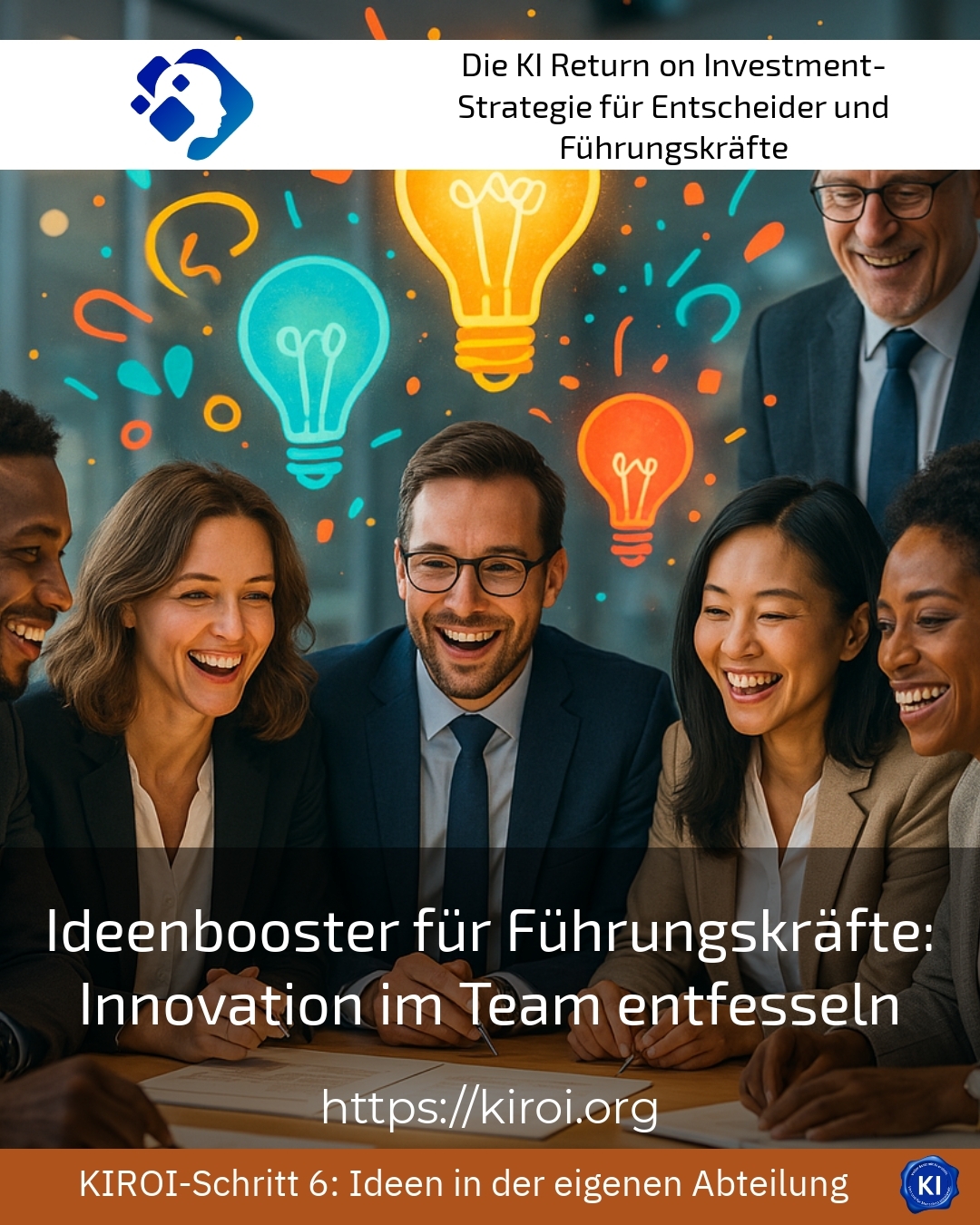
Have you ever wondered why some teams are so full of creativity while others, despite enormous effort, remain stagnant? The answer often lies not in the abilities of individual employees, but rather in the way in which leaders act as Ideas booster for leaders to function and thus to unleash the creative potential of their teams to its fullest extent. In a world that is constantly changing due to technological breakthroughs and volatile markets, the ability to continuously innovate determines the success and failure of entire organizations. Many executives who come to us report a certain sense of uncertainty in the face of stagnant structures and a culture that stifles rather than encourages new ideas. Transruptions coaching accompanies these individuals in their projects around transforming their leadership culture and establishing sustainable creativity processes.
Understand the hidden blockages to creative team dynamics
Before you become a true leader Ideas booster for leaders To be able to achieve this, you must first understand the invisible barriers that hinder the free flow of innovative ideas within your team. Often, it’s not the obvious factors such as lack of resources or lack of time that hinder this. Rather, subtle psychological mechanisms play a crucial role. Fear of criticism inhibits many team members. Hierarchical structures stifle divergent opinions. Perfectionism prevents the necessary experimentation.
In the automotive industry, for example, we observe how established development teams fail with disruptive powertrain concepts despite high technical expertise, because the existing corporate culture rewards incremental improvements and considers radical innovations as a risk. Pharmaceutical companies often face similar challenges: while research teams deliver brilliant individual contributions, interdisciplinary collaboration between chemists, biologists, and data analysts faces communication hurdles. This pattern is also evident in the financial sector, where traditional banks, despite enormous investments in digital transformation, often cannot compete with agile fintech startups because their established structures systematically hinder rapid decision-making and experimental approaches.
Best practice with a AIROI customer
A medium-sized engineering company from southern Germany came to us with the challenge that their development department had not produced any truly groundbreaking product ideas for years. The technically highly skilled engineers worked in isolation in their respective fields and only exchanged ideas in formal meetings, which were characterized by rigid agendas and little room for spontaneous ideas. As part of AIROI our coaching, we first conducted a comprehensive analysis of the existing communication channels and found that informal conversations between departments practically did not exist. Subsequently, we implemented a system of so-called creative corridors, physical meeting zones between the office areas, equipped with inspiring materials and prototyping tools. In addition, we introduced weekly cross-functional jams where employees from different departments came together without a predetermined agenda. After six months, management reported a significant increase in patent applications and a noticeably improved collaboration between the technical disciplines.
Creating psychological safety as a foundation
The concept of psychological safety, popularized by the research of Amy Edmondson [1], describes a work environment where people feel safe to take risks, ask questions, and admit mistakes without fearing negative consequences. For you as a leader, this means actively and consciously creating a space where failure is not seen as a flaw, but as a necessary part of the learning process.
Google has found in its famous Project Aristotle [2] that psychological safety is the most important factor for successful teamwork. Leaders can foster this safety. They start with themselves. They acknowledge their own uncertainties. They actively seek out dissenting opinions. They respond constructively to criticism.
In the chemical industry, this is evident, for example, when laboratory managers encourage their research teams to pursue unconventional synthesis routes, even if they initially appear to be unlikely to yield success. Technology companies like Microsoft have undergone a fundamental cultural transformation under the leadership of Satya Nadella, moving from a know-it-all culture to a learn-it-all culture, which has significantly increased the experimental spirit and thus the innovation potential. In the aviation industry, where safety traditionally has the highest priority, advanced companies have also recognized that an open error culture paradoxically leads to greater safety because problems can be detected and resolved earlier.
Idea boosters for executives: concrete methods to promote creativity
Theory alone is not enough. Leaders need concrete tools. The Design Thinking method [3] offers a structured approach to creative problem solving that is successfully used in many industries and helps to put the needs of users at the center. The SCAMPER technique allows for systematically questioning existing products or processes by substituting, combining, adapting, modifying, using in other ways, eliminating, or reversing them.
Brainstorming sessions are often conducted ineffectively. The result is mediocre ideas. Brainwriting works better. In this method, participants first write their ideas silently. Only then do they discuss them. This method prevents dominant personalities from monopolizing the conversation and also gives introverted team members a voice.
In the consumer goods industry, companies such as Procter & Gamble have been using open innovation approaches for years, in which they systematically incorporate external ideas, thus significantly expanding their internal innovation pipeline. Medical technology companies are increasingly relying on so-called hackathons, intensive creative workshops in which interdisciplinary teams develop prototypes for new products or services within a few days. The fashion industry, in turn, has perfected the concept of trend scouts, employees who systematically seek inspiration outside their own industry and incorporate it into product development.
Best practice with a AIROI customer
A large insurance company approached us because they had found that their digital product innovations regularly fell short of expectations and were not accepted by the customer base. The internal analysis had revealed that the development teams were working too far removed from the actual customer needs and that their solutions were based on assumptions rather than real insights. As part of AIROI our coaching, we implemented a Customer Immersion Program in which developers regularly accompanied and observed customers in their daily interactions with insurance products. Additionally, we established monthly innovation circles in which employees from all levels of the hierarchy were able to contribute ideas equally, with the evaluation of the ideas being conducted anonymously to avoid hierarchical biases. The results were remarkable, because within a year the success rate of new digital products increased significantly, and employee satisfaction in the development teams improved noticeably, because people felt that their ideas were heard and appreciated.
The role of the physical and digital working environment
The design of the workplace significantly influences the creativity of employees, which is why as a manager you should also pay special attention to this aspect. Studies show that a combination of open collaboration areas and quiet retreat spaces achieves the best results, as both spontaneous idea exchange and focused individual work are enabled.
Technology companies in Silicon Valley have long since integrated these findings into their office designs; companies like Apple, with their new headquarters Apple Park, have deliberately created meeting zones that are intended to encourage casual conversations between employees from different departments. Traditional industrial companies such as the German automotive supplier Bosch are also increasingly experimenting with innovative space concepts that merge the workshop, laboratory, and office spaces, thus enabling the rapid transition from idea to prototype. The advertising industry, in turn, has always been a pioneer in designing creative work environments; agencies like IDEO are known worldwide for their inspiring spaces, filled with materials, prototypes, and visual stimuli.
In the digital realm, virtual collaboration tools are becoming increasingly important. They enable creative collaboration across locations. Platforms like Miro or Mural provide digital whiteboards for distributed teams. These tools can complement physical meetings, but rarely replace them.
Idea booster for executives: Using diversity as a driving force for creativity
Homogeneous teams think homogeneously. Diversity in all its facets, whether regarding gender, age, cultural origin, education, or personality type, demonstrably leads to more creative solutions because different perspectives come together and enrich each other. Leaders who want to act as genuine catalysts of creativity must therefore actively ensure diverse team compositions and ensure that all voices are heard.
In the game development industry, it has been shown that teams with diverse cultural backgrounds develop games that appeal to a broader audience and are more commercially successful. Pharmaceutical companies report that interdisciplinary teams of physicians, engineers, data scientists, and patient representatives have led to breakthroughs that remained closed to purely medical teams. In architecture, the value of diversity is also evident when international teams with different cultural backgrounds develop innovative building concepts that combine local traditions with global standards.
Establish sustainable structures for continuous renewal
Individual creativity workshops can provide an impetus, but to achieve lasting results, you need a plan. Ideas booster for leaders systematic structures that integrate creativity into the workday. Many successful companies have introduced dedicated innovation time, such as Google’s famous 20 percent model, where employees are allowed to spend part of their working time on their own projects.
The technology company 3M is considered a pioneer of this approach. Decades ago, it already introduced the so-called 15-percent rule. This initiative gave rise to legendary products such as the Post-it notes. Such spaces of freedom signal to employees that creative thinking is valued and encouraged.
Energy companies face the challenge of fundamentally transforming their business model and have established internal incubators where teams can work on disruptive business ideas without being constrained by the constraints of day-to-day operations. Retail companies like Amazon have established a culture with concepts like the Day-One principle, in which a start-up mentality is maintained despite the size of the company and every day is considered the first day. The telecommunications industry, in turn, is increasingly adopting corporate venturing approaches, in which established companies invest in external start-ups and benefit from their innovative power.
Best practice with a AIROI customer
An international logistics company asked us for support in establishing a sustainable innovation culture, after several large-scale transformation initiatives had generated short-term enthusiasm but had not resulted in lasting changes. AIROI Our analysis revealed that previous efforts had focused too much on individual large projects and had not changed the daily work routines of employees. Together with the leadership team, we developed a system of innovation rituals, small but regular practices that anchored creativity in everyday life. These included weekly learning lunches where employees presented insights from other industries, monthly reverse mentoring sessions where younger employees shared their digital expertise with experienced leaders, and quarterly fail-forward events where failed projects were analyzed and the lessons learned celebrated. After a year, these practices had become so deeply embedded in the corporate culture that they continued even without external support and the employees themselves developed new formats.
My AIROI Analysis
Accompanying numerous executives and teams on their journey towards greater creativity and innovation has shown me that there is no one-size-fits-all solution that works equally well for all organizations. However, what all successful transformations have in common is the sincere commitment of the leadership to not only undertake structural changes but also to fundamentally question and adapt their own behavior. The most effective Ideas booster for leaders Ultimately, they are not methods or tools, but an attitude of openness, curiosity, and humility.
AIROI My analysis repeatedly shows that the biggest obstacles to creative teamwork are rarely due to a lack of resources or lacking skills, but lie in deeply rooted cultural patterns that have developed over years or even decades and can only be changed through persistent, consistent work. Transruptive coaching, as a support for projects that seek exactly this transformation, assists in these projects without promising simple solutions that do not meet the complexity of organizational change processes.
Executives who come to us often bring similar issues with them. They feel a discrepancy between the potential of their teams and the results actually achieved. They experience how good ideas get bogged down in bureaucratic processes. They want to create a culture in which creativity can flourish. What I share with these people is the realization that sustainable change takes time and that the path itself, with all its setbacks and learning moments, is already an essential part of success. Providing impulses, opening up new perspectives, and creating the space for experimentation are the core elements of leadership that unleash creative potential and enable teams to perform at their best.
Further links from the text above:
[1] Amy Edmondson – Psychological Safety
[2] Google re:Work – Project Aristotle
[3] Interaction Design Foundation – Design Thinking
For more information and if you have any questions, please contact Contact us or read more blog posts on the topic Artificial intelligence here.









 Deutsch
  English (UK)