
Have you ever wondered why some departments just burst with creative energy while others remain stuck in rigid routines and can hardly develop any new impulses?
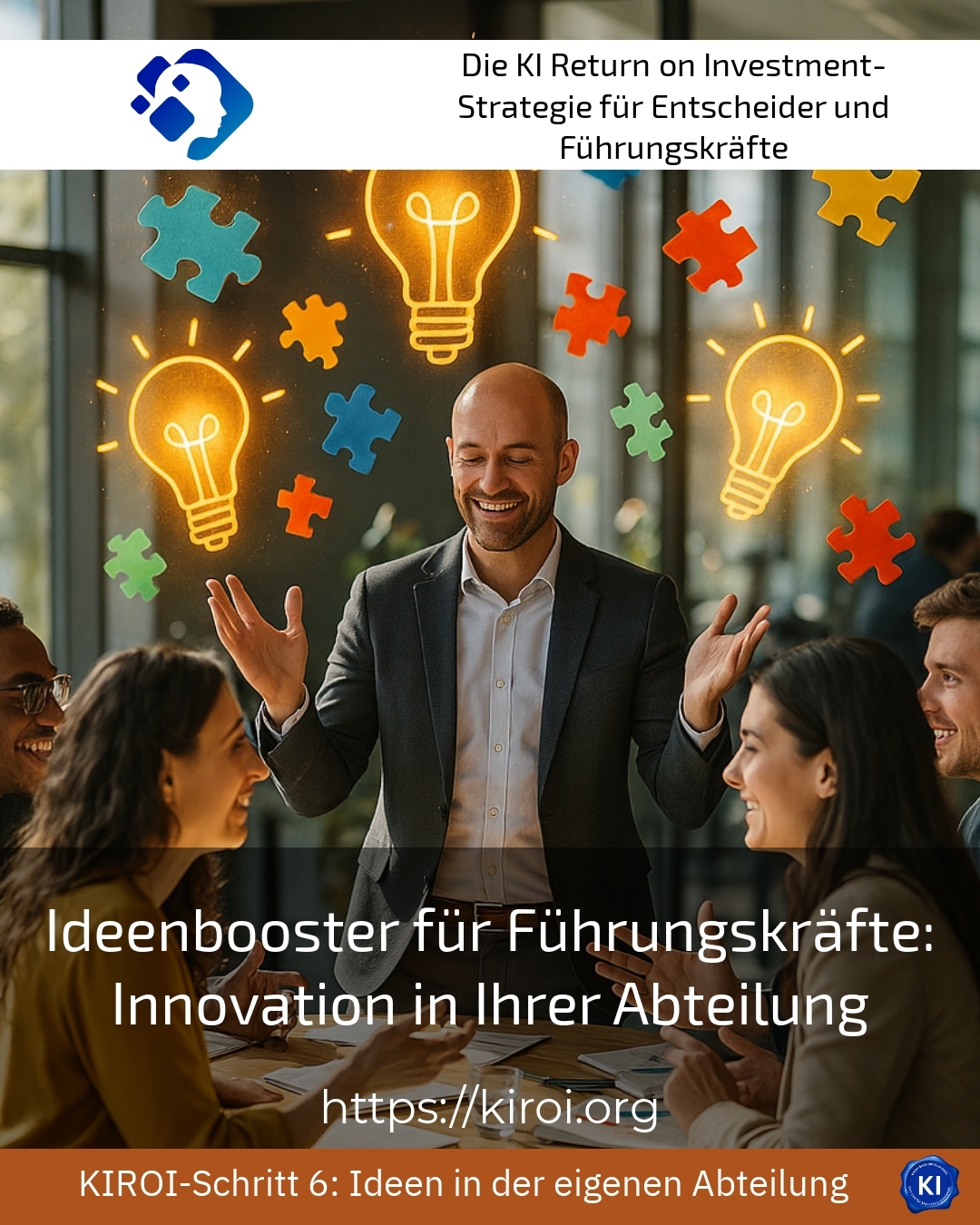
This question occupies leaders in all areas of business. The Ideas booster for leaders represents a crucial lever in this process. It enables entrenched structures to be broken up. Innovation rarely happens by chance. It requires fertile ground. This ground is created through targeted methods and an open culture. Clients frequently report similar challenges. They want to encourage their teams to be more creative. At the same time, they lack the right tools for it. Transruption coaching supports leaders precisely with these projects. It provides valuable impetus for sustainable change processes.
Understanding the basics of the idea booster for leaders
Before you can initiate innovative processes in your department, you must understand the underlying mechanisms. Creativity follows certain principles. These can be systematically promoted. In the automotive industry, for example, development departments rely on so-called design thinking workshops. These bring together engineers, designers and marketing experts. Together they develop new vehicle concepts. The pharmaceutical sector, on the other hand, uses cross-functional teams. Scientists from various disciplines work together on joint projects. In retail, managers experiment with hackathons. Employees from all hierarchical levels present their suggestions for improvement there.
The role of the leader is fundamentally changing in the process. They act less as a controlling authority. Instead, they are becoming an enabler and catalyst. This transformation requires a rethink on several levels. It affects one's self-perception just as much as communication with the team.
Best practice with a AIROI customer
A medium-sized engineering company faced a crucial challenge. The development department was barely producing any innovative solutions anymore. The manager felt increasingly frustrated. As part of the transruptions coaching, we first analysed the existing structures. It turned out that the meeting culture systematically suppressed creative impulses. Every new idea was immediately examined for its feasibility. This led to employees holding back their suggestions. Together, we developed a new format called the idea kitchen. In fortnightly sessions, all suggestions were initially collected without judgement. Evaluation only took place at a later stage. After six months, the number of submitted suggestions for improvement had tripled. Three of these ideas resulted in patentable new developments. The manager reported a noticeably positive change in the team climate.
Psychological safety as the foundation for the leadership idea booster
Google conducted an extensive study called Project Aristotle [1]. The results surprised even experienced HR professionals. The most important factor for team effectiveness was not technical competence. It was psychological safety. Employees need to feel that they can take risks. They need the certainty that mistakes will not be punished. Only then do they dare to voice unconventional ideas.
This is particularly evident in the financial sector. Banks and insurance companies are traditionally very risk-averse. Innovative ideas are frequently viewed with skepticism there. However, managers who establish a culture of experimentation report impressive results. In the technology sector, this attitude is already part of the corporate culture. Start-ups practically celebrate their failures. They view them as valuable learning experiences. The food industry has also adopted this approach. Product developers continuously test new recipes there.
Practical methods for generating ideas in your department
The theoretical principles form the foundation. Now it is time for concrete implementation. Which methods do you use to help spark creative processes? The selection is vast and should fit the respective corporate culture.
Most leaders are already familiar with classic brainstorming. However, it is frequently applied incorrectly. A study by the Harvard Business Review shows interesting findings [2]. Groups produce fewer ideas than individuals. The reason lies in so-called production blocking. While one person is speaking, the others have to wait. Their own thoughts are often lost in the process. The solution lies in a two-stage process. First, each participant writes down their ideas alone. Only after that does the exchange take place in the group.
In the logistics industry, the method of analogical reasoning has proven successful. Teams analyse successful solutions from completely different fields. An example illustrates this. A logistics company studied the working methods of ants, from which it developed a new concept for warehousing. The energy sector is making increasing use of scenario planning, with teams developing various visions of the future. These serve as the basis for innovative strategies. In healthcare, clinics rely on simulations, with doctors and nursing staff first testing new procedures in a secure setting.
Best practice with a AIROI customer
A retail manager came to transruption coaching with a specific concern. The team was tasked with developing new concepts for customer engagement. Previous workshops had yielded no usable results. Together, we analysed the methods used. An interesting pattern emerged. The participants felt pressured. They were expected to present perfect solutions immediately. We then introduced the method of perspective-taking. For one day, each employee stepped into the role of a customer. They visited their own and other branches. They documented their experiences in personal diaries. The subsequent evaluation yielded surprising insights. Small details such as lighting or product placement significantly influenced the shopping experience. From these observations, twelve concrete proposals for improvement emerged. Seven of these were implemented within three months.
Digital tools as amplifiers of creative processes
Digitisation opens up entirely new possibilities for idea generation. Collaboration platforms such as Miro or Mural enable virtual workshops [3]. Teams can work together regardless of their location. This is particularly valuable for internationally positioned companies. Artificial intelligence is increasingly supporting creative tasks. It analyses large volumes of data and identifies patterns. These insights can serve as a starting point for new ideas.
The telecommunications industry is increasingly relying on digital idea management systems. Employees can submit suggestions there at any time. A transparent evaluation system ensures motivation. In the manufacturing sector, companies use virtual reality. Engineers can make new product designs experienceable virtually. The media industry is experimenting with crowdsourcing platforms. External creatives develop concepts for campaigns there.
Embedding the idea booster for managers into daily routines
One-off workshops and creative sessions are not enough. Innovation must become part of the daily work routine. This requires structural changes. They affect meeting formats, communication channels and decision-making processes.
A proven format is the so-called innovation time. Companies like Google made this concept famous. Employees are given a fixed proportion of their working time for their own projects. In the chemical industry, several corporations have introduced similar programmes. There, researchers can work on projects that do not belong to the core business. The tourism industry is increasingly using job rotation. Employees regularly switch between different departments. This promotes the exchange of knowledge and new perspectives. In the construction industry, companies are experimenting with interdisciplinary project teams. Architects, civil engineers and tradespeople jointly develop new solutions.
The role of the leader remains central in this regard. They must lead by example with the new formats. They must help to overcome resistance. And they must make successes visible. Only in this way can a sustainable culture of innovation be created.
Best practice with a AIROI customer
An insurance company wanted to accelerate its product development. The manager of the department responsible sought support through transruption coaching. Together, we developed a multi-stage concept. First, we analysed the existing processes. The idea for a new product typically passed through seven committees. It often took several years until market launch. We proposed an alternative model. A small team was given permission to test prototypes quickly. The usual approval processes were temporarily suspended. Within eight weeks, the team developed three new product variants. These were initially tested in a limited market. The results exceeded all expectations. Two of the products went into regular development. The manager reported a veritable cultural shift within the department. Other teams became interested in the new approach.
Recognising and constructively using resistance
Not all employees welcome change with enthusiasm. Resistance is a natural part of every innovation process. It can even be valuable. Critical voices point out potential problems. They force the refinement of ideas. The trick lies in using resistance constructively.
In the textile industry, managers frequently encounter the argument of tradition. Certain processes have proven their worth over decades. A step-by-step approach helps here. Small pilot projects demonstrate the benefits of new approaches. The steel industry knows similar challenges. Safety concerns play a major role there. Innovative ideas must take these concerns seriously. In the education sector, digital innovations often meet with scepticism. Teachers fear the loss of tried and tested pedagogical methods. Successful communication can address these worries.
My AIROI Analysis
Mentoring leaders through innovation projects continually reveals similar patterns. The desire for greater creativity within the department is strong. However, implementation often fails due to hidden obstacles. These obstacles are rarely a lack of resources. They lie in the corporate culture and in personal beliefs.
The Ideas booster for leaders works best in an environment of psychological safety. Employees must feel that they are heard. They need permission to express unconventional thoughts as well. This requires a rethink at leadership level. The traditional role of the decision-maker is shifting to the role of the enabler.
At the same time, experience from transruptions coaching shows an important aspect. Innovation cannot be forced. It takes time and the right framework. Leaders who create this framework often experience surprising developments. Teams previously considered lacking in ideas suddenly unfold enormous potential. The keys to this are trust, clear structures and honest communication.
The Ideas booster for leaders is not a one-off event. It is a continuous process. It requires patience and a willingness to learn from mistakes. However, the results justify the effort. Teams become more engaged and satisfied. The department gains in agility and competitiveness. And the leader themselves grows through the new challenges. transruptions coaching is happy to accompany you on this journey. It provides impulses and supports practical implementation.
Further links from the text above:
[1] Google re:Work – Guide: Understand team effectiveness
[2] Harvard Business Review – Why Group Brainstorming Is a Waste of Time
[3] Miro – Guide to Online Collaboration
For more information and if you have any questions, please contact Contact us or read more blog posts on the topic Artificial intelligence here.








 Deutsch
  English (UK)