
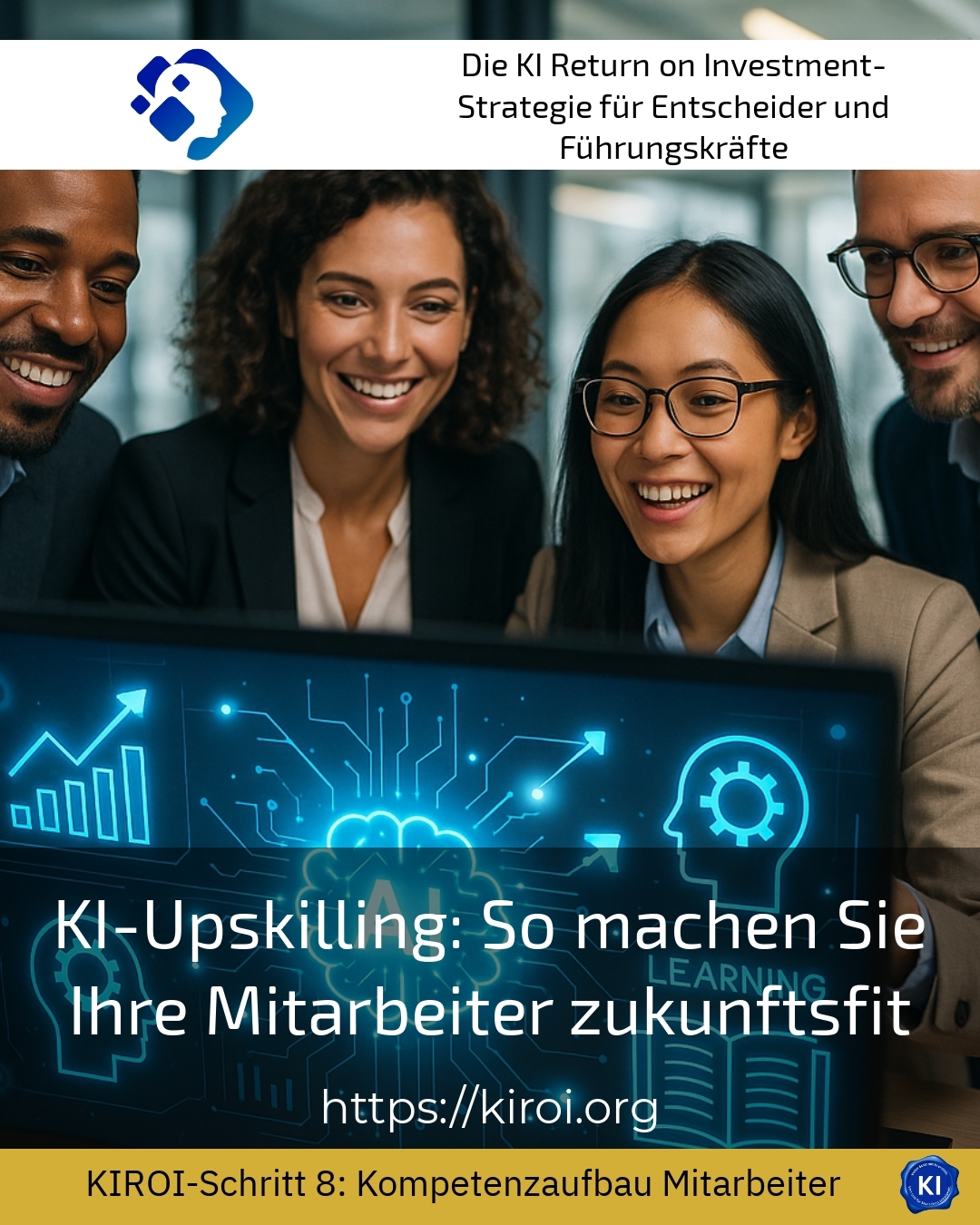
Have you ever wondered why some companies seemingly master technological change effortlessly, while others stagnate despite enormous investments in modern systems and lose their competitiveness? The answer often lies not in the technology itself, but in the people who are supposed to use these tools daily, which is why the topic AI Upskilling Currently being intensively discussed in leadership circles worldwide. Many executives report that they initially hesitated because they underestimated the complexity of change. But right now, as algorithmic systems become increasingly powerful, the competence of your workforce determines the success or failure of your digital transformation. In this article, you will learn how to systematically develop your teams and which concrete steps have proven effective in practice.
Why the human component is often underestimated
Digital transformation rarely fails due to technology. Instead, it often lacks the willingness and ability of employees. Many companies invest millions in new software solutions. At the same time, they completely neglect the training of their teams. This leads to frustration on all sides. Managers are surprised by the lack of acceptance. Employees feel overwhelmed and left alone. This vicious cycle can only be broken if companies put people at the center of their digital transformation strategy and understand that technological tools only reach their full potential when those who use them also truly understand how to use them optimally [1].
Imagine a manufacturing company implementing AI-based quality control. The software reliably detects errors. But employees don’t understand why certain parts are being discarded. They question the machine’s decisions. Some even deliberately ignore the warnings. Without proper training, this potential remains untapped. We observe a similar situation in customer service. Chatbots handle routine requests there. But employees don’t know how to handle complex cases. They don’t understand the handover points between human and machine. In the financial sector, the same pattern is evident. Algorithms analyze credit risks there. However, the officers cannot interpret the results. This leads to errors and inefficiencies despite the latest technology.
Strategic AI upskilling as a competitive advantage
Companies that invest early in the development of their workforce gain a sustainable advantage over their competitors because they not only have access to the latest technology, but also have people who understand this technology and can question and creatively develop it. AI Upskilling This involves much more than simply learning new software functions. It is rather about a deep understanding of how algorithmic systems work, what their limits are, and how humans and machines can work together optimally to achieve results that neither could achieve alone [2].
For example, a logistics company relies on automated route planning. The dispatchers not only learn how to operate the system; they also understand the underlying algorithms. This allows them to intervene effectively in special cases. A retail company uses predictive models for demand planning. The buyers know which data is included. They recognize when the predictions could become unreliable. An insurance company partially automates the claims processing process. The claims experts understand the decision logic. They can competently assess exceptions and provide a justification.
Best practice with a AIROI customer
A medium-sized machine manufacturer faced the challenge of qualifying its service technicians for the use of predictive maintenance systems that should automatically detect and report maintenance needs based on sensor data. The technicians’ previous expertise was by no means obsolete; rather, it needed to be supplemented with new competencies. Together with the transruptions coaching team, the company developed a multi-stage training program that initially introduced the basic concepts of algorithmic data analysis, then addressed the specific application to their own machines and systems, and finally included practical exercises in which the technicians learned to critically evaluate the system recommendations and align them with their own experience. The result exceeded expectations significantly, as not only was the unplanned downtime of customer systems reduced by more than a third, but the technicians also independently developed improvement suggestions for the algorithms, which were based on their practical experience and further improved the system’s predictive accuracy. Clients often report that it is precisely this combination of technical knowledge and practical application skills that makes the difference and that employees are not only more competent but also more motivated after such programs, because they understand the contribution they make to the company’s success.
The right learning culture as the foundation for successful AI upskilling
Individual training measures are not enough. Companies need a culture of continuous learning. This culture must be instilled from the top down. Employees observe closely whether their superiors remain curious themselves. They register whether mistakes are seen as learning opportunities or as failures. An open culture of error is therefore indispensable. Because those who fear mistakes do not experiment. And those who do not experiment do not learn effectively. Especially when dealing with new technological tools, people need the freedom to experiment in order to develop confidence in the systems and to learn their limits [3].
In an automotive supplier, management actively promotes knowledge sharing. Experienced employees mentor younger colleagues on new systems. At the same time, older employees learn from the digital affinity of the younger generation. In a pharmaceutical company, there are regular innovation labs. Teams there test new applications in a protected environment. Errors are documented and analyzed together. A bank has established so-called reverse mentoring programs. Young digital experts mentor experienced executives there. This creates mutual understanding and respect.
Practical implementation steps for your company
The transformation begins with an honest assessment of the current situation. Where are your employees today? What specific skills are lacking? This analysis should not remain abstract. Instead, it is recommended to define concrete use cases. What should employees be able to do in six months? What tasks will change? Based on this, customized development programs can then be designed that provide both theoretical knowledge and practical application skills and take into account the participants’ different backgrounds and learning speeds.
An energy provider has systematically trained its network planners. The training combined online courses with practical workshops. In addition, there was coaching for particularly complex application cases. A food company relied on learning-by-doing approaches. Small teams worked on real projects. Accompanying experts were available for questions. A telecommunications company developed its own learning platform. Employees can learn autonomously there. Gamification elements provide motivation and engagement.
The role of leaders in the transformation process
Leaders play a key role in any change. They must not only enable the change but actively drive it forward. This means first and foremost being a role model themselves. Leaders who refuse to learn undermine any initiative. At the same time, they must provide resources for further training. Time is often the critical factor here. If employees do not have time to learn, no learning takes place. Therefore, leaders must prioritize and communicate. The message must be: Further training is not a chore but a duty [4].
In a chemical company, managers regularly block calendar time for learning. These times are untouchable for operational tasks. In a media conglomerate, development goals are part of performance evaluation. Management is also measured by how they develop their teams. A trading company has appointed special change agents. They support teams in the practical implementation. They are the contact persons for questions and concerns.
Best practice with a AIROI customer
An international logistics service provider wanted to qualify its executives to support automation projects, where the particular challenge was that many of these executives had been with the company for decades and did not bring any deep technical knowledge, but possessed enormous process knowledge and people skills. The transruptive coaching accompanied this transformation over several months, starting by providing initial impulses for a fundamental understanding of algorithmic decision-making and then working with the executives to develop how they could lead their teams through the change without having to become technical experts themselves. Particularly valuable was the insight that these executives were able to ask the exact questions that often went unnoticed by the technical specialists because they knew the practical working day from years of experience. The leaders developed a new sense of self that valued their previous experience while being open to new ideas, and later reported that they no longer felt threatened by technology but acted as important builders of bridges between the technical possibilities and the human needs of their teams. This attitude also spread to their employees, who also became more open to change.
Understanding and constructively using resistance
Not all employees welcome changes enthusiastically. That is normal and human. Resistance can have many causes. Some fear for their jobs. Others question the purpose of the changes. Still others simply feel overwhelmed. It is crucial to take these resistances seriously. Behind them often lie legitimate concerns and valuable insights. A staff member who raises critical questions can uncover important blind spots. Therefore, companies should not suppress resistance but use it as a resource and transform it into a constructive dialogue.
A construction company experienced strong resistance when introducing digital construction sites. The polishers felt monitored and disempowered. Only intensive discussions revealed the real concerns. Together, they found solutions that involved everyone. A care service provider implemented documentation-supporting systems. At first, many caregivers resisted. Workshops demonstrated the time savings concretely. Acceptance subsequently increased significantly. An engineering office wanted to automate calculation processes. Experienced engineers saw their expertise being devalued. The management actively involved them in the development process. Thus, critics became dedicated co-creators.
Ensure sustainability in AI upskilling
One-time training courses quickly become ineffective. Therefore, structures are needed for continuous learning. Regular refresher courses keep knowledge up to date. New application scenarios always require new skills. Mentoring programs can provide valuable support here. Experienced users can mentor newcomers for extended periods of time. This creates a self-sustaining learning system that is not dependent on individual training measures but becomes an integral part of the corporate culture and still works even when external stimuli are lacking [5].
An insurance company has established communities of practice. Users regularly exchange ideas there. New findings are immediately shared. A machine manufacturer uses short video tutorials for updates. Employees can access them at any time. The content is updated monthly. A textile company conducts quarterly competency checks. This identifies knowledge gaps. Targeted follow-up training then quickly closes them.
My AIROI Analysis
The systematic development of the skills of your workforce is not an optional addition to your digitalization strategy, but rather its indispensable foundation; without it, even the most advanced technology cannot realize its potential. In my opinion, many transformation projects fail not because of the technology, but because of the human factor. Companies that are early in their digital transformation journey are more likely to succeed than those that are late. AI Upskilling By investing in people, the winners of change will be those who are more agile and innovative than their competitors. Transruptive coaching can help companies address these very challenges by not only providing knowledge but also creating the cultural and organizational conditions for sustainable learning.
It is important to understand that there is no one-size-fits-all solution. Every company is different. Every workforce has different starting conditions. Therefore, development programs must always be designed individually. The examples described here can serve as inspiration. They show what is possible. But the concrete implementation must fit the specific situation. I recommend starting with an honest assessment of the current situation. Where do you really stand today? What is missing specifically? From this basis, a realistic development plan can be created that is ambitious enough to bring about real change, but not so overwhelming that it is doomed to failure. The journey to becoming a future-ready organization is a marathon, not a sprint. But every marathon begins with the first step.
Further links from the text above:
[1] McKinsey: The Human Side of Digital Transformation
[2] World Economic Forum: Reskilling Revolution
[3] Harvard Business Review: Building a Learning Culture
[4] Gartner: Leadership in Digital Transformation
[5] LinkedIn Learning: Continuous Learning Strategies
For more information and if you have any questions, please contact Contact us or read more blog posts on the topic Artificial intelligence here.







 Deutsch
 English (UK)