
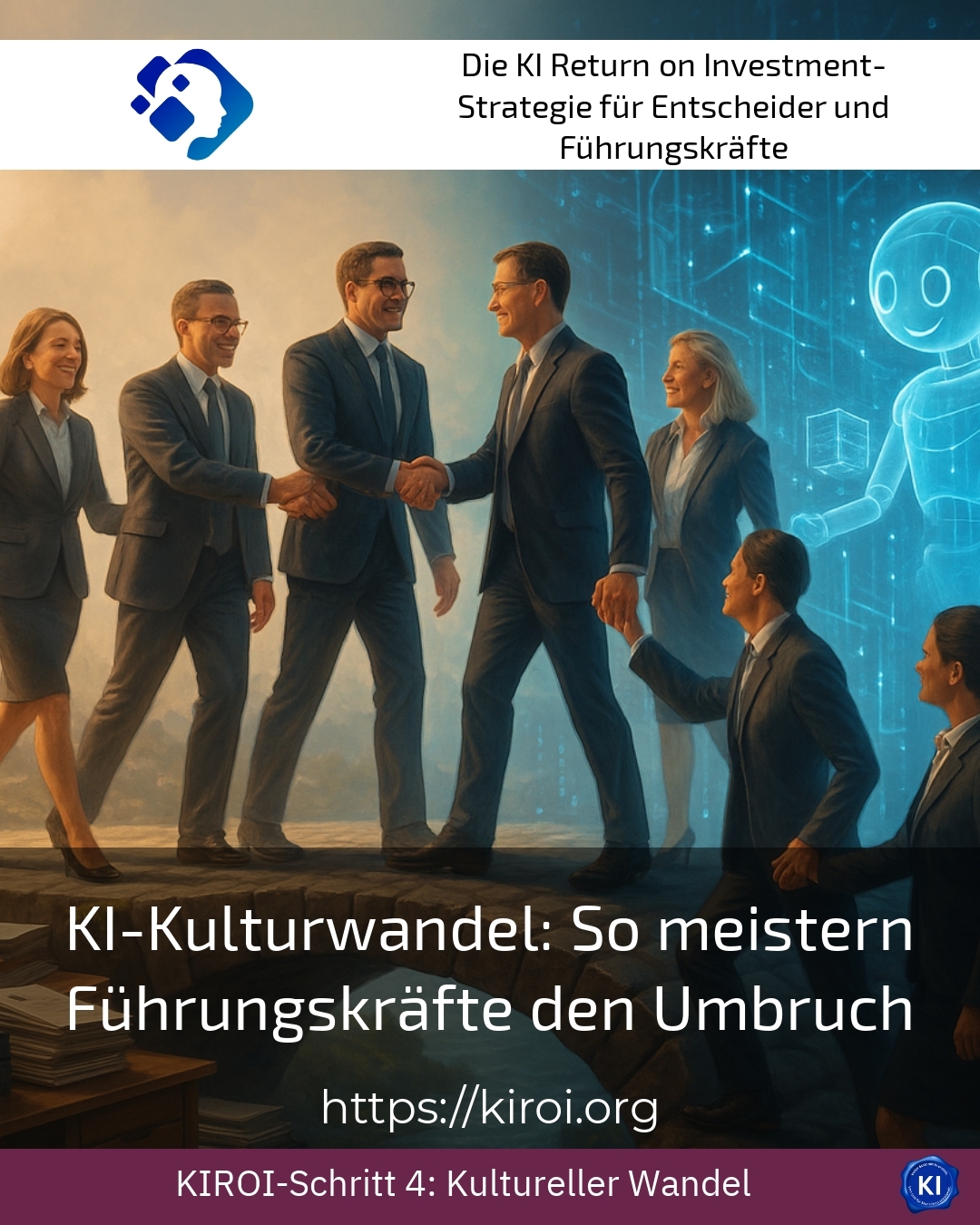
Digital transformation is fundamentally changing businesses. But technology alone does not determine success or failure. The true key lies in people and their willingness to change. This is exactly where AI cultural change an, which presents leaders with entirely new challenges. Those who believe they can simply implement new systems without adapting the company culture will be quickly disabused. Indeed, many transformation projects fail not because of the technology itself, but due to employee resistance and a lack of leadership competence. This article shows you practical ways to actively shape change as a leader.
The invisible barrier: why technology alone is not enough
Many companies are investing considerable sums in modern systems and intelligent solutions. Despite this, the hoped-for results often fail to materialise. The reason is frequently hidden deep within the company culture. Employees fear for their jobs and react with rejection. Management significantly underestimates the emotional component of change. For example, an engineering company introduced an intelligent maintenance system. The technicians were supposed to be relieved of repetitive tasks. Instead, they felt monitored and reacted with passive resistance. The system delivered less data than expected because inputs were deliberately delayed.
A similar pattern emerged at a logistics company. There, intelligent route planning was intended to increase efficiency. However, the drivers perceived the system as a limitation of their experience and systematically bypassed its recommendations, preferring to trust their intuition. The situation only changed when management initiated a dialogue. A third example comes from the finance sector. A bank implemented automated credit decisions. The advisors felt disempowered and did not openly communicate their concerns. The consequences were rising error rates and declining customer satisfaction.
Best practice with a AIROI customer
A medium-sized manufacturing company faced the challenge of introducing intelligent quality control. The initial implementation had failed because the workforce perceived the system as a threat. As part of transruption coaching, we intensively supported the management over several months. First, we analysed the existing company culture and identified hidden fears. Employees feared that their years of experience would be devalued. Together, we developed a communication strategy that took these concerns seriously. Managers learned to conduct open discussions and to understand resistance as valuable feedback. We established pilot groups in which experienced employees could co-design the system. These ambassadors carried positive experiences throughout the organisation. After six months, acceptance increased significantly, and quality metrics improved measurably. Today, the company reports a more open error culture and strengthened trust between hierarchical levels.
The AI culture change begins in the minds of senior management
Leaders bear a special responsibility in transformation processes. Their attitude significantly influences the entire company. If they themselves exude scepticism, it is transmitted to all levels. An insurance group recognised this pattern and acted accordingly. The management team themselves underwent intensive training in new technologies. They publicly demonstrated that they too were willing to learn and open to change. This role model effect was stronger than any internal campaign.
A comparable picture emerged in the healthcare sector. A hospital network wanted to introduce diagnostic support systems. The senior physicians were initially hesitant and sceptical. The junior physicians sensed this reservation and unconsciously adopted it. Only when the leading physicians themselves shared positive experiences did the dynamic change. Another example can be found in the media industry. A publishing house introduced automated text analyses for editorial departments. The editors-in-chief initially saw this as a threat to journalistic quality. After intensive workshops, they understood the potential for in-depth research. They became active advocates and motivated their teams accordingly.
The AI cultural change This therefore requires a rethink at all leadership levels. Leaders should acknowledge uncertainty as a normal reaction to change. They can provide impetus without wanting to force change. Clients often report relief when they are allowed to name their fears openly. This psychological safety first creates the basis for genuine readiness for change.
Communication as the Foundation of AI-Driven Cultural Change
Open communication forms the core of every successful transformation. Employees want to understand why changes are necessary. They want to know what impact to expect on their daily work. An energy supplier therefore established regular dialogue formats at all levels. In monthly town hall meetings, management provided information on progress and challenges. At the same time, employees were given the opportunity to ask questions directly. This transparency significantly reduced rumours and strengthened trust.
In the automotive supply industry, a different approach proved successful. A manufacturer of precision parts set up feedback channels for anonymous responses. Employees could voice concerns without fear of repercussions. Management publicly responded to the most frequent issues. This created a continuous dialogue that made resistance visible early on. A trading company went one step further. It specifically trained managers in empathetic communication. They learned to listen actively and not dismiss emotional reactions. The quality of conversations improved noticeably, and acceptance of change increased.
Skills development as a strategic investment
Knowledge reduces employees' anxiety and strengthens their self-confidence. Companies should therefore invest in further training early on. A chemical company developed a comprehensive training programme for all hierarchical levels. The content was tailored to different prior knowledge and areas of responsibility. Employees were able to learn at their own pace and ask questions. The investment paid off through increased acceptance and faster implementation.
A telecommunications provider adopted a practical approach. Instead of theoretical training, they focused on learning by doing. Employees experimented with new systems in protected environments. Mistakes were explicitly welcomed as learning opportunities and not penalised. This attitude fostered curiosity and significantly reduced apprehension. In the pharmaceutical industry, the concept of learning partnerships proved successful. Experienced employees were paired with younger colleagues. Both sides benefited from the mutual exchange of knowledge. The older employees gained a better understanding of new technologies, while the younger ones gained insight into tried-and-tested processes.
Best practice with a AIROI customer
A consulting firm with international operations approached us with a specific request. The partners had decided to implement intelligent analysis tools in client consulting. However, the consultants reacted with considerable scepticism, fearing a devaluation of their expertise. Some even threatened to resign if the project went ahead as planned. In the transruption coaching, we first worked with the leadership team on their own mindset. They recognised that they themselves harboured ambivalent feelings towards the change. This honesty enabled more authentic conversations with the teams. Together, we developed a pilot project where volunteers could test the new tools. The participants became internal experts and shared their experiences in workshops. We guided the leadership team in constructively handling criticism and taking concerns seriously. After nine months, the mood had fundamentally changed. The consultants reported a significant reduction in repetitive analysis tasks. They gained time for the personal consultation of their clients, which increased their job satisfaction. The company also recorded a measurable improvement in customer ratings.
Understanding and using resistance as a resource
Resistance is not a weakness, but a valuable pointer to overlooked aspects. Employees who voice concerns demonstrate commitment to the company. They often have deep insights into operational processes and potential pitfalls. A construction company had this experience when introducing digital project management. The experienced site managers initially strongly resisted the new system. They referred to the specificities of individual construction sites that the system did not take into account. The project management took these objections seriously and adapted the implementation accordingly. The result was a more practical system with higher acceptance.
A similar pattern was observed in the tourism industry. A tour operator wanted to support customer consulting with intelligent recommendation systems [1]. Travel agents criticised the standardised suggestions as unsuitable for individual customer requests. Management could have dismissed this criticism as rejection. Instead, they invited the most critical voices to participate in further development. Together, they improved the algorithms and achieved a higher hit rate. A food company even proactively used resistance as a source of innovation. Before any major change, critical employees were deliberately asked for their assessment. Their concerns were incorporated into the planning and measurably improved the success rate.
The role of middle management in cultural change
The middle management layer occupies a key position in change processes. It translates strategic decisions into operational reality. At the same time, it perceives the concerns of employees and communicates them upwards. A technology company underestimated this layer during a major transformation. The team leaders felt overlooked and passed this frustration on to their teams. The consequence was a significant loss of acceptance at the operational level. The situation only improved when the company specifically invested in the development of these managers.
A retail group took a different approach, involving store managers at an early stage. They received training in change management and communication techniques [2]. They became ambassadors for change and motivated their local teams. The decentralised structure also allowed for adjustments to local specificities. A third example comes from the logistics sector. There, a freight forwarder established regular exchange formats for middle management. Participants exchanged experiences and best practices with each other. This network significantly strengthened the resilience of the entire organisation.
Sustainable anchoring of the AI culture change within the organisation
Cultural change is not a one-off project with a clear endpoint. It requires continuous attention and regular adjustments. For this reason, a textile manufacturer established a permanent transformation department. This department supported change processes in the long term and ensured continuity. Employees always knew who to turn to with questions. This structure created reliability in a time of constant change.
A different approach to embedding sustainability proved successful in the aviation industry. One airline integrated cultural aspects into its regular employee discussions [3]. Managers and staff jointly reflected on changes and their impact. This structured reflection made the transformation tangible and measurable. A mechanical engineering company went a step further and adapted its incentive system accordingly. Managers were not only measured by business results. The development of their teams and their willingness to change were also incorporated into their evaluations.
The AI cultural change requires time and patience. Quick successes are rarely sustainable. Companies should set realistic expectations for timelines and results. Clients often report setbacks after initial progress. These phases are a normal part of a transformation. How leaders handle these moments is crucial.
My AIROI Analysis
Guiding numerous transformation projects has given me valuable insights. Technological change only succeeds when people are at the centre. Leaders often significantly underestimate the emotional dimension of change. They concentrate on processes and systems, overlooking the needs of their employees. The most successful transformations combine technical excellence with cultural sensitivity.
I regularly observe that resistance is viewed as an obstacle rather than a resource. This perspective wastes valuable potential for improvement. Critical voices often contain important information about planning blind spots. Companies that incorporate these voices achieve better and more sustainable results.
The middle management layer deserves particular attention in transformation processes. It can either accelerate or significantly slow down changes. Investments in the development of this layer pay off multiple times over. Transruption coaching supports leaders in reflecting on their own attitude and communicating authentically.
The AI cultural change is a marathon, not a sprint. Companies need endurance and a willingness to learn from mistakes. Those who embark on this journey with patience and openness will reap the rewards. The future belongs to organisations that can combine technological innovation with human development.
Further links from the text above:
[1] Harvard Business Review – AI and Machine Learning
[2] McKinsey – Culture Change That Sticks
[3] MIT Sloan Management Review – Organisational Culture
For more information and if you have any questions, please contact Contact us or read more blog posts on the topic Artificial intelligence here.








 Deutsch
  English (UK)