
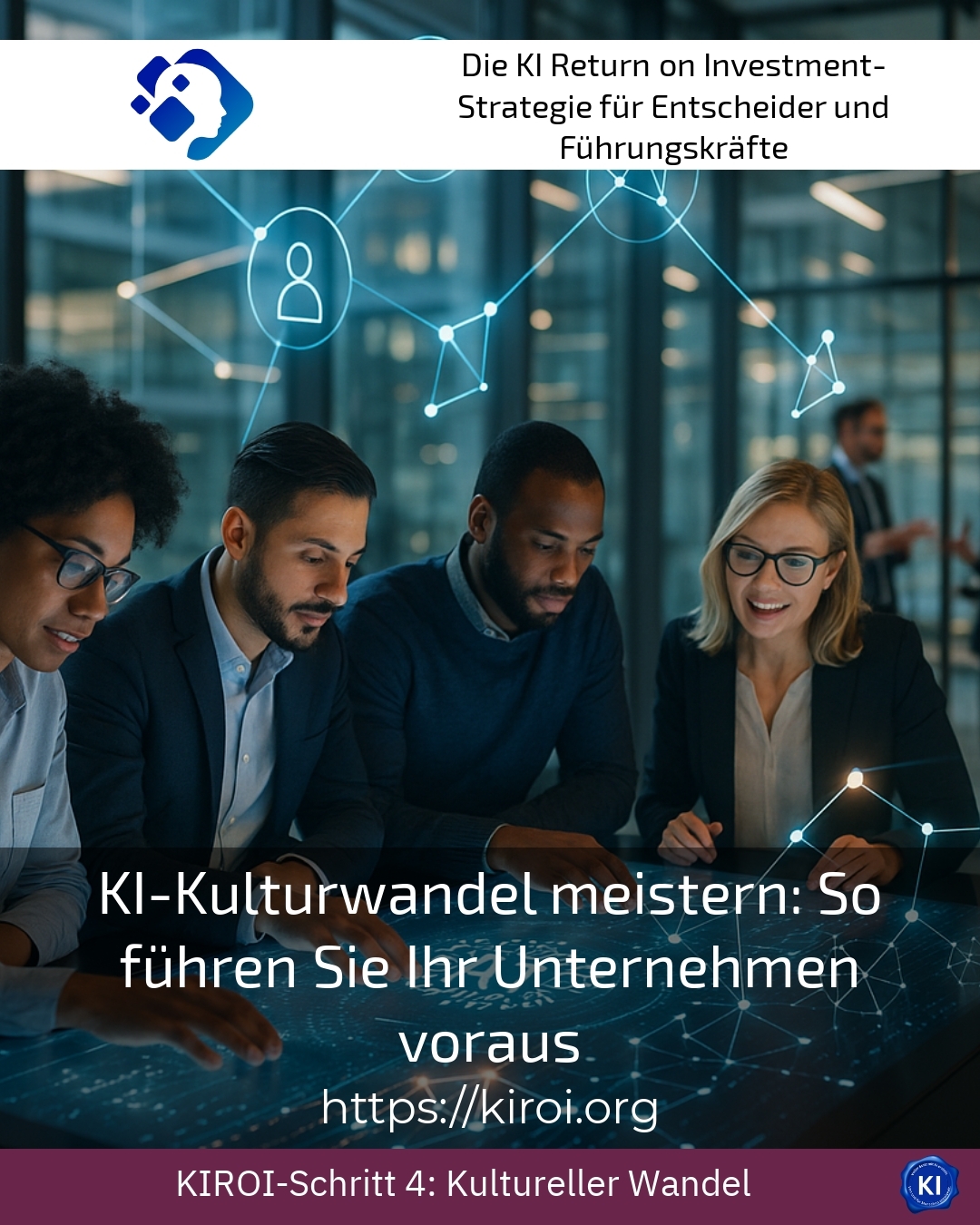
The digital transformation is fundamentally changing companies. However, many executives underestimate a crucial factor. That factor is Mastering AI cultural change It means much more than just introducing new technologies. It’s about people, values, and mindsets. Those who actively shape this change create a real competitive advantage for their company. In this article, you’ll learn how to successfully lead your organization into the new era.
Why mastering the AI culture change must become a matter of leadership
Many companies invest substantial sums in modern technologies. They purchase powerful software and train their employees. However, the hoped-for results often remain elusive. The reason rarely lies in the technology itself. Rather, projects fail due to a lack of cultural preparation. Employees feel overwhelmed or not included. Leaders often communicate changes inadequately. This creates resistance that can block the entire transformation process.
For example, a medium-sized manufacturing company implemented intelligent analysis systems. The technology worked flawlessly. However, experienced professionals refused to consider the system’s recommendations. They preferred to rely on their years of experience. It was only when the management sought dialogue that the situation improved. The employees were given the opportunity to openly express their concerns. Together, they developed an approach that linked experience with data-based insights.
A financial services provider faced similar challenges. The new customer analytics platform was initially hardly used. Consultants perceived the system as a control instrument. Through transparent communication and pilot projects, management was able to build trust. Today, over ninety percent of the workforce regularly use the platform and report significantly more efficient workflows.
Understanding the human dimension of transformation
Technological change initially causes uncertainty in many people. This reaction is completely natural and should be taken seriously. Successful leaders recognize this emotional component. They create spaces for open conversations and honest questions. This creates an atmosphere of trust that facilitates change.
A business company decided to take a special approach. Before introducing new systems, detailed workshops were conducted. Employees were able to express their concerns and wishes. These feedback were directly incorporated into the implementation strategy. The result was a significantly higher acceptance while simultaneously shortening the implementation phase. The workforce felt like an active part of the change.
A logistics company also adopted participatory methods. Drivers and dispatchers were involved in decision-making processes early on. They were able to contribute to determining which functions the new route planning should include. This involvement led to practical solutions and high motivation. Today, the company is considered a pioneer in its industry.
Best practice with a AIROI customer
An internationally operating mechanical engineering company faced the challenge of fundamentally modernizing its service processes. The management recognized early on that technical solutions alone would not be sufficient. Therefore, they decided to provide comprehensive support through transruptive coaching. First, we jointly analyzed the existing corporate culture and identified potential barriers to change. It became apparent that many service technicians had concerns about their future role. They feared being replaced by automated systems. In several workshops, we worked together to develop a new understanding of roles. The technicians were to become strategic problem solvers, supported by intelligent assistance systems. This new positioning was positively received by the workforce. At the same time, we established regular feedback loops between management and operational teams. This allowed problems to be identified and addressed early on. After six months, eighty percent of the employees reported an improved quality of work. Customer satisfaction increased measurably, and service times were significantly shortened.
Developing leadership skills for the new world of work
The change requires new skills at all levels of leadership. Traditional hierarchies often no longer function optimally in dynamic environments. Instead, agile structures and collaborative leadership styles are gaining importance. Leaders must learn to relinquish control and to trust others. At the same time, they continue to bear responsibility for results and strategic direction.
One media company recognized this connection early on. The management initiated an extensive development program for all levels of leadership. The focus was not on technical skills; rather, it was on communication, empathy, and change management. The participants learned to integrate different perspectives and to deal constructively with resistance. The program has been running for several years now and is showing lasting results.
One insurance company took a similar approach. They trained so-called change agents who act as multipliers. These employees possess special skills in guiding change processes. They support their colleagues in adapting to new working methods. The network of change agents has proven to be a valuable resource for the entire company.
Master the AI cultural transformation through continuous learning
A learning organization adapts more quickly to changing conditions. Companies should therefore create structures that promote continuous learning. This includes formal continuing education programs as well as informal knowledge sharing. In particular, formats that enable cross-departmental collaboration are valuable. This leads to new ideas and solutions.
One pharmaceutical company, for example, organized regular innovation days [1]. On these days, employees can work on self-selected projects. Many of these projects focus on improving existing processes. Some have already led to patentable innovations. The innovation days also promote the exchange between different departments.
An energy provider established virtual learning communities on various topics. Employees can join together based on their interests and develop new skills together. The groups operate largely independently and are supported by the human resources department. This format has proven to be a cost-effective addition to traditional training courses.
Create structural prerequisites for successful change
Cultural change requires appropriate frameworks. Companies should critically review their existing structures. Often, outdated processes and rigid hierarchies hinder necessary changes. An honest assessment forms the basis for targeted adjustments. This is not about questioning everything that exists. Rather, structures should become more flexible and adaptable.
An automotive supplier has fundamentally reorganized its development department [2]. Instead of functional silos, interdisciplinary teams with clear product responsibility emerged. These teams can respond more quickly to customer requirements. Collaboration with external partners has also been simplified. Decision-making processes were significantly shortened without compromising the quality of the results.
A telecommunications company introduced flexible work models. Employees can largely determine their place of work and working hours. This flexibility significantly increases the attractiveness as an employer. At the same time, the satisfaction of the existing workforce increases measurably. Productivity has even improved after an initial adjustment period.
Best practice with a AIROI customer
A traditional family business in the consumer goods sector approached us with a special challenge. The younger generation wanted to modernize the company, while the older generation wanted to maintain the status quo. This generation conflict had been paralyzing important decision-making processes for a long time. As part of our transruptive coaching, we moderated intensive conversations between both sides. It became clear that both perspectives were justified. The company’s tradition represented a real competitive advantage. At the same time, the market required a stronger customer focus and faster reaction times. Together, we developed a strategy that integrated both aspects. The company maintained its value-based corporate culture. At the same time, new structures for innovation and agility were created. An important component was the establishment of an internal innovation lab. Here, employees can try out new ideas in a protected environment. Successful concepts are then integrated into the core business. This balance between tradition and innovation has proven to be a viable model.
Using communication as the key to success
Transparent communication forms the foundation of any successful transformation. Employees need to understand why changes are necessary. They want to know how their work routine will change in concrete terms. Leaders should regularly inform about progress and challenges. Honesty is more important than flattering descriptions.
A healthcare provider developed a comprehensive communication strategy for its transformation. In addition to traditional town hall meetings, digital formats were established. In short videos, employees shared their experiences with new working methods. These authentic insights were more convincing than abstract management presentations. Acceptance of change increased significantly.
One retail company relied on two-way communication. Employees can ask questions and provide feedback at any time through a platform. The management committed to answering all inquiries within 48 hours. This commitment creates trust and encourages open dialogue. Problems are thus identified early and can be addressed promptly.
Understand change as a continuous process
Cultural change is not a project with a defined beginning and end. Rather, it is an ongoing process of adaptation and development. Companies should therefore establish structures that enable continuous improvement. Regular reflection and adaptation become an integral part of corporate culture in this way.
A consulting company introduced quarterly cultural audits [3]. These systematically collect various indicators of the company culture. The results are used to inform strategic decisions. This way, the company can work on improvements specifically. The process has established itself as a valuable tool for organizational development.
A construction company established regular retrospectives at all levels. After completing important projects, teams analyze what worked well. Similarly, improvement potentials are identified. These findings are documented and made available for future projects. The continuous learning culture has measurably improved the quality of work.
My AIROI Analysis
Coaching numerous transformation projects has given me important insights. Successful change always starts with the people, not the technology. Companies that involve their employees early achieve significantly better results. The emotional dimension of change deserves more attention than it often receives.
Leaders play a crucial role as role models and facilitators. They must themselves be willing to learn new things and abandon old habits. Only then can they authentically guide their teams through change processes. To do this, it helps to openly address uncertainties and seek solutions together.
The importance of communication cannot be overstated. Transparency creates trust and significantly reduces resistance. Companies should use a variety of channels and actively seek dialogue. Authentic testimonials from colleagues who have already successfully mastered change are particularly valuable.
Transruptions coaching provides valuable support for companies of all sizes. As external guidance, we can provide inspiration and uncover blind spots. At the same time, we bring experience from different industries and contexts. This perspective complements internal knowledge and expands the scope for action. Clients often report that external guidance has been crucial to success. Cultural change is a challenge, but also a great opportunity for forward-thinking companies.
Further links from the text above:
[1] Harvard Business Review – Innovation Management
[2] McKinsey – Organisational Performance Insights
[3] Gartner – Human Resources Research
For more information and if you have any questions, please contact Contact us or read more blog posts on the topic Artificial intelligence here.









 Deutsch
 English (UK)