
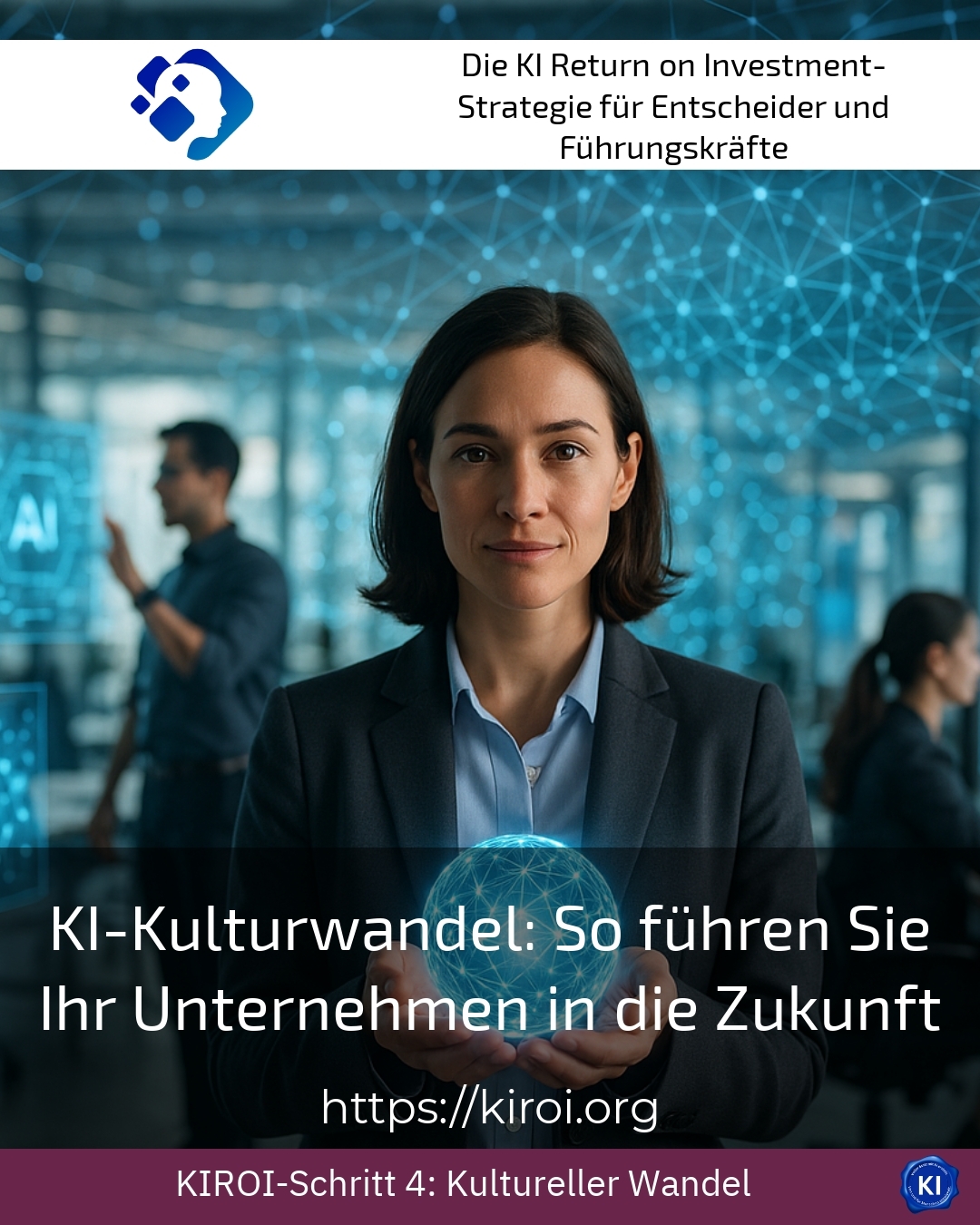
Have you ever wondered why some organizations thrive with intelligent technologies while others fail despite enormous investments? The answer rarely lies in the technology itself, but rather in the way people handle it. AI cultural change Today, it represents one of the biggest challenges facing leaders. It is not primarily about algorithms or data volumes, but about fundamental changes in the way teams work, think, and collaborate. Clients often report that although they have implemented the most modern systems, they are hardly used. Transruptive coaching can provide valuable impulses as professional support in this context to trigger sustainable transformations.
Why the cultural transformation of AI means much more than technology
The introduction of intelligent systems not only changes processes but also power relations, communication channels, and established routines within an organization. Employees often perceive such changes as a threat to their previous competencies and positions. Therefore, many transformation projects fail not due to technical obstacles but due to human resistance. Fear of job loss plays just as big a role as uncertainty about new requirements [1]. Leaders often underestimate the emotional dimension of such change processes. Instead, they focus on budgets, schedules, and technical specifications.
In practice, however, it is repeatedly shown that successful transformations require a completely different approach. They begin with open discussions about fears and expectations. They create spaces for experimentation and allow mistakes to be part of the learning process. Gradually, a culture of openness towards new possibilities is created. Because this change takes time, companies should have realistic expectations regarding the timeframe. Transruptive coaching supports organizations in structuring these complex processes.
Best practice with a AIROI customer
A medium-sized manufacturing company faced the challenge of integrating intelligent quality control systems into its production lines. The initial reaction of the workforce was characterized by skepticism and rejection, as employees feared for their jobs. As part of AIROI the project, we initially conducted extensive discussions with all involved parties. It turned out that the biggest concerns did not relate to the technology itself, but to the lack of communication on the part of the management. We jointly developed a training program that actively involved the employees in the implementation process. The experienced professionals were trained to become internal experts and were able to pass on their knowledge to colleagues. After six months of intensive support, the mood had fundamentally changed. The staff recognized the added value of the new systems and even independently made suggestions for improvements. Productivity increased by eighteen percent, while the error rate dropped significantly.
The five pillars of a successful AI cultural change
Sustainable change is based on several fundamental elements that must interact and reinforce each other. The first pillar is transparent communication, which involves all levels of the organization from the outset. Leaders should openly discuss goals, expectations, and also uncertainties. The second pillar includes systematic competence development because new technologies also require new skills [2]. This involves not only technical knowledge but also analytical thinking and creative problem-solving skills.
The third pillar concerns the adaptation of organizational structures, as rigid hierarchies often hinder the flow of information and collaboration. Agile working methods and interdisciplinary teams can provide important impulses in this regard. Ethical reflection serves as the fourth pillar, ensuring that new technologies are used responsibly. Finally, the fifth pillar is continuous evaluation and adaptation of the adopted strategy. In this way, companies can react flexibly to new developments and optimize their approach.
Practical steps for getting started with the transformation
The path to a sustainable organization begins with an honest assessment of the current situation. What competencies already exist, and where are gaps? How is the basic attitude of the workforce towards change? These questions should be answered systematically before concrete measures are planned. A proven approach is to conduct pilot projects in selected areas [3]. This allows for the gathering of experience without overwhelming the entire organization.
For example, a large retail company began its transformation by optimizing its inventory management system. The insights gained were documented and applied to other areas. A financial services provider, in turn, started by automating simple customer inquiries to gain experience. And a logistics company initially implemented route optimization systems in a single branch. All three approaches have in common that they began modestly and were expanded gradually.
Leadership competencies in the age of intelligent systems
The role of leaders changes fundamentally when intelligent systems take hold in organizations. Traditional control mechanisms lose importance, while coaching and mentoring become more important. Leaders must learn to tolerate uncertainty while still providing guidance. They become facilitators who create the framework, rather than giving detailed instructions. Clients often report that this transition is particularly difficult because they have to abandon old behavioral patterns.
The ability to communicate complex technical issues in an understandable way is particularly important. One executive in the insurance industry once described this as a translation of different worlds. On the one hand, they must take employees’ concerns seriously and on the other hand, they must make clear the strategic necessity of change. In the healthcare sector, on the other hand, leaders must be particularly sensitive when dealing with data protection issues. And in the education sector, the question is how new technologies can complement pedagogical concepts.
Best practice with a AIROI customer
A service company with several hundred employees approached us because the implementation of an intelligent customer management system had led to significant internal tensions. The management level had pushed ahead with the implementation without sufficient involvement of the affected teams. The result was frustration, declining motivation, and even initial resignations from key professionals. As part of the AIROI coaching process, we initially worked intensively with the management on their leadership understanding and communication style. In parallel, we organized moderated workshops with the teams, where concerns could be openly addressed. The employees were given the opportunity to bring forward improvement suggestions and to adapt the system to their actual needs. This approach led to a remarkable change in sentiment within a few weeks. The initial critics became active supporters of the project. The company not only achieved the expected efficiency gains, but also recorded a significantly improved employee satisfaction.
The AI cultural shift as a continuous process
Transformation is not a one-time project with a defined beginning and end, but an ongoing development process. Organizations must establish a learning culture that enables and promotes continuous adaptation. This includes regular reflection on successes and failures alike [4]. The willingness to correct paths taken when they prove to be non-goal-oriented is also crucial. Transruptive coaching accompanies companies over extended periods of time to anchor lasting changes.
In the automotive industry, for example, we can see how profound change can be. Traditional manufacturers must simultaneously address issues such as electric mobility, autonomous driving, and new mobility concepts. The telecommunications industry, in turn, is experiencing massive disruptions due to new competitors and changing customer expectations. And the retail sector faces the challenge of intelligently connecting online and offline worlds. All of these developments not only require technical adaptations, but above all cultural adjustments.
Understanding and constructively using resistance
Resistance to change is a completely natural phenomenon and should not be viewed as a problem, but as a valuable source of information. Often, resistance points to real problems that were overlooked during planning. Employees who express concerns often know the operational details better than the senior management. Their objections can help avoid implementation errors and find better solutions. Therefore, leaders should actively create spaces where criticism can be expressed.
One pharmaceutical company successfully used this approach when introducing intelligent laboratory assistance systems. The initial skepticism of the scientists led to important adjustments to the software. An energy provider, in turn, incorporated the concerns of its technicians into the design of new maintenance processes. And a media company allowed its editors to actively participate in defining guidelines for handling automated content. In all cases, the constructive inclusion of critics led to better results.
Ethical dimensions of transformation
The introduction of intelligent systems raises numerous ethical questions that must be carefully considered. What decisions should be made by machines, and what remain reserved for humans? How can biases in algorithms be detected and avoided? And how do we deal with the responsibility for erroneous decisions made by systems [5]? These questions are not only of a philosophical nature but also have immediate practical relevance for everyday work.
In human resources, for example, companies must carefully consider the role that automated systems should play in hiring decisions. In the credit industry, similar questions arise when assessing the creditworthiness of applicants. And in healthcare, it comes down to the responsibility for diagnostic recommendations made by intelligent systems. Companies should develop clear ethical guidelines and regularly review them.
My AIROI Analysis
Based on my many years of experience in supporting transformation projects, a clear pattern emerges in successful organizations: they understand that the AI cultural change Primarily, a human task is one that requires technical knowledge, but goes far beyond it. The most successful companies invest at least as much in the development of their employees as in the technology itself. They create psychological safety, which allows mistakes to be viewed as learning opportunities and to speak openly about uncertainties.
At the same time, I observe that many organizations continue to make the mistake of treating transformation as a purely technical project. They purchase software, train employees in its use, and then wonder why the hoped-for changes are not occurring. What AIROI is missing is a deep engagement with values, beliefs, and working practices. The model offers a structured framework for systematically addressing all relevant dimensions. It combines technical expertise with organizational psychology knowledge and practical experience from numerous projects. Organizations that adopt this holistic approach report more sustainable results and higher employee satisfaction.
My central recommendation is therefore: Start every transformation process with the people, not with the technology. Invest in conversations, workshops, and spaces for reflection. Seek external support when needed to identify blind spots. This will lay the foundation for a transformation that not only works on paper but also delivers in the lived reality of your organization.
Further links from the text above:
[1] McKinsey – The Future of Work
[2] World Economic Forum – Future of Work Initiative
[3] Harvard Business Review – Change Management
[4] Boston Consulting Group – AI Transformation
[5] European Parliament – Artificial Intelligence
For more information and if you have any questions, please contact Contact us or read more blog posts on the topic Artificial intelligence here.








 Deutsch
  English (UK)