
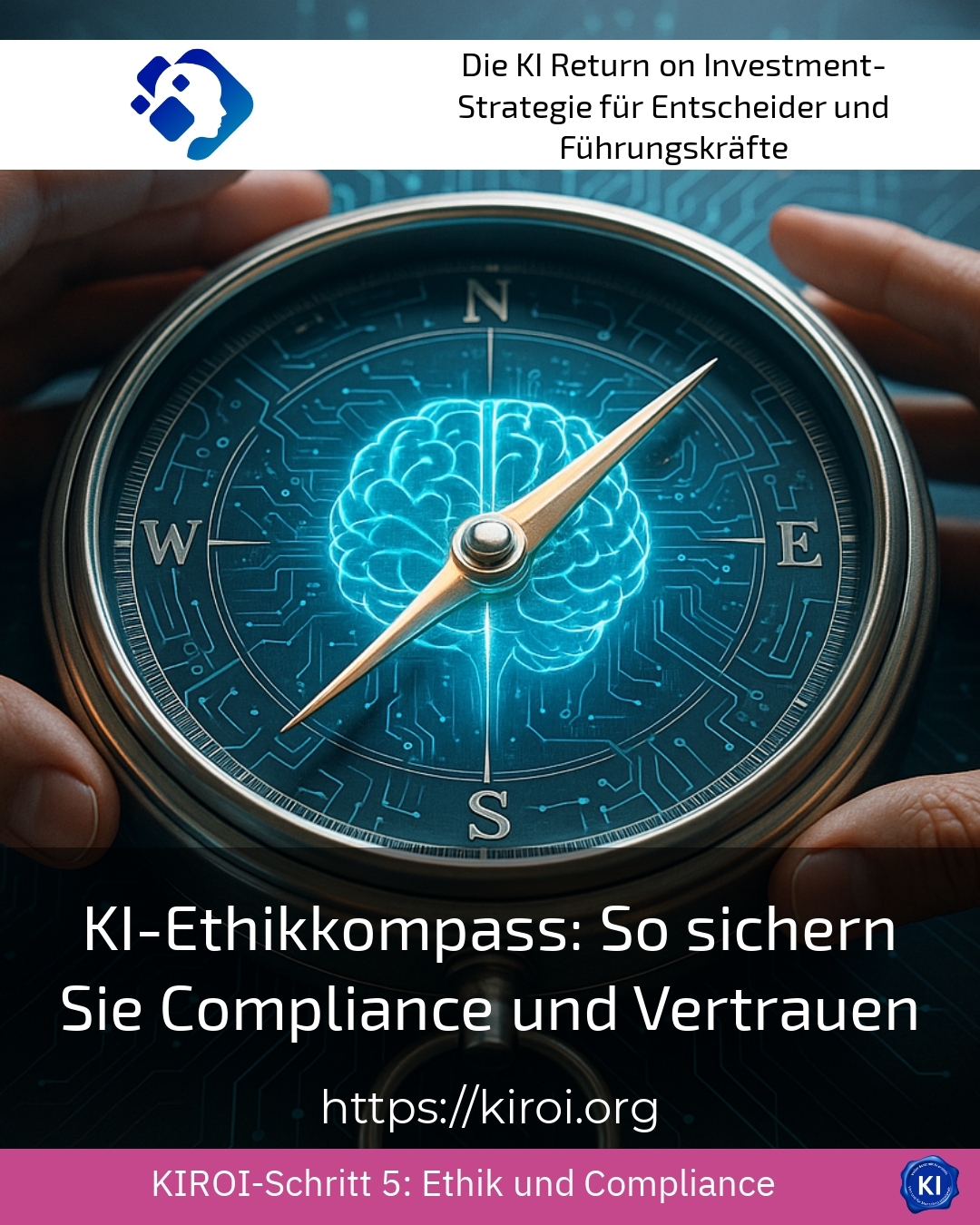
Stellen Sie sich vor, Ihre Organisation trifft täglich Hunderte von Entscheidungen mithilfe intelligenter Systeme, doch niemand kann erklären, warum diese Entscheidungen so ausfallen. Kunden verlieren das Vertrauen. Regulierungsbehörden klopfen an die Tür. Reputationsschäden drohen. Genau hier setzt der AI Ethics Compass: How to Ensure Compliance and Trust as it offers guidance in an increasingly complex technological landscape. The following lines will guide you through best practices and concrete recommendations for action to help you embed responsible technology use within your corporate culture.
The cornerstones of responsible technology use
Responsible technology use is based on several fundamental pillars. Transparency is paramount. Organisations must understand how their systems make decisions. Auditability builds trust among all stakeholders. Fairness prevents discriminatory outcomes. Data protection safeguards the privacy of those affected [1].
For example, a leading insurance company implemented an explainability system for its claims assessment. Customers now receive understandable justifications for decisions. Customer satisfaction rates rose significantly as a result. A retail group uses similar principles for pricing. Automated price adjustments are communicated transparently. This makes customers feel treated fairly.
In the healthcare sector, particularly impressive examples are emerging. Clinics are focusing on comprehensible diagnostic support. Doctors can review the systems' recommendations. Patients receive understandable explanations of treatment suggestions.
AI Ethics Compass: How to ensure compliance through structured processes
Compliance requires systematic approaches and clear responsibilities. Organisations benefit from defined audit cycles and documentation obligations. Regular audits identify potential risks early on. Training programmes raise employee awareness of ethical issues.
An international bank established a three-tiered control system. Firstly, internal teams vet all new applications. Secondly, external experts conduct independent assessments. Thirdly, automated systems continuously monitor the outcomes. This structure significantly minimises risks.
Telecommunications companies face similar challenges. A large provider developed specific guidelines for customer interactions. Chatbots automatically identify themselves as automated systems. Customers can switch to human advisors at any time. This transparency sustainably strengthens trust.
Best practice with a AIROI customer
A medium-sized manufacturing company in the automotive supply sector approached us with specific concerns regarding its quality control systems, which relied increasingly on automated decision-making processes, raising questions among employees and customers. Transruption coaching supported the project team over several months in developing a comprehensive governance framework that considered both technical and organisational aspects. Initially, we worked together to take stock of all systems in use and identify areas with increased risk potential, paying particular attention to decisions that had direct impacts on employees or end customers. In the second step, we developed a training concept that raised awareness among managers and subject matter experts regarding ethical issues and provided practical recommendations for action. The company subsequently implemented a complaint procedure for those affected, documented all decision processes in a traceable manner, and established regular review cycles. Employee satisfaction improved measurably because employees now understood how automated systems supported rather than replaced their work. Customers reported increased confidence in the company's quality standards.
Practical tools for daily implementation
The theoretical foundations must be translated into practical tools. Checklists support the systematic evaluation of new projects. Risk matrices help with the prioritisation of measures. Escalation paths define clear responsibilities for problems.
For example, a logistics company uses a traffic light system for all automation projects. Green means unproblematic. Yellow requires further checks. Red stops the project until outstanding issues are clarified. This simple system significantly speeds up decision-making processes [2].
Energy suppliers rely on similar structures. Smart grids require special care. Consumption data is subject to strict protection requirements. Automated load management must be fair and transparent.
Building trust through transparency and communication
Trust is not automatically created by technical measures alone. Communication plays a crucial role. Organisations must actively inform about their practices. Stakeholders expect open dialogues on opportunities and risks.
A leading e-commerce provider publishes regular transparency reports. Customers learn which data is used for recommendations. Personalisation options can be individually adjusted. This openness measurably strengthens customer loyalty.
Media companies face particular challenges. Algorithms influence news selection and reach. Transparent criteria prevent accusations of manipulation. Users better understand why certain content appears.
Educational institutions are experimenting with adaptive learning systems. Students receive personalised learning pathways. Educators can review and adapt recommendations. Parents receive understandable information about the methods being used [3].
The AI Ethics Compass: How to Secure Trust in Sensitive Applications
Particularly sensitive application areas require increased care. Personnel decisions, credit lending and healthcare directly affect people. Errors in these areas have far-reaching consequences. The AI Ethics Compass: How to Ensure Compliance and Trust offers particularly valuable guidance here.
A recruitment agency has fundamentally revised its application processes. Automated pre-selection now takes place according to transparent criteria. Applicants can obtain feedback on decisions. Regular audits check for unintentional discrimination.
Financial institutions are developing similar approaches to credit decisions. Applicants will receive clear explanations for rejections. Alternative options will be proactively highlighted. This practice complies with regulatory requirements and strengthens customer relationships.
Best practice with a AIROI customer
A municipal administration in southern Germany sought support in the ethical design of its digital citizen services, which increasingly contained automated decision components and caused concern among some citizens. The transruption coaching supported the responsible teams in developing a citizen participation concept that involved various interest groups and ensured maximum acceptance. Together, we conducted workshops with employees from different departments and identified critical touchpoints between automated systems and citizen interactions, paying particular attention to vulnerable groups such as the elderly or individuals with limited German language skills. The administration subsequently implemented a multi-stage information concept that proactively informs citizens about the use of automated systems and provides alternative access routes for personal advice. Particularly noteworthy is the developed objection procedure, which allows citizens to have automated decisions reviewed by human case workers. Acceptance of digital services increased significantly, and the number of complaints noticeably decreased. Employees reported an improved working atmosphere because clear guidelines reduced uncertainties.
Proactively meet regulatory requirements
The regulatory landscape is evolving dynamically. European regulations are setting new standards for transparency and accountability. Organisations benefit from proactive compliance. Those who act early avoid later remedial action [4].
Pharmaceutical companies are already preparing for upcoming requirements. Clinical trials are increasingly using automated analyses. These must comply with strict validation standards. Documentation obligations require traceable decision-making processes.
The automotive sector faces similar challenges. Driver assistance systems make safety-critical decisions. Manufacturers must be able to explain functionalities understandably. Liability issues require complete documentation.
Trading companies are optimising their supply chains with intelligent systems. Forecasts influence order quantities and stock levels. Sustainability aspects are gaining importance. Transparent algorithms support environmental reporting.
Cultural Change as a Success Factor
Technical solutions alone are not enough. Organisations require a cultural shift. Ethical considerations must become an inherent part of decision-making processes. Leaders play a pivotal role in this.
An international consumer goods group established Ethics Champions across all business units. These employees raise colleagues' awareness of ethical issues. They serve as the first point of contact for uncertainties. Regular exchange meetings promote organisation-wide learning.
Technology companies are going even further. Ethical reviews are an integral part of product development. Interdisciplinary teams assess potential impacts early on. This practice prevents costly rework.
Consultancy firms develop specialised services. Clients receive support with the implementation of ethical guidelines. Training programmes impart practical competencies. Benchmarking enables comparisons with industry standards [5].
My AIROI Analysis
The engagement with ethical issues in automated decision-making systems is evolving from an optional measure to a business-critical necessity, affecting organisations of all sizes and sectors, and its importance will continue to grow in the coming years. The AI Ethics Compass: How to Ensure Compliance and Trust provides a valuable framework for orientation that considers technical, organisational, and cultural aspects equally and delivers practical recommendations for action.
My experiences from numerous support projects show that successful implementations have three common characteristics: Firstly, these organisations embed ethical considerations at leadership level, thereby creating the necessary legitimacy for corresponding investments. Secondly, they establish systematic processes that make ethical reviews an integral part of project workflows, rather than treating them as afterthoughts or subsequent checks. Thirdly, they foster a culture of openness where employees can voice concerns without fear of negative consequences.
I find the development in medium-sized companies particularly noteworthy, as they often react more agilely to ethical requirements than large corporations, because shorter decision-making paths allow for quicker adjustments. At the same time, smaller organisations often lack the resources for extensive internal expertise, which is why external support can be particularly valuable. Transruption coaching positions itself here as a partner that provides impetus and accompanies processes without imposing ready-made solutions, as sustainable changes only arise when organisations develop their own competencies and make ethical considerations a part of their identity.
Further links from the text above:
[1] EU Guidelines for Trustworthy AI
[2] BSI – Artificial Intelligence and IT Security
[3] AlgorithmWatch – Transparency in automated decision-making
[4] EU AI Act – European Regulation for AI
[5] Platform Learning Systems – Germany's AI Strategy
For more information and if you have any questions, please contact Contact us or read more blog posts on the topic Artificial intelligence here.










 Deutsch
  English (UK)