
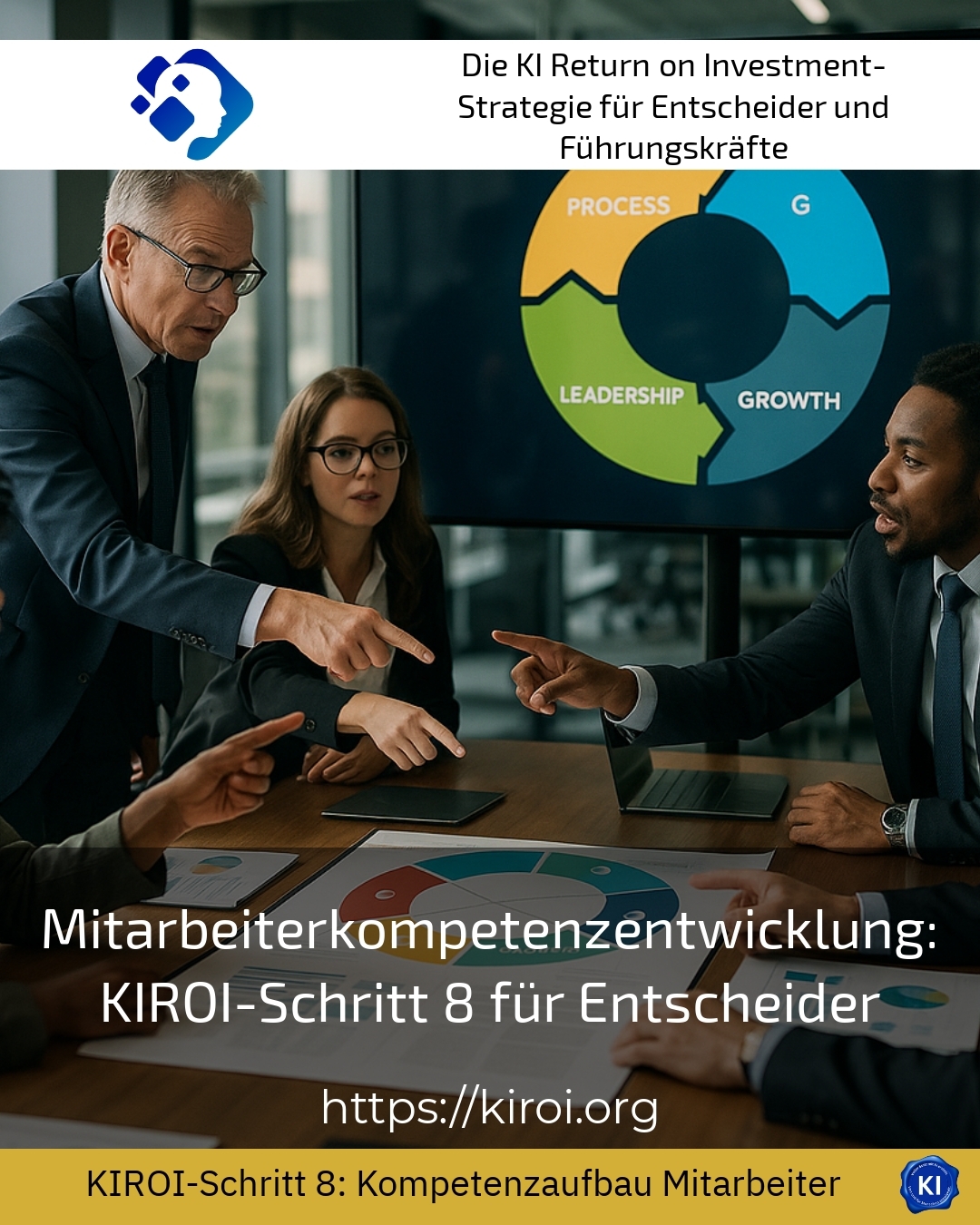
Targeted employee skills development is a key driver of sustainable business success today. Many decision-makers recognise that traditional training alone is no longer sufficient. Instead, holistic approaches are needed that foster individual potential and actively involve teams in the development process. Employee skills development is systematically and strategically designed, particularly within the framework of AIROI Step 8. This is not just about knowledge transfer, but about strengthening self-organisation, a sense of responsibility, and the ability to actively shape change.
Why employee skills development is crucial today
Companies face constant challenges. Technological advancements, new forms of work, and changing requirements necessitate the continuous development of employees. Employee skills development helps to identify future skill gaps early on and close them in a targeted manner. Many managers report that this approach allows them to react more quickly to new challenges.
An example from the IT industry: A team of developers is working on a complex project. Through regular workshops and coaching sessions, employees are expanding their technical skills. At the same time, they are improving their communication and collaboration. The result is a motivated team that solves complex tasks independently.
Another example from the manufacturing sector: here, employee competence development is promoted through on-the-job training and job rotation. Employees learn new processes and can therefore react more flexibly to changes. Companies in the financial sector are also relying on individual learning paths to retain their employees long-term.
Employee competency development as a strategic process
Clear goal definition and individual potential analysis
Clear goal definition is crucial for successful employee competency development. The goals are aligned with the company strategy and future requirements. Targeted potential analysis helps to identify the right employees and recognise their development opportunities.
For example, telecommunications companies use regular feedback discussions and development plans to increase employee retention. Service firms report that a mix of training and coaching accelerates individual development and strengthens team spirit.
Here's another example: A trading company conducts annual skills analyses. The results are directly incorporated into personnel development planning. This allows specific measures to be derived that strengthen both professional and social skills.
Integration of practical phases and a feedback culture
The integration of practical phases is an important component of employee competency development. Employees directly apply newly acquired knowledge in their daily work. This promotes understanding and the sustainability of what has been learned.
An example from logistics: Employees complete on-the-job training and take on new tasks. They receive regular feedback and reflect on their progress. This way, they develop not only technical but also methodological skills.
Another example: A service company promotes employee skills development through project work. Employees work on challenging projects that expand their skills. They gain new perspectives and learn to take responsibility.
Employee competency development in a team context
Coaching and Mentoring as Development Impulses
Coaching and mentoring are personalised development methods. An experienced mentor or professional coach supports an employee over a longer period. They provide support, feedback and guidance for personal and professional development.
An example from the finance industry: A company is focusing on mentoring programmes. Young employees receive targeted support and learn from experienced colleagues. This not only strengthens their technical skills but also their soft skills and career development.
Another example: An IT company uses one-on-one coaching. Employees receive individual feedback and learn to overcome challenges. This promotes self-organisation and a sense of responsibility.
A third example: A manufacturing company conducts regular team coaching sessions. Employees reflect on their progress together and develop solutions for current challenges.
Employee competency development with transruptive coaching
Transruption coaching supports companies in developing tailor-made strategies for employee skills development. This involves not only knowledge transfer but also strengthening self-organisation and a sense of responsibility. The coaching concept helps decision-makers to implement development measures in a structured way.
This provides decision-makers with concrete tools and stimuli to support them in managing competence development processes. Furthermore, the sustainability and effectiveness of the measures are increased by involving employees as active shapers of their learning process.
An example from the IT industry: A company works with transruption coaching to strengthen employee competence development. Employees receive regular workshops and coaching sessions. The result is a motivated team that solves complex tasks independently.
Another example: A manufacturing company uses transruption coaching to promote employee competency development through on-the-job training and job rotation. Employees learn new processes and can thus react more flexibly to changes.
A third example: A service company is focusing on individual learning paths to support employee competency development. Employees receive targeted support and learn to master challenges.
BEST PRACTICE with one customer (name hidden due to NDA contract) In a medium-sized logistics company, employee competency development was promoted through regular workshops and coaching sessions. Employees expanded their professional skills and improved their communication and collaboration. The result was a motivated team that independently solved complex tasks and achieved company goals more quickly. Employee competency development was established as a strategic process and regularly evaluated.
My analysis
Employee competence development is a key success factor for companies. It helps to identify future skills gaps early and to close them in a targeted manner. Clear goal definition, individual potential analysis, integration of practical phases and an open feedback culture increase the sustainability and effectiveness of the measures. Transruption coaching supports decision-makers in developing tailor-made strategies and actively shaping the change process.
Further links from the text above:
Competence Development: Definition + Successful Examples
Rethinking employee development: AIROI-8 for strong teams
What is competence development? – teamazing Glossary
Employee competence development for decision-makers – AIROI
Successful skills development: 9 tips and 3...
For more information and if you have any questions, please contact Contact us or read more blog posts on the topic Artificial intelligence here.








 Deutsch
  English (UK)