
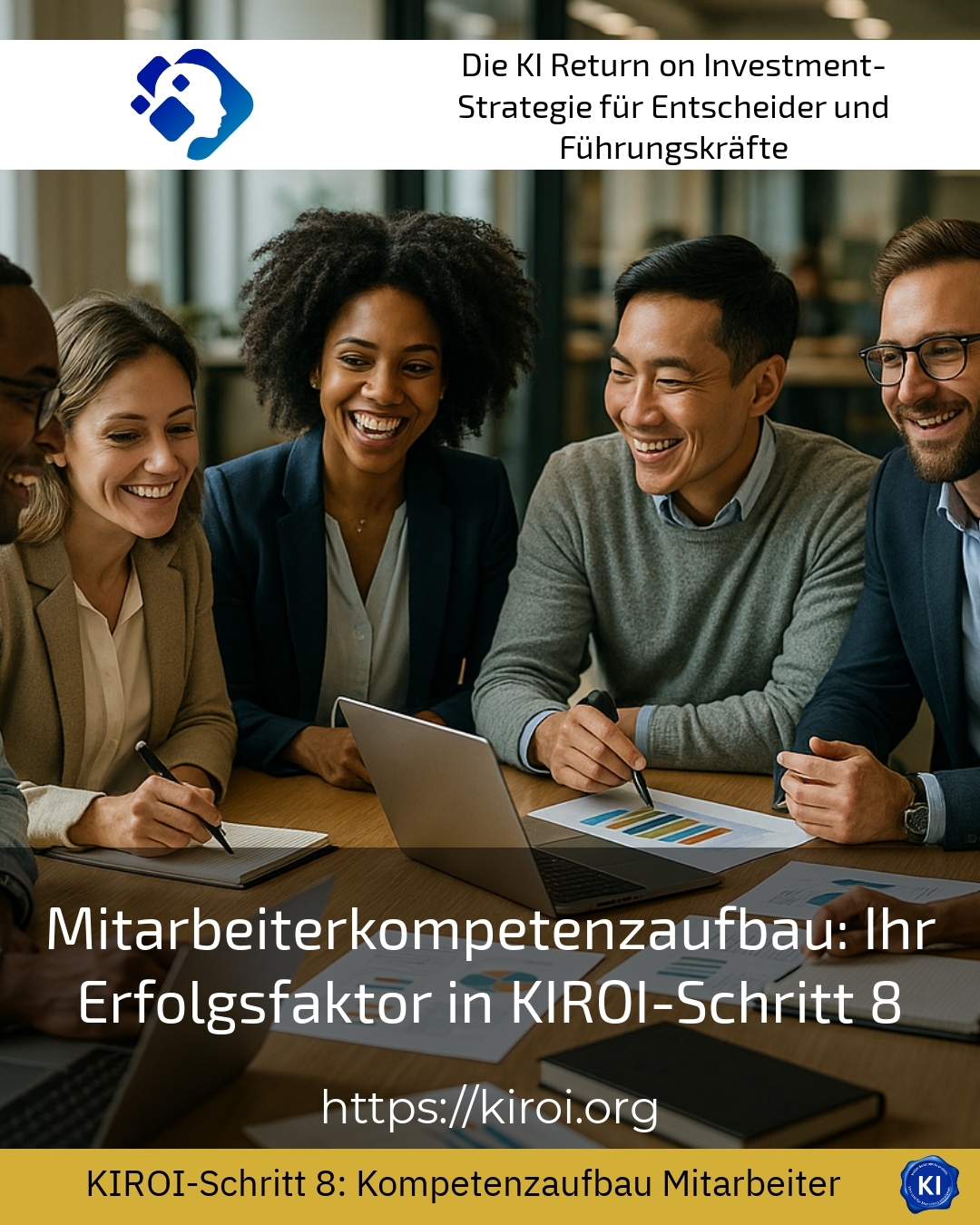
The development of employee competencies is a key success factor in modern companies. Especially within the framework of the AIROI model, the eighth step plays a crucial role because it specifically designs development processes. Companies that systematically support the development of employee competencies create the foundation for sustainable growth and competitiveness. This article shows how this process can be implemented practically and effectively.
Employee competence building: A strategic link in AIROI Step 8
In the eighth step of the AIROI model, the focus is strongly on targeted skills development. Employee competency building here is not just a one-off event, but a continuous process. Technologically, AI-based systems support personalised development by analysing individual training needs and creating suitable offers. This ensures that learning content is precisely tailored to the strengths and weaknesses of employees.
In the automotive industry, for example, advanced AI systems detect the competencies needed for new manufacturing technologies early on. Employees receive targeted training, preparing them step by step for upcoming challenges. In the logistics industry, similar technologies are used to provide tailored training for drivers and warehouse staff, which reduces errors and increases safety. In healthcare, such individual competency development facilitates rapid adaptation to new medical standards and patient software.
Practical examples from different industries
BEST PRACTICE with one customer (name hidden due to NDA contract)This mechanical engineering company completely transformed continuing education: through digital learning platforms and accompanying coaching, employees are now continuously empowered to operate and maintain innovative machines. This has sustainably improved employee competence development, leading to a measurable increase in productivity.
In the IT sector, companies are using skill analyses that automatically recommend suitable e-learning courses based on project requirements. This ensures employees are always up-to-date with the latest programming languages and frameworks. Similarly, the financial sector benefits from AI-powered career paths that specifically prepare employees for leadership roles, thereby increasing engagement and retention.
How companies can successfully shape employee skills development
The success of building employee competence relies heavily on leadership engagement. Leaders act as learning facilitators, identifying individual potential and jointly formulating development plans with employees. Clear objective agreements and regular feedback discussions are fundamental to this process.
Concrete measures include coaching, workshops, and project-related learning tasks that appeal to different learning types. Companies from the service sector also rely on flexible learning formats such as microlearning to be able to react quickly to changing requirements. In the manufacturing industry, status assessments make learning progress visible and promote continuous development.
This approach not only strengthens individual competencies but also enhances overall team performance. This is especially true because employees are motivated to actively contribute through transparent career paths and recognised learning achievements. Employee competency development thus remains not an abstract concept, but becomes tangible and experienceable.
Tips for sustainable skills development in everyday business
- Use competency models as a guide to identify and structure individual development needs.
- Foster an open feedback culture that supports self-reflection and constructive exchange.
- Incorporate versatile methods such as coaching, mentoring, workshops, and learning projects.
- Agree clear development goals with defined milestones in dialogue with employees.
- Work with real-world practical examples to facilitate the transfer from learning to professional application.
My analysis
Employee skills development is a key driver for sustainable business success as part of AIROI Step 8. It makes it possible to link strategic and individual development goals, and promotes both employee motivation and retention. The use of digital technologies and personalised learning formats supports the effective implementation and tailored guidance of all learning phases.
Companies that systematically integrate employee skills development into their everyday management practices create better conditions for keeping pace with the challenges of the modern world of work. Transparent communication and a proactively shaped learning culture are particularly beneficial in this regard. Employee skills development is thus a central building block that provides impetus for innovation and productivity.
Further links from the text above:
Employee competence development: AIROI Step 8 for...
Employee skills development: AIROI Step 8 for managers
Skills development: importance and methods
AIROI Step 8: Employee Competence Development …
For more information and if you have any questions, please contact Contact us or read more blog posts on the topic Artificial intelligence here.








 Deutsch
  English (UK)